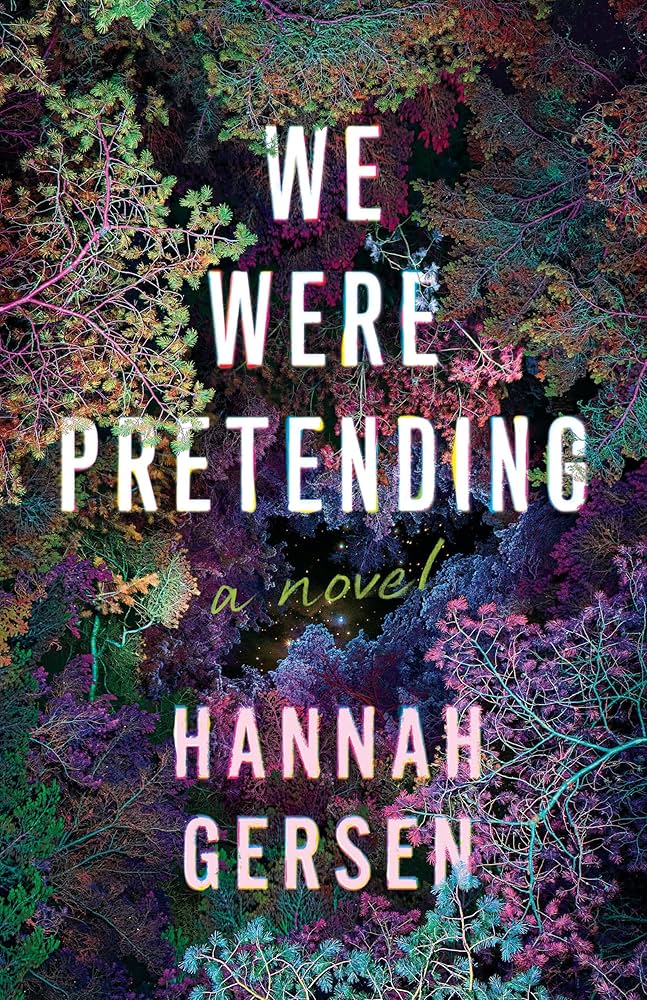
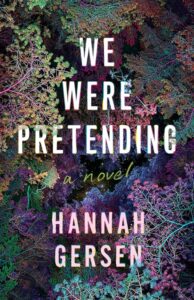
This piece is excerpted from the novel We Were Pretending by Hannah Gersen, a guest at Amherst College’s eleventh annual literary festival. Register and see the full list of LitFest 2026 events here.
I had been researching Jennifer Hex for nearly an hour before I realized she was someone I used to know. Her Instagram feed sparked my memory, a photo of her dressed in green and relaxing in the shade of a sycamore tree. The dappled light made her appear slightly younger, reminding me of the teenager I’d known. Jenny, I realized. I was looking at Jenny Heck. This long-haired, casually glamorous guru had once been the tall new girl who’d slouched down the halls of Lost Falls Senior High. Now she was Jennifer Hex: Tree Listener, Healer, Diviner of Green. Her location, according to her profile, was “Los Angeles by way of Patience.” Her website said she practiced something called “tree therapy.” She had a yearlong waiting list. Probably a lot of unreported tax earnings, too, but that wasn’t how she’d come to the government’s attention.
I marveled at her transformation. In high school, she’d had a gap-toothed smile, round cheeks, and intense eyes that bugged out slightly. The effect had been almost comical. But in adulthood, her prominent cheekbones, straight teeth, and full eyebrows were striking. Her curly brown hair, which she had always worn in a messy nineties bob, was long, gently waved and a lighter shade than I remembered. In every picture, she wore something green.
I lingered on a photo of her with her arms outstretched to reach the trailing branches of a weeping willow. She reminded me of her father, with his long silver braids and the heavy pink crystal he always wore around his neck. Everett Heck was regarded as a local crackpot who sold trinkets to gullible college girls in his New Age store, but I’d always believed he was sincere.
Like Jenny, he thought that connecting to nature could heal psychic pain. When my mother was dying, Everett was the one who’d told us about Hecate’s Key, a rare mushroom that could take away the terror of terminal illness.
Maybe seeing Jenny reminded me of my mother, too. Maybe I’m always thinking about my mother, a little bit.
I knew I should ask for Jennifer Hex to be assigned to someone else on my team. We’re not supposed to conduct interviews with people we know. At the bare minimum, we need to disclose prior relationships. But how well did I really know Jenny? She wasn’t a close friend, or even a genuine confidante. She’d been two years ahead of me, and I’d looked up to her in the way that kids do in high school, when the divide between a senior and a sophomore is cavernous. We met doing theater together, and she had the kind of gawky, daring talent that’s unforgettable. In my mind’s eye, she was still the seventeen-year-old sauntering onstage in cutoff jeans and black tights. She was legendary for pretending to chew gum during her audition, a stunt that flummoxed the teachers, especially when she stuck the fake wad under her chair. (Later, she told me she’d gleaned this trick from a Barbra Streisand interview.) I believed with all my teenage heart that she would become a famous actor. She was dreamy—the type of person who could bring you into her dream.
Jenny was dropped into our little Maryland town for her senior year only. Apparently, her mother had dumped her with her estranged hippie father because she was such a troublemaker. But Jenny never struck me as rebellious. Just restless. When we drove home from rehearsals in her dad’s bumper-stickered car with the window down, blasting “Gardening at Night,” I sometimes worried—and perhaps secretly hoped—that she’d just keep going on north, right over the Mason-Dixon Line. We lost touch after she graduated. But she was one of those people who’d stayed in my mind since I’d left my hometown. I’d searched for her online a couple of times over the years, feeding her name to the internet, but nothing came up. It was uncanny to finally find her by accident through work.
I’ve been at the US Department of Defense for almost a decade now, but when I came across Jenny, the job still felt new. At that time, I was researching alternative therapies for inclusion in the military’s Field Manual for the Army, incorporating holistic health into its fitness recommendations, with an emphasis on rest, recovery, and self-care. To the layperson, the updates are probably kind of obvious—soldiers are advised to try yoga, meditation, journaling, and napping—but it’s a big step for the military to acknowledge that soldiers are human beings with emotions and moods.
In addition to the field manual, my department was conducting research for a wearable device—a complement to the manual. This has been an ongoing project, one that still hasn’t been released to the public, but they’re getting close. They’re calling it an “Integrated Readiness Trainer for Holistic Health” (know in-house as IRTH2, pronounced like “earth two”) and it will be akin to a fitness watch, with the ability to track and record diet and exercise goals. Unlike your typical wearable, IRTH2 will recommend individualized treatments for each soldier, whether they are deployed, on reserve, or retired. IRTH2 will also provide support for mental health and existential crises. It’s the latter that has been the hardest to incorporate. Treatment for spiritual malaise requires a level of discernment that is nearly impossible to program. It’s just very difficult to know what will put someone on the path to transcendence.
I was working on the Spiritual Readiness problem when I found Jenny.
Hannah Gersen is the author of two novels: We Were Pretending (2024) and Home Field (2016), which was longlisted for the Crook’s Corner Book Prize. For over a decade, she was a staff writer at The Millions, where her essays appeared regularly. Her fiction, essays and reviews have been featured in various publications, including The Common, Electric Lit, Granta, LitHub, Los Angeles Review of Books, New England Review, The New York Times, Poets & Writers Magazine, The Southern Review and The Sun. She lives in Brunswick, Maine, with her family.