
All posts tagged: 2026

Conjuring Home: Talia Lakshmi Kolluri interviews Samina Najmi

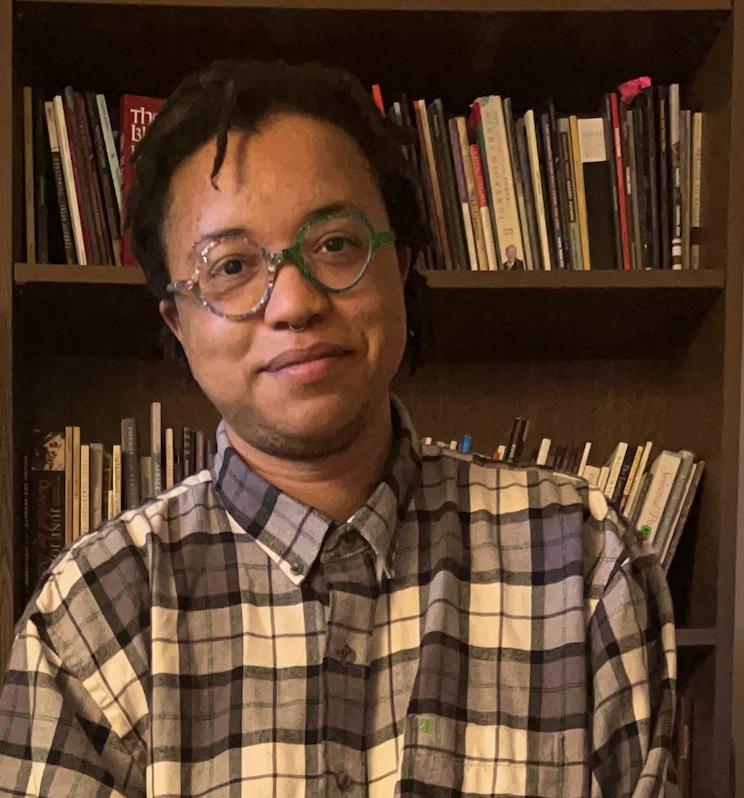
Talia Lakshmi Kolluri (left) and Samina Najmi (right)

Talia Lakshmi Kolluri (left) and Samina Najmi (right)

SAMINA NAJMI and TALIA LAKSHMI KOLLURI first met in 2022 after Najmi read Kolluri’s short story collection What We Fed to the Manticore and conducted her own interview for The Normal School. In that conversation, they found that not only are they practically neighbors, but they share a tremendous amount of common ground. Thus, a friendship was born. This conversation unfolded over email during Najmi’s book tour for her electric memoir-in-essays, Sing Me a Circle: Love, Loss, and a Home in Time, which spans her childhood in Pakistan and England, her first foray into the US in Boston, her family and professorial life, and Fresno, the place she now calls home. In this conversation, Kolluri and Najmi explore memory, return, the meaning of home, and the way we tell our stories.

Conjuring Home: Talia Lakshmi Kolluri interviews Samina Najmi
Read more...

Podcast: A. J. Bermudez on “The Sixteenth Brother”

Apple Podcasts logo

Listen on Apple Podcasts.

Spotify Logo Green

Listen on Spotify.

Transcript: A. J. Bermudez

A. J. BERMUDEZ speaks to EMILY EVERETT about her story “The Sixteenth Brother,” which appears in The Common’s fall issue. With a fable-like feel, the story explores the dynamics of family and gender roles in Morocco, as fifteen brothers scheme to convince their youngest sibling to allow the sale of the family’s ancient and opulent riyad. A. J. discusses the story’s framing device—a storyteller relaying it, almost like gossip—and how it creates both intimacy and distance. She also talks about her work in film, and the interplay between writing for the page and for the screen.

Podcast: A. J. Bermudez on “The Sixteenth Brother”
Read more...

How to Cry in Public Places

By EMILIA DŁUŻEWSKA

Translated from the Polish by KLAUDIA CIERLUK

Translator’s Note

I first encountered Emilia Dłużewska’s How to Cry in Public Places (Jak płakać w miejscach publicznych) three years ago, when it was shortlisted for the Joseph Conrad award—the most important Polish prize for a debut work. I was immediately captivated by its strong and unique voice: if you’re looking for a somber work about depression, this is not what you’ll find here. Instead, Dłużewska navigates her experiences with mental illness, the structural inequalities that fuel it, and the grey reality of post-Soviet Poland with unusual grace and humor, smoothly moving between disparate tones and registers. Playful vignettes, to-do lists, and shrewd word plays are just a few of the elements that comprise this genre-defying work. Set in contemporary Warsaw, with the lingering shadows of the Soviet era still shaping everyday life, How to Cry in Public Places nevertheless attests to the universality of the experience of depression, exploring how private suffering is deeply connected to the social and political contexts that surround it. The book’s intelligent deconstruction of mental illness affixes it to the vibrant vein of modern, English-language classics that approach similar issues through an equally dark and funny perspective, such as Ottessa Moshfegh’s My Year of Rest and Relaxation and Juliet Escoria’s Juliet the Maniac—the key reason in my belief that Dłużewska’s prose will appeal to readers on the other side of the ocean as well. 

How to Cry in Public Places
Read more...

Before Times

By JENNIFER CHRISTGAU AQUINO

Seattle, Washington

We walk sixteen thousand steps in shopping bags and Patagonia rain jackets through the never-rain, using Google maps to navigate your hometown. I talk incessantly about my lost life while you take us down wrong turns, saying, You will get there. At a paper maps store, we pull out drawers of flattened Earth. Of streets in Seville and Oslo, as if life can be laid out and easily navigated. More than once I say, Wouldn’t it be nice to travel there.

Before Times
Read more...

Working In

By ANDREW STEINER

The first time I saw Lake I was sitting on the bench between sets, waiting for the burn in my chest to subside. She walked past me to the big cage and slung her duffel to the floor. I watched with idle interest as she wrapped her wrists with soft black straps and wrangled her hair into a high loop. Her rose-colored Alphaletes came up well above her hips, and she wore a long-sleeved crop top that announced in block letters   

NO TIME FOR RATS. 

NO TIME FOR SNAKES. 

Working In
Read more...

The Grave Fox

By DANIEL TOBIN

Like a dog truant among the tended plots
it turns back toward us a considerate eye
as though sensing the disquiet of our being

lost here among all the unfamiliar graves
that would be landmarks proving the right way
if this were the way we’d believed it to be.

The Grave Fox
Read more...

Jesus’ Body Found Outside Ice Cream Parlor in Black Suburb 

By STEFAN BINDLEY-TAYLOR

His left wrist dangled out the half-wound-down glass of a boxy brown Cadillac with red felt seats. Flies drifted in and out. He had a dip top cone in his hand. The place was famous for them. You’d think it would be melting in the heat, but the molten chocolate shell held the ice cream within firm and cold. The air reeked of gasoline. No one had thought to turn the engine off. 

Jesus’ Body Found Outside Ice Cream Parlor in Black Suburb 
Read more...

Dead Man’s Association

By SINDYA BHANOO

Dead Man’s Association meets every Wednesday evening at Padiyappa’s Tea Stall & Smoke Shop. I am the president and the primary focus of the club. There is only one table at Padiyappa’s, but at 6:00 p.m. on Wednesdays, no local would dare take my spot. It’s been this way for the past fifteen years. The tea stall boy, a new chap, hands us stainless steel tumblers of piping hot tea and then hangs around to stare at me.

“Po da,” I say to him, eyeing his hairless chest, visible because his top two buttons are not fastened. “This is not a circus. Let me be.”

Dead Man’s Association
Read more...