Excerpted from Good Guys, out October 13 from Melville House.



By RODRIGO URQUIOLA FLORES
Translated by SHAINA BRASSARD
Story appears below in English and the original Spanish.
Translator’s Note
It is a pleasure to share my translation of this short story from contemporary Bolivian author Rodrigo Urquiola Flores. This semi-autobiographical work of fiction transports the reader to the windswept edges of the city of La Paz during the early and mid-1990s, when young children like the author and myself were cognizant of the mysterious and feared chupacabra as a topic of conversation and media coverage.
The story is part cataloging of the author’s first significant experiences and memories. Thrillingly, the narrator takes us on a journey from the neglect and loneliness of his spare, dusty home to the high drama of the soccer stadium. It is nothing short of a revelation. In this third space, he finds seemingly all the raw materials of life: effort, teamwork, luck, heartbreak, agony, triumph, relief.
Through the storytelling of his Aymara grandmother, Urquiola also takes us back in time to the Ocobaya hacienda, a site of subjugation and domination. I have resisted translating – and therefore decontextualizing – pongo, patrón, and amo, the unique terms of racialized power associated with this social and economic system. Curious readers are invited to learn more about haciendas, a significant feature of not-so-distant Latin American history with meaningful connections to the plantation system of the United States.

By GRACILIANO RAMOS
Translated by MILA MASSAKI GOMES
Translator’s Note
In Portuguese, “Baleia” means whale. Baleia… how funny it had seemed to me when I first encountered Graciliano Ramos’s work — a dog named “Whale.” It isn’t, of course, a simple or even silly name. In this short story, excerpted from the famous Brazilian novel Vidas Secas (1938), we follow a dog as she lives out her last miserable, heart-wrenching moments. Starved, thirsty, and rabid, Baleia is no more than a limping bag of bones to an outsider’s eyes. It is ironic: a skinny, limping dog, easily killed, named after an enormous, powerful, and beautiful animal. The deserted, scorched, barren land is home to a dog named after a sea creature. The end of her life, though brutal, is an act of mercy out in the arid backlands where she lives. While canid, Baleia is a reflection of her human family — migrants, alone in the backlands, fighting hunger, drought, sickness, and the threat of a gun held by an authority that sees people in the vast, desert lands as no more than sick animals to be killed. As she dies, Baleia dreams of an abundance she lacks, an abundance of care, joy, love, and food. Many people feel empathy for dying dogs — their deaths are hard and painful to read. With “Baleia,” I imagine Graciliano Ramos turning this empathy around to the Brazilian elite living near the coast. His story asks, “What would be of the world if we felt the same empathy we feel for dogs for the people who share this land with us?”

By SHATADAL MITRA
Translated by BISHNUPRIYA CHOWDHURI
Piece appears below in English. Click here to read the original in Bengali.
Translator’s Note
I believe what makes stories great is their ability to surprise and hearten their readers simultaneously. The tale of Khanandihi, which revolves around a quintessential Bengal village as it lives through generations of transformation— social, economic, and ethical—does so with an unparalleled efficacy that deserves a global readership. The narrative defies linearity, both in its language and in its structure. As a result, past and present run interwoven into each other, endowing even the smallest characters with a cosmic expanse and scope. The text resists rushed reading—its layers of long, winding sentences and subtle subtextual nuances unlock only when savored.

By ELANA LAVINE
He gets in the water piece by piece, ankle thigh nipples, grunt. Shoulders below the same surface, it’s obscene, like slipping into my bed.
Oh that’s cold
I’ve stopped for breath. Not for this.
You’re a strong swimmer, he says, I was watching. A round-calved lifeguard stalks, pink toenails at my eyeline. She knows, and I know, that I can’t have a lane all to myself.

Excerpted from Long Island Girls

Susan wanders aimlessly down the alt rock aisle of Tower Records, one parking lot over from the Walt Whitman Mall, next to the TGI Fridays. She runs her fingers along the top edges of the CDs while a Fall Out Boy song plays through the store’s speakers, nails on a chalkboard with its high-pitched harmonies. She’s wearing her large headphones like a necklace, plugged into a Walkman in her black pleather messenger bag.

When I got home from school that day, my mother was clearly excited about something. She must have been watching for me from the window, because she met me at the door, and behind her I could see something denim folded up on the table beside the teapot. “I have a special treat for you,” she said. My heart ballooned in my chest. Levi’s. All at once I wanted to hug her and rush past her to put them on, I wanted to dance around the apartment like I never did, and I wanted more things, too—for my father to emerge from where he had been hiding all my life, the closet, or the jungles of Africa or Mexico, stepping from the shadows, framed by the doorway.
She took my hand and walked with me over to the table. My heart began to deflate the closer we got, for it was clear that what was folded up there wasn’t a pair of Levi’s, but a length of raw fabric that had been created to rival Western denim. My mother was so happy that she seemed to slip outside her own body, snapping out the fabric like a flag, running her hand down it, wrapping it around my waist, nearly singing her words, because she thought she had given me what I wanted, that this would then be enough for me: this apartment, this city, this country, and my mother.
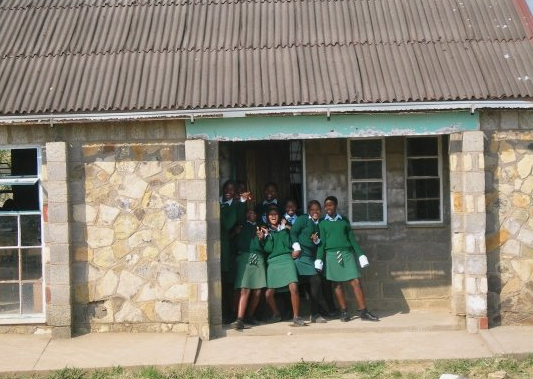
The village sits in the throat of the Maloti mountains, which hum pink with the setting sun. From east to west, the mountains resemble many fists, the knuckles as peaks, the fingers as slopes, the space between a deep emerald.
Tsepiso—fifteen, lover of algebraic maths, The Bold and the Beautiful, and the Greek-American singer Yanni—must walk to the village pump and return home before dark. Thabang, her neighbor, who saves sweets for her from the Chinese shop, intends to marry Tsepiso. This news drifted through the village like a Sunlight soap bubble, and so Tsepiso’s mother has warned her to be home early. Otherwise, Thabang will take her into the maize fields, lay her down, and make her a wife.
Translated from the Polish by KLAUDIA CIERLUK
Translator’s Note
I first encountered Emilia Dłużewska’s How to Cry in Public Places (Jak płakać w miejscach publicznych) three years ago, when it was shortlisted for the Joseph Conrad award—the most important Polish prize for a debut work. I was immediately captivated by its strong and unique voice: if you’re looking for a somber work about depression, this is not what you’ll find here. Instead, Dłużewska navigates her experiences with mental illness, the structural inequalities that fuel it, and the grey reality of post-Soviet Poland with unusual grace and humor, smoothly moving between disparate tones and registers. Playful vignettes, to-do lists, and shrewd word plays are just a few of the elements that comprise this genre-defying work. Set in contemporary Warsaw, with the lingering shadows of the Soviet era still shaping everyday life, How to Cry in Public Places nevertheless attests to the universality of the experience of depression, exploring how private suffering is deeply connected to the social and political contexts that surround it. The book’s intelligent deconstruction of mental illness affixes it to the vibrant vein of modern, English-language classics that approach similar issues through an equally dark and funny perspective, such as Ottessa Moshfegh’s My Year of Rest and Relaxation and Juliet Escoria’s Juliet the Maniac—the key reason in my belief that Dłużewska’s prose will appeal to readers on the other side of the ocean as well.

The first time I saw Lake I was sitting on the bench between sets, waiting for the burn in my chest to subside. She walked past me to the big cage and slung her duffel to the floor. I watched with idle interest as she wrapped her wrists with soft black straps and wrangled her hair into a high loop. Her rose-colored Alphaletes came up well above her hips, and she wore a long-sleeved crop top that announced in block letters
NO TIME FOR RATS.
NO TIME FOR SNAKES.

Don’t miss an issue! Subscribe to The Common.