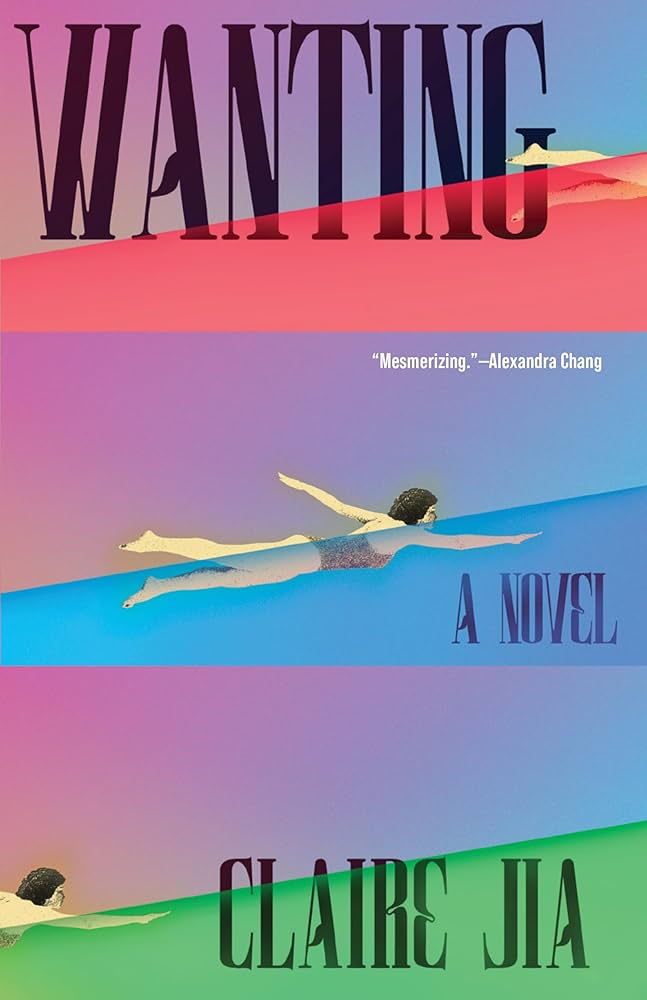
By CLAIRE JIA

This piece is excerpted from the novel Wanting by Claire Jia, a guest at Amherst College’s eleventh annual literary festival. Register and see the full list of LitFest 2026 events here.
The woman who would soon become known as Vivian Straeffer-Kenney looked perfectly American: her full lips curved orange-slice plump and outward, her hair billowed off her shoulders in fat, blondish waves, layers of mascara gave her eyes that perfect half-vernal, half-vampish shimmer irresistible to men everywhere.
She was recording herself in her living room, while the screen flashed with an architectural rendering of a mansion she and her new fiancé planned to build in the Shunyi district of Beijing. The house was palatial, vaulted ceilings rendering it nearly holy, a tiled pool reflecting aquamarine onto its pale stone walls. She gushed about the views they’d get from the rooftop terrace. It was gorgeous, the kind of home only the most abundant of money mountains could afford.
She’d gotten work done on her eyelids; Lian was sure of it. She stared, pausing the video on her phone and zooming in on her face. She had never had that crease before; it caused the midpoint of her eye to pop up in a look of constant delight—the kind that was once reserved for the moments that really deserved it.
Lian hated how she rushed to watch every new video Vivian posted. She couldn’t help it. She was looking for something—something only she could see.
“Lian? Lian. We’re almost there.”
Her boyfriend was gesturing at the elevator doors. Their floor was coming up. A projector splashed an advertisement for a new food delivery app on the wall.
“Right,” Lian said, putting her phone in her pocket. The elevator pinged and the doors slid open.
A woman in a stiff maroon suit was standing outside, her left arm dutifully gripping a clipboard. Her gold name badge read SANDY. She stuck out her hand. “You made it!”
They were viewing a condo in the Chaoyang One subdivision, an appointment her mother had brownnosed upwards of a dozen acquaintances to secure. Sandy was allegedly the best of the best. She’d sold Zhu Zixi her luxury condo for I00,000 kuai under asking, nearly impossible in this year’s housing market, and because of that, Lian was expected to put her future in Sandy’s hands. Zhetai wore his nicest shirt; there was something jittery in his step.
Sandy opened the door to the apartment. Her first impression was that it was quite expansive; the living room and dining space bled into each other seamlessly. It had been outfitted in a mid-century modern style, currently popular in the West, according to Sandy. A low leather couch spilled across an orangey rug while a single drop lamp arched perilously over an armchair whose back was so vertical she couldn’t comprehend how one would sit in it comfortably.
Zhetai sat down on the couch, leaning back in a pose of uncharacteristic casualness, the faint grid lines of his shirt creasing as he stretched his arms out. “I love this couch, Lian,” he said. “I want to get this exact couch.” Western light streamed in, bathing Zhetai’s face in a sherbet glow. Lian smiled. For a moment, she could see the two of them here, years older, their faces more rugged and lined, sitting on this very couch. Sandy was beaming at them, no doubt dreaming of her own family in her own high-rise condominium one day. On the wall, the ductless air conditioner oscillated soundlessly. This was a place where joy—or at least contentment—was expected to grow.
“It’s a great couch,” Lian agreed.
They walked into the guest bedroom, which had its own balcony with a sliding door.
“The second balcony is so rare,” Sandy said. “You two can enjoy your alone time on the primary bedroom balcony, while your child can entertain himself on this balcony.”
“We don’t have children,” Lian clarified. She wondered what a child would do with a balcony. Use it to smoke cigarettes, probably. “Oh, but you might someday!” Sandy chirped. Her face was trained right on Lian, her eyelashes thrumming, and Lian smiled again.
She opened the sliding door and stepped, precariously, onto the stone base jutting out forty meters above the ground. She surveyed the landscape of the subdivision before her: seven perfect obelisks rose in a cluster of glass and concrete, imperious in a sea of slightly shorter, slightly lesser buildings in the city beyond them. In the middle of the subdivision was a playground, a prerequisite for paradise, its clementine exercise bikes and shamrock swings providing whimsy and respite for child and adult alike. She saw a small boy sitting at a pectoral fly machine, his shoulders splayed unnaturally as his hands gripped the lacquered metal bars. Together the hands came—thwack! A little look of surprise startled his features out of place. And then back out the metal bars went, threatening to rip his arms from their sockets. He wore a bright green shirt and Velcro shoes. His mother looked on, her hair swept up by a plastic claw clip, which she unclasped and clasped as she chatted with another woman, whose own young child did belligerent half somersaults at her feet. Surrounding them were cobblestone paths and grassy patches in the shape of koi fish. Rotund bulldogs dragged their lumpy bodies across the Astroturf. Young couples pushed their baby strollers by the water while BMWs crawled past on their way home.
Sublime, she thought.
Idyllic.
Halcyon. She grinned. Halcyon was a good word.
The boy slammed the machine closed in front of him so swiftly Lian could almost see the look of surprise on his face, all the way from the twelfth floor. She remembered sitting at similar machines as a kid: You always thought the weight would be heavier than it ended up being. You thought those machines were real weight machines and expected to feel the way body-builders on TV looked: burdened, heroic for having mastered them. When the arms clanked shut, for a moment you marveled at yourself—wow, I am stronger than any bodybuilder. In the moment immediately after that, however, the truth slid over you: about the machine, about you.
“On a clearer day, you can see Jingshan Park from here!” Sandy pointed at a murky blur in the southwest distance.
“I think I can see it,” Zhetai said. “Isn’t that the pagoda overlooking the palace?”
“Yes, yes!”
Lian couldn’t see a thing, but she smiled and nodded. The three of them stood there, staring out at nothing.
Excerpted from Wanting by Claire Jia. Copyright © 2025 Claire Jia. Published with permission from Tin House, an imprint of Zando, LLC.
Claire Jia ’15 is a writer from the Chicago suburbs. She has written on TV shows such as Zombies: The Re-Animated Series, Awkwafina Is Nora from Queens, Fresh Off the Boat and Gangsters of Shanghai. She co-wrote the 2024 Peabody Award-winning video game We Are OFK. Her writing has appeared in The New York Times, Reductress, The Establishment, The Rumpus and more. Her parents are from Beijing, and there’s nothing she loves more than haggling for stationery in a chaotic Beijing marketplace. She peaked at age 16, when she became the All-State Illinois Shotokan Karate Club Kihon Green Belt Champion. Today she lives in Los Angeles with her friends. Wanting (2025) is her debut novel.