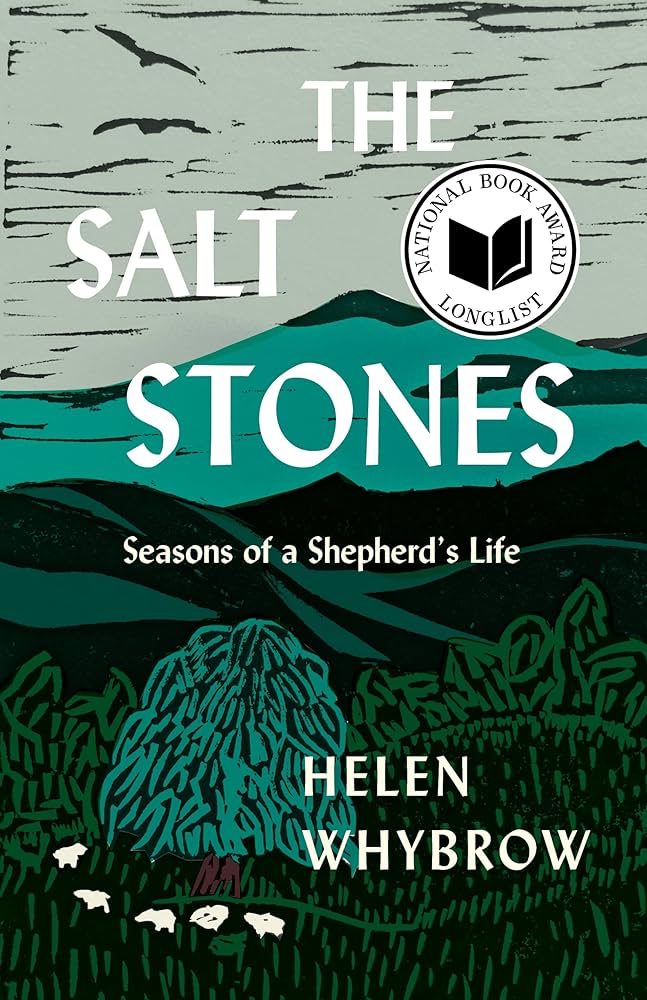
This piece is excerpted from the memoir The Salt Stones: Seasons of a Shepherd’s Life by Helen Whybrow, a guest at Amherst College’s eleventh annual literary festival. Register and see the full list of for LitFest 2026 events here.
A bird is not born knowing how to fly. Not exactly. Leaping off a rafter and opening two perfectly constructed aerodynamic wings will get a fledgling only so far—usually to another rafter, or a spot on the ground, or sometimes to a confusing corner of a window where an invisible cobweb will wrap its sticky strands around a beating wing and mangle the delicate microzippered fibers ever so slightly so that the wing no longer beats at all.
One of my greatest joys is watching the parent barn swallows—so elegant with their ruby-colored cravat at the throat, creamy shirt coat, and long blue coattails—coach their young how to transition from being perchers and reckless lurchers to flyers capable of not only defying gravity but of snatching a transparent mayfly on the wing.
In June, the swallows had found a broken-down manure spreader in the pasture to be the ideal launchpad. As I passed by on my way down the hill to check on the flock in the morning, I would see eight or ten immature birds—like toddlers in retro pile coats with oversized heads and beady eyes—lined up and ready for school. Every time an adult swooped in with a snack, the round-bodied babes would chatter excitedly and hop sideways up and down the edge of the manure spreader. Then they would launch after the parent bird, more nervous chatter ensuing.
One landed in the grass, got stuck, and cried hysterically for a parent to come and help, though I wasn’t sure how they could help, other than to fly at the head of a predator and be a distraction to avert disaster. They were swooping at my head as I stood there watching. A baby has to struggle back up on its own. Or not. I wondered if it would be wrong to pick the little thing up and place it back on the rim of the manure spreader, just as I had wondered with the fawn.
A few weeks earlier I had stepped over the sheep fence early one morning and heard a low snort from the woods behind me; a doe stamped her foot and didn’t move away. The grass was long and dew-soaked, and my jeans clung to my thighs. As I walked to the sheep I almost stepped on a newborn fawn the size of a cat, with eyes like wet river stones. A small emerald beetle was crawling over its golden flank, but the fawn didn’t flinch. I froze in midstep. Though I was inches away, the fawn’s best defense was to make itself invisible. I have heard—and it seems right in some cases, but not all—never to touch a wild animal’s baby, or its parent will reject it. But this newborn fawn was on the other side of a hot electric fence from its mother. Even if the mother— who can jump in and out easily—came back for it, I knew the fawn would not be able to follow her out of the enclosure.
I’ve watched sheep die a horrible death in electric fence before I could cut them free. I once released a badly damaged wild turkey, and I’ve found the fried carcasses of spotted salamanders who crawled over the bottom wire in their spring migration. So I reached down and picked up the fawn—who weighed less than a newborn lamb and was limp and warm, with a dappled coat—and I carried it to the edge where I had seen the doe in the trees. She was gone, but I left the fawn in the ferns. Later, I saw them walking together under the apples.
When we came to the farm in 2001, the air was thick with swallows. Ann Day walked me around the outside of the barn and showed me how the barn swallows took up residence each May in nests along the southern and eastern eaves of the large roof, while the cliff swallows made their nests along the western side. A few tree swallows claimed the north-facing entrance to the barn under a long covered ramp extending from the eaves, but mostly they occupied the nest boxes Ann had put up all through the fields.
Ann, who was an expert birder and for decades had written a weekly nature column for the local paper, taught me how to identify each type of swallow: The barn swallows can be easily noted in flight for their striking forked tails and are indigo blue with a creamy underside and russet throat. Tree swallows are elegantly simple: blue-black with a white breast. The cliff swallows are dressed in soft earthy tones like the barn swallows but have a less rakish tail—notched instead of forked—and a small white forehead patch. Their nests are different too. While the barn and cliff swallows build theirs out of mud and straw, the tree swallows gather twigs, grass, and bits of bark to inhabit the boxes in the fields. The cliff swallow nests are nearly conical ovens of clay with a little hole in the side facing the sun, while the barn swallows make more open bowls attached to ceiling beams.
The year after we moved in, I counted sixty-three nesting pairs of swallows and noted it in a journal. In recent years I’ve counted a fraction of that number, even as low as eight. I learned that all types of swallows are in decline in North America, as is the case for all avian aerial insectivores (birds that catch insects on the wing). Major reasons, according to the Audubon Society, are fewer insects due to pesticide use, and a loss of nesting sites because of the loss of old farms. In one study I came across, a significant factor in the swallows’ decline seemed to be the rate at which hatchlings died before leaving the nest. But researchers didn’t pinpoint why. This is what I wanted to know. Why had all these baby birds died?
I go up the ladder, pick up the dead bird on the rafter gingerly by its feet, and place it in the nest with its mates. Then I dislodge the nest from the beam. I stick the mess under my arm and carry it outside below the barn, where I tip out and fold the birds into the soft darkness of the giant compost heap. Kicking a pile of warm, half-decomposed hay and manure over them, I am comforted to think that whatever ailed them will be cleansed by the death-eating microphages of the living soil—dirt as purification. I crumble the nest onto the compost, a salad of dung and dust, bone and beetle, bits of pearly shell, and shards of grass. Each material has its own life history, its own constellation of elements and matter essential in the creation of life on earth as well as in the twinned cycle of decay. These elements came together in these forms—egg, bone, feather, flesh, heart—in this moment, to be taken apart again and return in other forms, without limit into eternity.
Excerpted from The Salt Stones: Seasons of a Shepherd’s Life by Helen Whybrow. (Milkweed Editions 2026.)
Helen Whybrow ’90 is a writer, editor and organic farmer whose book about shepherding, land and belonging, The Salt Stones, was longlisted for the National Book Award and chosen as a New Yorker Best Book of 2025. Her other titles include Dead Reckoning (W. W. Norton, 2001) and A Man Apart (Chelsea Green, 2015). She has a master’s in journalism and has taught writing at Middlebury College and the Breadloaf Environmental Writer’s Conference. She and her family farm and steward a refuge for land justice at Knoll Farm in Fayston, Vermont.