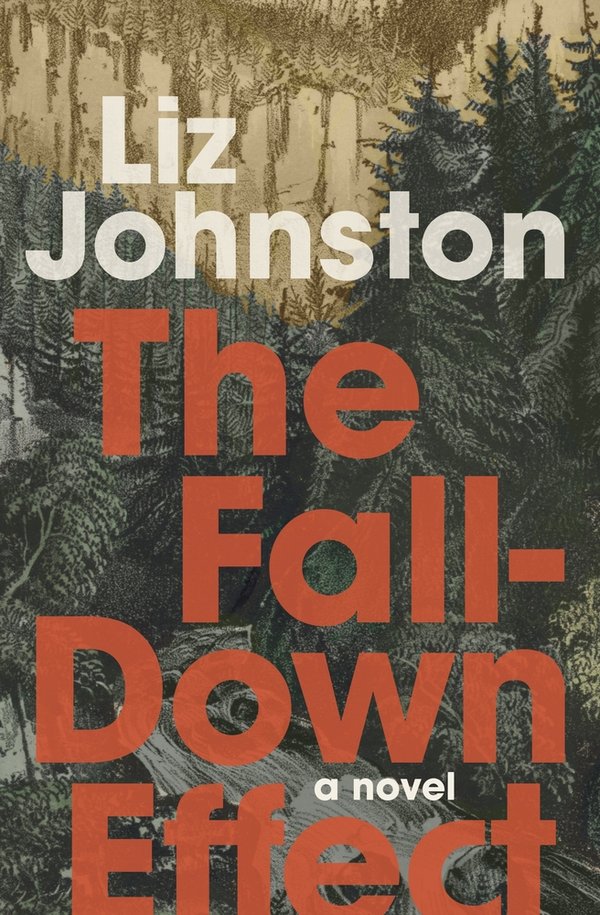
By LIZ JOHNSTON and EOGHAN WALLS
Review by JULIA LICHTBLAU
It’s hard to fight for other organisms and remain on speaking terms with humanity. People don’t care about extinction. What’s one species, they say, compared to my precious convenience? Trees and birds do their bit for the ecosystem merely by existing. Humans are uniquely selfish and destructive. Come to think of it, maybe we’re the expendable species.
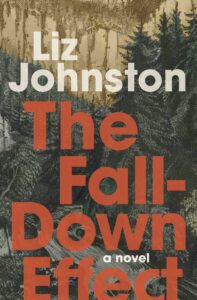
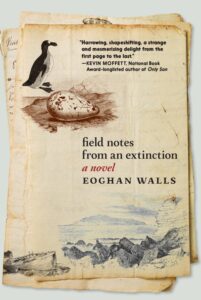
Two timely new novels, The Fall-Down Effect, Canadian writer and Brick magazine editor Liz Johnston’s debut, and Field Notes from an Extinction by Northern Irish poet and novelist Eoghan Walls, center on those who risk their lives—and other people’s—for nature. Both books ask what makes a person willing to go that far. Nature? Nurture? What’s the tipping point? Why now?
The protagonists in these books have suffered family traumas that harden them to distractions like love, and they share reclusive personalities, as well as a mix of megalomania and desperation. The Fall-Down Effect’s protagonist says: Enough thinking. Now. The main character of Field Notes says: A species is dying. The world needs to know.
Fern Wilson, the main character of The Fall-Down Effect, grew up fighting the logging of old-growth forests in British Columbia at her activist mother’s side. She becomes a fugitive after blowing up a sawmill, an act of arson. Johnston avoids loaded terms, but “ecotage,” which Encyclopedia Britannica defines as sabotage to defend the environment that causes economic harm, not death or injury, seems to capture both result and intent. The question of whether the earth or any organism benefited from this act, haunts the book. Ignatius Green, the main character of Field Notes, is a cranky English ornithologist on a remote Irish island monitoring the last great auk colony in 1847, during an even larger extinction event, the Irish Potato Famine, which killed three million and set in motion the great Irish migration of the 19th century.
The Fall-Down Effect, set from pre-internet 1989 through the pandemic, takes its name from the decline in timber volume after old growth forests are chopped down. Trees never grow back as vigorously. Diminishing yields create perverse incentives for lumber companies to keep cutting old-growth stands, destroying the environment on which other species depend and further diminishing lumber yield. Like coal-miners in West Virginia, the loggers identify with a declining industry that will screw them without a backward glance and leave a decimated landscape, having vilified environmentalists who told them so. We don’t see much actual logging—this isn’t a labor novel, but the industry’s importance to the province is ingrained in the story. It’s in the tension between conformity and counter-culture/resistance within the family, from the opening scenes, as Fern, seven, Sylvia, eleven, and River, six, await their mother Lynn’s return from a McDonald’s protest—which she played hooky from homeschooling the kids to attend—a secret they’d have kept from their father, had he not gotten home first and found them alone.
Lynn’s gadfly role has alienated their small town and put her partner, Tom, a former activist turned park ranger, in a difficult position. When Lynn asks Tom, who’s haunted by a youthful protest gone bad, to join her in an action like the old days of their relationship, he says, “I’m not that guy anymore.”
Undeterred, Lynn gets the idea to chain herself and the children across a new logging road. If they get news coverage, she muses, she won’t “have to resent [the children] for how little she did for the world beyond their home these days.”
The book is constructed like a piece of Shaker furniture. The point-of-view shifts throughout the book dovetail so smoothly that readers wouldn’t feel a joint if they could touch them. The children’s perceptions of this day underlie the entire book.
Shades of Hansel and Gretel: Early one morning, the mother drives her children into the dark forest, leaving their sleeping father at home. She will run chains across the road, padlocked around tree trunks, and handcuff her children’s arms inside plastic sleeves attached to the chains. When the men and the trucks arrive, they won’t be able to get through to cut the trees down. Sylvia, the mature one, who tries to keep her clothes clean while helping her mother hook up the rusty chains, thinks: “The minute they turned [the car] around and started driving back down the mountain, the loggers would roll right in to start chopping trees. Mom wouldn’t come all this way and let that happen, which meant they could never leave.” Fern is exhilarated by the roaring truck engines, the smell of diesel, the angry men. Yeah, Mom. We’re saving the trees for real! River wants to be a big boy, but his handcuffed arm hurts and the trucks he recognizes from his picture book are terrifying up close.
No surprise, the sheriff shows up at their house and invokes Child Protection Services, enraging Lynn. In short order, the kids are enrolled in public school, where Sylvia is in her element; River comes around gradually; and Fern adopts a sullen defiance. Lynn will leave Tom and the children without saying good-bye (too hard on Fern, she reasons). She vows to devote herself to the planet, downplaying her other reason for leaving—desire for a relationship with a woman, set aside in choosing Tom.
The book’s three sections are separated by a decade or more. Part 2 picks up in 2001. River’s in high school, a budding artist; Sylvia’s away in college; Tom has a new partner, while Fern works in a coffee shop, preparing to make her mark with the help of a pamphlet from a man who singled her out at a demonstration as “ready to burn shit to the ground.” She leaves a note telling her family they’ll never see her again, don’t call the police. The next night, the town sawmill burns.
The family fault lines split again. Who made Fern an arsonist? How come nobody noticed? Each family member mourns missed clues. Fern’s made of steelier stuff than her mother, but shares her self-absorption. At 19, she thinks she’s finally accomplishing something by stopping one factory from turning tree trunks into “smooth golden lumber.” Hey, it’s my life.
It’s never just your life.
Fern didn’t kill anyone but she discounted the risk of the fire spreading or someone being unexpectedly inside, and she put her family in legal jeopardy. What the town holds against her and the family are the jobs lost when the mill burned and didn’t come back. Maybe the company would have closed up shop anyway. But Fern’s action gave them cover. A radical left terrorist put us out of business!
Perhaps the one chink in this meticulously crafted book is the ease with which police interest in Fern fades from the story. Johnston chose not to write an eco-thriller—she still delivers plenty of suspense. Instead, she focussed on what led angry young Fern to embrace violence: A sense of futility—an emotion I suspect most readers of Johnston’s book—myself included–can relate to in this moment. The book ends stoically, unsentimentally on Fern living in exile under an assumed name, no clear way home. The little girl who relished yelling at logging trucks sacrificed her freedom to speak for trees. Fern is too smart not to realize this. And Johnston leaves us turning over the ramifications for her long after we close the book.
Ignatius Green is not a radical—he argues against distributing free grain to the starving Irish so that they don’t grow dependent on the state. Green, who lost his wife and child in childbirth, channels his sympathy into the great auks or garefowl on Tor Mor, a rocky crag off the northern coast of Donegal, which he’s monitoring for the island’s owner, Sir Walpole Phillip. He’s given them Shakespearean names and describes them whimsically as if they were people. It’s 1847, two years into Ireland’s great famine. Green depends on a wily light house keeper named McGonigle from Inishtrahull, the island between Tor Mor and the mainland, for his allotted supplies. Green doesn’t care how provocative his project is to the starving and profiteers like McGonigle. Ireland was part of England, and the English landowners’ exports of grain, meat and other foods made the famine much worse and fueled Irish hatred. Green and Lynn, Fern’s activist mother, share a certain political obtuseness.
Irish readers are likely more familiar than I was with the garefowl’s terrible extinction story, which the novel, following its conceit of being a notebook, doesn’t recount in full. Pinguinus impennis were once common in the North Atlantic, unrelated to the penguin but similar in appearance—nearly a meter tall and flightless, meaty, with handsome black feathers. Defenseless out of water, they were slaughtered systematically, like the passenger pigeon or the buffalo. In 1844, the last nesting pair and their egg on Eldey Island near Iceland were—the word “murdered” seems appropriate—by trophy hunters. The fictional Tor Mor colony is described as a previously undiscovered nesting ground, hence Green’s hope for a regeneration and sense of the importance of his mission.
The massacre of flightless birds felt like a parallel to the decimation of old-growth forests in The Fall Down Effect—human greed meets helpless prey.
The story is told through several narrative devices, primarily Green’s notebook entries, interspersed with newspaper clippings, which feed the mystery at the center of the book. The notebook entries include bird measurements, rock formations, guano consistency, every ingredient of every meal, and conversation. He records dialogue as in a play (Myself: You are honestly trying to tell me you have not nabbed almost half my provisions? McGonigle: I would be offended at the suggestion, sir.)
Like any decent diarist, Green writes to an imaginary reader. Here’s a bit of bird behavior: “I witnessed the changing of the guard as I arrived. Canute has become the sole parent to his grey egg. When the womenfolk return from fishing, the other men growl & cluck, preening. Then the switch: the ladies shuffle to the nests, while the men head out.”
In the first three pages of the novel, Walls uses all his tricks to show what’s at stake. Page One is a newspaper account of a bailiff killing a Mr. O’Leary, whose wife and child ran away, on February 10, 1847; Two is Green’s letter of June 22 to whomever finds his notebook—accusing McGonigle and the people of Inishtrahull of seeking to kill him and a girl in his care and extinguishing the garefowl, “a theft of life.” Three jumps back to Monday, 31st May, 1847, a diary entry, which sets the story in motion: “The islandmen have smuggled a child onto Tor Mor Rock.”
Feral, lice-ridden, speaking only Gaelic, the girl was stowed among his provisions, along with a note, warning Green to “act as her mother” or “it will not end well for you,” signed “The Canniball, Aisling O’Leary.” Who?
He tries to send the girl back, but she resists with demonic intensity.
Green eventually learns from his only personal visitor, a priest, that Aisling O’Leary was a real woman who has become an avenging folk-character, a bogey, who eats her foes, and transforms into a hound or swan. Why him? That’s the central mystery of the book.
He cares for the girl in his rough way, nursing her through an illness, stitching her a coat out of a cast-off jacket, training her to relieve herself outdoors and use rudimentary English, and encouraging her to draw, while punishing her harshly for breaking the desalinating still.
Tenderness he reserves for the four nesting pairs of auks, Othello & Desdemona, Antony & Cleopatra, Canute & Boadicea, and Macbeth & Lady Macbeth. The males joust with hooked bills, but “[n]o lethal blow is ever struck; they are cautious in both attempted adultery & violence.” He records their calls: Wheee, wheee (mating)…Grrrr, Grrrr-uh (an acknowledgement)….HOOOwk, HOOOwk (excitement, distress)…Chit-chit-chit-chit-chit (warning)…CLACK CLACK (threat). Tragedy strikes, an egg is cracked. “The loss of even one egg is a human loss,” he writes. “Canute oblivious. Bristles when I get close, CLACKS at me. CLACK CLACK CLACK. Stands as if to rush me. Poor fellow.”
He records a similar taxonomy of the child’s weeping. Her name is Bridget.
In a book full of epic scenes, the arrival of Bridget’s mother about a month after the girl’s appearance on the island is downright operatic. We know from the newspaper clippings that she has been on a vengeance tour against those responsible for evicting starving tenants, beginning with the bailiff who killed her husband. A Celtic Amazon, she arrives by boat, dressed like a man, laden with food, presumably from her victims. After a tumultuous reunion with the child, she throws Green out of his cabin for several days, and eventually takes him to bed, where he learns she was a servant in his house on the mainland when his wife was alive, and remembered him as being gentle to the girls when he seduced them, which is how she came to choose him as a foster father. Then she sails off, leaving the heartbroken child with Green, who has started to depend on her as well.
Poachers come for the birds. After a brave, terrible fight, Green and Bridget set off in a rowboat to the mainland, seeking the child’s mother and a measure of justice, but they find scenes reminiscent of the plague. Green has a patron in England, where he can presumably restart his life with his foundling—he talks of a boat to Liverpool. Maybe they’ll join the flood of refugees to America.
After reading these books, I found myself wondering what advice historical figures, activists and scientists, would have given Fern and Ignatius Green. Abbie Hoffman, the most famous political prankster of the 1960s, spent seven years underground after skipping bail for drug charges. He made a life with a new partner and campaigned to protect the Hudson River under a pseudonym before turning himself in. Would he have told Fern to negotiate a deal with prosecutors? Or get plastic surgery and live as full a life as possible, until you can’t take it? He died in 1989 of a drug overdose at 52, nine years after regaining his freedom. The strain, he might tell her, never goes away.
Michel Adanson, the French naturalist and explorer (1727-1806) who collected and codified some 40,000 plants and animals and invented an alternative system of classification from Linnaeus, would surely have complimented Green for continuing his work on the great auk at great personal risk. Adanson, who was fictionalized by French-Senegalese writer David Diop in Beyond the Door of No Return, spent the last thirty years of his life trying to extend his system to all realms of knowledge. Green would no doubt have returned the favor and warned Monsieur Adanson about losing touch with the real world.
Julia Lichtblau is a bilingual (French/English) writer whose work explores migration, exile, and belonging. Her writing has appeared in the French literary journal Volutes, The American Scholar, The Museum of Americana, American Fiction, Blackbird, Narrative, The Florida Review, and The Common, where she was previously book review editor.