When Hannibal was loose in Italy and could not be made to leave, the Romans did a strange thing. They consulted their books of prophecy, and the books told them to go get a mother.
Not a general. A mother. The prophecy said the invader could be driven out of Italy if the Mother of the Gods was carried from her shrine at Pessinus to Rome. So the Romans sailed east and asked for the Idaean Mother, and what came back, in 204 B.C.E., was a black stone. The people of her country said the stone had fallen from the sky. The people of her country said the stone was her. Rome bore her up the Tiber, built her a temple on the Palatine, gave her games each April, and kept her at the center of the world for six hundred years.
They had begged her off a king. An embassy to Pergamon, conducted inland to Pessinus, sailed home with the goddess in the hold. A delegation of men ferried the Mother of the Gods across the sea because a book said she would save them.
Even her welcome was a test of a woman’s virtue. When the ship reached the river, the story goes, a Roman matron under suspicion of unchastity was the one who brought the goddess in, and her success became the proof that she was pure. The mother had barely landed, and already she was being used to grade a daughter.
Notice what the Romans wanted. Her function. The city had a problem only a mother could solve, so the city sent for a mother, the way a child calls for mommy when something needs fixing. I have stood on both sides of that transaction.
I know Cybele’s story because I could not get what I needed from my mother or my abuela, who raised me while her daughter was at work. To save space for each other, they denied me the language they shared. “Nosotros somos los cubanos y tú, la americana,” Abuela said. (Please note that she never used nosotras, the collective feminized “we.” Make of that what you will.) I had to learn Spanish at school and bring it home as a portal to our identity. As an adult, with Abuela gone and Mom absent, I went looking for a mother in the historical record.
“Mother wound” is a coinage of the therapy shelf, a term shaped to sell healing back to the wounded. It took me years to understand that a mother wound is not only something that happens inside a family. It happened in history, to the idea of the mother herself. Our mothers inherited the idea, and the wound it conceals, long before they handed it to us.
What I needed to see was the shaping at work on something older than any living woman, older than the coinage, older than what Adrienne Rich called the institution of motherhood. I needed a mother older than all of it.
I first heard Cybele’s name in a mossy pagan temple in northwestern Spain, my eldest son still a baby strapped to my body. Seeking Cybele took me many places I had never thought to enter, from the recesses of my own memory to the archives of the Louvre. Needing a version of femininity that I could worship, I found a mother older than Rome. In the highlands of what is now Turkey, her name was simply Matar—Mother. The oldest carvings give her a wild bird of prey on her arm. Homer calls her mother of all gods and all mortals. The Greeks made the image the world remembers: the Mother of the Gods on a throne, a drum in her hand, lions at her sides.
The deeper I read, the more of her I watched go missing. Somewhere in the crossing west, Cybele lost the bird. In its place, the poets gave her a beautiful shepherd named Attis—in Ovid’s telling her own beloved, who broke his vow to her, castrated himself in remorse for his infidelity, and bled out. Her priests cut themselves free in his memory. What Rome actually worshipped, behind the processions, was a stone: a mother no child could climb into.
I read her record with the voraciousness of a lonely child, pulling the histories of her cult, handling drawings of her in the Louvre’s archives, hunting the version of her that would finally hold. Some might call this bias. As a daughter of our self-help era, I call it re-mothering myself. It is an old method, pressing your need against the past until it gives up its guidance. Rome did it with a navy. I did it with a reading list.
Cybele’s sanctuary on the Vatican hill was still receiving altars at the end of the fourth century. St. Peter’s Basilica stands there now. At Ephesus, in her own Anatolia, a church council voted in 431 CE to call a different mother the God-bearer: a virgin with a son whose long shadow gave her a capital V.
The evidence itself is not innocent. Nearly everything we know of Cybele’s rites reaches us through Roman men writing with cloaked purpose, Christian polemicists writing against her, and archaeologists mining the prejudices of their century. The record of the Mother is a record of her handlers. Any daughter who has narrated her own mother knows the genre.
I wanted what the hymn promised: a mother of everything, with room for me. What the record held instead was evidence of wanting: centuries of people carrying her, dressing her, cutting away what did not serve, and calling the remainder Mother. My abuela was somebody’s daughter. My mother was hers. The silencing that each handed down had been imposed on her first. A family does to its mothers what the centuries did to the Mother.
What to do with a wound whose every available myth turned out to be serving someone else? I had to stop waiting for the woman in front of me to become what I needed her to represent.
Which is good, because my mother didn’t call when she heard I was sick. I went into surgery thinking I had spared myself her scrutiny. Turns out she stayed away to see if I survived. I can’t imagine getting to that place with my own kids. But life can be like that. It can hand you scenes you’d prefer not to describe in detail.
Kate Zambreno built Book of Mutter, a gathering of fragments about their mother’s death, out of trying to write their mother, and arrived at the impasse with characteristic honesty: “My mother is the text. I cannot enter her.” That sentence relieved me when I found it. The failure to enter is not a failure of love or craft. It is the condition. The mother is the first book we cannot read, which may be why some of us became the kind of readers we are.
At least Hélène Cixous, the French novelist and theorist whose 1975 manifesto “The Laugh of the Medusa” called on women to write their bodies, left a door open: A woman “is never far from ‘mother,’” she wrote: “There is always within her at least a little of that good mother’s milk. She writes in white ink.”
What survives scrutiny: The stone came up the Tiber. The bird is on the old carvings. The altars are under the Vatican hill. Lay the facts end to end, and they tell themselves as a story. The wild mother loses her bird, gains a dying boy, hardens into stone, and is finally replaced by a virgin—the Great Mother diminished, by increments, into someone safe to adore. I believed that story. I wanted it. It made my private hunger historical. It gave my wound a genealogy.
The French philosopher and psychoanalyst Luce Irigaray presses the claim to its foundation. Western culture, she argues, rests on an unacknowledged matricide, the mother buried under the order raised on top of her. This is the mother wound at historical scale: a compulsion, reenacted century upon century, to remake the mother into whatever the present cannot supply.
What does not survive is the single line drawn through these facts, the simple story in which each mother replaces the last. The historians of Cybele’s cult, Lynn Roller and Philippe Borgeaud, have dismantled it. Roller, an archaeologist excavating in the highlands where the Mother was called Matar, reads the goddess in the stones her worshipers carved. Roller skewers prior scholars for repeating that a matriarchal society once flourished under Cybele.
Borgeaud, a historian of religions in Geneva, follows the Mother through Asia Minor, Greece, and Rome. To him, there was no direct line of descent; he rejects claims that Cybele carries on a Great Goddess once worshiped by all humankind, and that the Virgin Mary descends from her mythology. Instead of treating these divine figures as an archetype of “feminine monotheism,” Borgeaud designates the “Mother of the Gods” as a fluid structure refashioned over time by those in need of a goddess to worship.
Seeking a mother I can believe in, I find great comfort in Sara Ahmed’s conviction that “the personal is structural.”
And yet, Borgeaud’s own book closes in Constantinople with a report from the historian Zosimus: the emperor Constantine ordered the lions slashed from a statue of the Mother of the Gods and her hands contorted into the posture of prayer to complete her pious conversion into the Virgin Mary. Roller, reviewing Borgeaud, noticed that he had ended on the very story he set out to disprove. Which should give his readers pause.
There is no unbroken mother. There are rooms of evidence in ruins, and people stride into them, needing something from the record.
Roller dedicated her book to her twins, a daughter and a son. “Their birth in 1995,” she wrote, “slowed down production of the book but contributed enormously to my understanding of a mother goddess.” I loved her for that sentence.
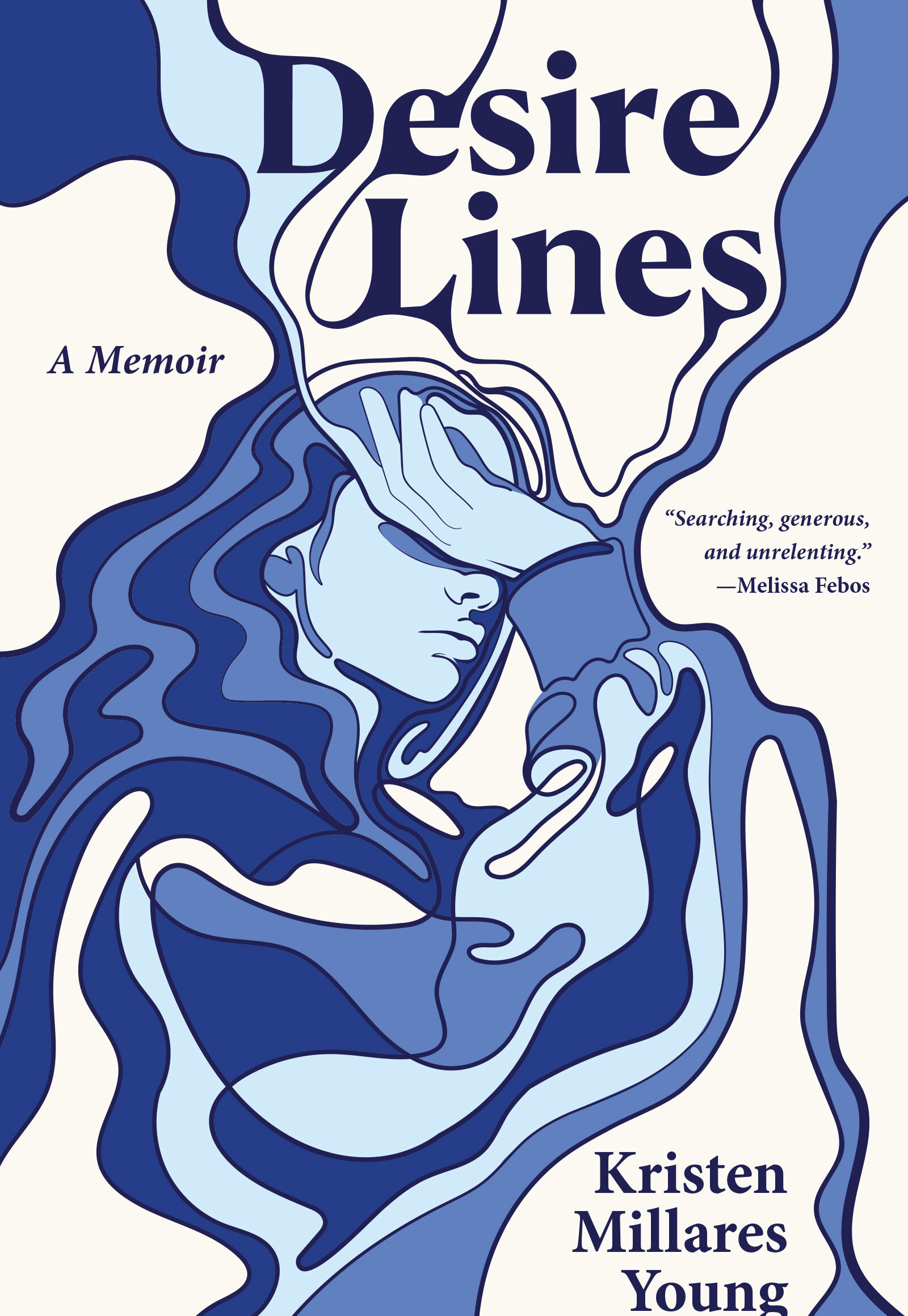
City planners have a name for the path people wear into the ground where none was built: a desire line. Between my mother and me there was such a path. Neither of us walks it now.
Kristen Millares Young is a novelist, journalist, and essayist. Her memoir Desire Lines, which Melissa Febos calls “searching, generous, and unrelenting,” is out from Red Hen Press on October 6, 2026, and was named a Most Anticipated Feminist Book of 2026 by Ms. magazine. Her novel Subduction was a staff pick of The Paris Review and won Nautilus and IPPY awards. Her essays, book reviews, and investigations appear in the Washington Post, the Guardian, and Literary Hub. A former Prose Writer-in-Residence at Hugo House and the editor of Seismic, she was in residence in 2025 at Storyknife Writers Retreat and as a UNESCO Cities of Literature fellow in Reykjavík. She was the researcher for the New York Times team whose “Snow Fall” won a Pulitzer Prize.