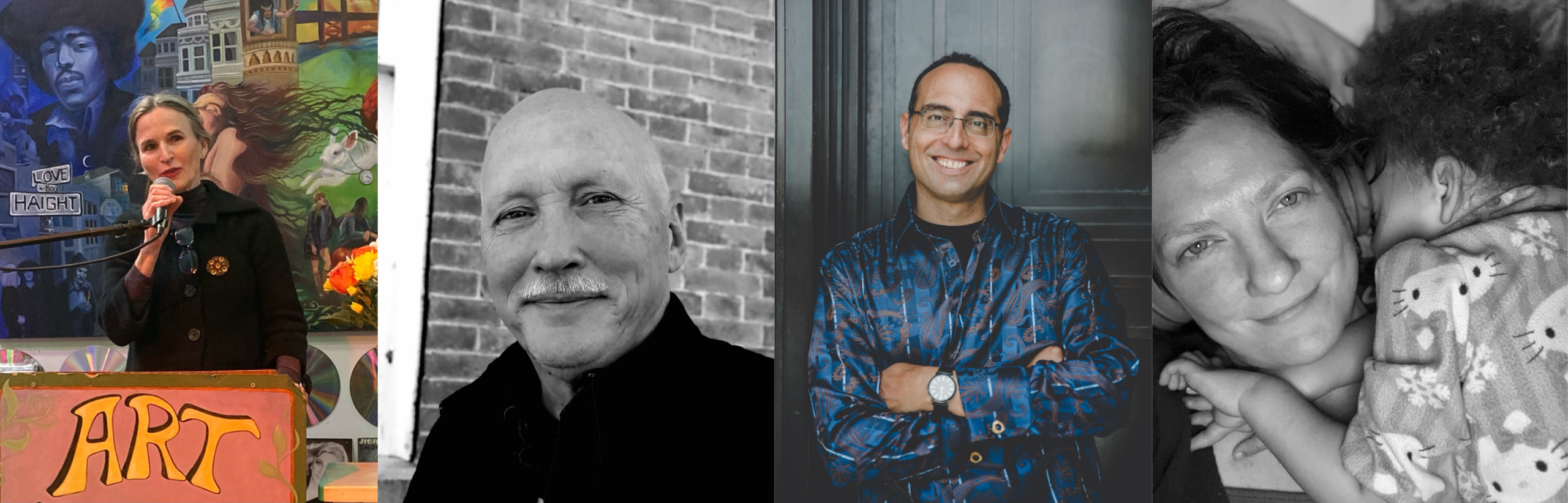
This month, we’re pleased to bring you poems by REBECCA FOUST, STEPHEN HAVEN, PHILIP METRES, and J.J. STARR-MCCLAIN.
Table of Contents:
- Rebecca Foust, “Sex, Beauty, & Freedom”
- Stephen Haven, “Revenant”
- Philip Metres, “Shadow Devotional”
- J.J. Starr-McClain, from That Would Remove

From left to right: Rebecca Foust, Stephen Haven, Philip Metres, and J.J. Starr-McClain
SEX, BEAUTY, & FREEDOM
By Rebecca Foust
after 1984
When Winston wakes into awareness of her, Julia is a burr
stuck in the pocket of his Party overalls,
picked up on some long-ago holiday outside the city
where it is still sometimes green.
The idea of her has, like the burr, worked its way through
the rough canvas to prick the tender skin
near Winston’s groin. She’s all he’s been trained to revere:
frigid baths, abstinence, absolute Party loyalty,
& he loathes her from his core. Blooming just out of reach,
she excites memories of how food used to taste,
clean water & air, plus other lost luxuries like sex, beauty
& freedom. Julia’s known many Winstons
& at first this one’s just a new challenge, a way to endure
the gray days. To her sex feels like power,
a backdoor hack, rebellion sung in a pleasure ping.
She didn’t expect passion or feeling or faith,
what pulps up the novels penned by the Fiction Department
in the Ministry of Truth. They’re like our TV,
meant to console & control the Prole population, but everyone
reads them, hungry for any sex, beauty & freedom
still being enjoyed by anyone, anywhere. Julia buys only
the books without covers, mortified by the paste-ups
of Big Brother’s petulant-toddler head onto a big-muscle body
clearly belonging to Rambo, & also by how
she still yearns to believe the back cover blurbs like Big Brother
is on your side. The only side she’s known is her own
with its Big-Brother-size thorn, but Winston has taught her
to cherish the sensation of being stabbed
by each indrawn breath, because it keeps her from forgetting
the world as it used to be—real
chocolate & coffee, tomatoes with salt, wild grapes bending
the vine. How it feels to be alone in the woods,
unwatched & untracked. How it feels to feel that way at home.
Julia is relearning the sensation of freedom.
She’s heard the thrush in the hedgerow, its slide-whistle song.
She’s lain with a man, not to make more comrades
or get better rations, but chosen from her own pure & dangerous
desire. She has lain with her lover liquid in time,
& when she dreams, it’s of Winston’s golden country, our world
before we were fascists. You remember it, don’t you?
Not for all, but for many—days of family, friends, work & play,
days like clean linen pinned to a line—
nights not spent doomscrolling or packing a go-bag. Nights not
a bare wire alternating currents of lethargy & terror,
but a time of nested rest, followed by a dawn you can count on.
That tastes not of ash, but of fresh figs & fire.
REVENANT
By Stephen Haven
Most of all I think of you whose son tucked
His father’s magnum in the only bedroom
That ever cradled him, the headboard,
The plasterboard, a map of where he’d gone.
Though I’m not Catholic, the day I heard
I lit a votive candle…. But long before
The advent of that grim moment,
You asked me to a friend’s first-floor flat,
“Stairway to Heaven” on the stereo.
I liked the song well enough but did I ever
Remember it as a frame for us? Grad school,
My first year back. You offered me
A litany of my brothers’ birthdays, common
Denominators we might factor up again
Until the original multiple raised its hand in class.
I felt touched when you, eight years married,
Squeezed my ass, tried to kiss me, you who once
Hushed my virginity. Or closer to your
First malled year, when from the down escalator
I could see, in my descent from SATs
And dormitories, your check-out counter,
Your radar flashing my in-coming. You’d ask me
For coffee then ghost me, a new-found loyalty
Promising a better hegemony. I knew from the get-go
The older kid you married. That’s what happens
In small town stories. His early morning shift,
Wherever he was working, afforded him
A second-hand “three-on-the-tree” ’63
Plymouth Valiant. In me the future gaped
Bleak as a book. Then anchored to my two kids,
Before the tragedy about which nothing speaks
Deeper than a mother’s wish, in the Grand Union,
Or was it the A&P, you studied the floorboards
When you, your husband, bumped into me. Together,
You walked the aisle as I turned the corner
Between Cheerios and Wheaties. Only he saluted
The way our boot soles crossed that holiday.
Almost to your waist, the slip of your sleek hair
Was a thick black curtain between him and me.
Now I can see, ever more clearly, your hand
Risen to your tucked chin, a smile, half laughter,
That did not dare to say hello, but carried, even then,
As if it spoke for all of us, the jolt of what someone once
Thought joy brought, a wintered immanence
Kindling in the loss.
SHADOW DEVOTIONAL
By Philip Metres
Because sun’s summer hammer stuns, addles,
Boils blood into sand, batters brain to worms,
I pray for shade, for shelter and shadow,
To lean beneath the tree’s wide underarms,
Huddle against such motherlegs, retreat
To shade’s haven, for penumbra to form
A beneath, roof that shields from hurt of heat,
Cave for your face, your unveiled skin, worn
Cloak of sable for you, eyes to dilate
In the dark of dark, an interior
Way, an inside to stay, to lie and late
To lay down your burnt brunt, your weary
Earth, and greet yourself in the closed quiet,
Clothed soft by the underside of light.
from THAT WOULD REMOVE
By J.J. Starr-McClain
(erasures)
…
i’m not living
to witness
the past
i want
to understand
can a person
understand
all i did
it did …
… forgive me …..
i can’t
any longer
hope …
i’ve been
smoking again
… the world
is a world
i can’t remember
… and you
… yes….
you’re always
another
…
…
i say again
and again
and again and again
i have been through enough
i have been as honest as i know how
i made choices
to protect you
you have no idea
the cost
i prayed fervently
i already asked
there is no
forgiveness
…
it was
i thought
compassion
that would
remove
this
ugliness
as if
these things
just one day
set
like a sun
Note: These erasures use a series of emails from my mother as the source material. As a survivor of childhood sexual abuse, the weight of her trauma made it impossible for her to sustain healthy relationships. These poems serve as a testament to what she left unsaid, both as a survivor and as a mother who struggled to maintain trust with the children she felt it was occasionally necessary to leave for their sake and hers.
Rebecca Foust’s books include YOU ARE LEAVING THE AMERICAN SECTOR: Love Poems(Blue Light Press 2026) and ONLY(Four Way Books 2022). Her poems appear widely in venues including The Slowdown, Iowa Review, Ploughshares, Poem-a-Day, POETRY, and Southern Review, winning the James Dickey, New Ohio Review, Pablo Neruda, James Hearst, and Poetry International prizes in recent years.
Stephen Haven’s fourth collection of poems, The Flight from Meaning, was a finalist for England’s International Beverly Prize for Literature and was published in 2025 by Slant Books. His three earlier collections are: The Last Sacred Place in North America, selected by T.R. Hummer as winner of the New American Poetry Prize; Dust and Bread, winner of the Ohio Poet of the Year prize; and The Long Silence of the Mohawk Carpet Smokestacks, runner-up for the Philip Levine Prize in the final year Levine served as judge. Haven is the founding director of the low-residency MFA Program at Ashland University, in Ashland, Ohio, where he led the program for ten years. He later directed the low-residency MFA Program at Lesley University. Twice a year-long Fulbright Lecturer at universities in Beijing, he has received fellowships from Yaddo, MacDowell, the Provincetown Fine Arts Work Center, and the Djerassi Foundation, as well as five Individual Excellence Awards in Poetry from the Ohio Arts Council. His work has appeared in The Southern Review, American Poetry Review, Parnassus, Literary Imagination, Crazyhorse, Guernica, Asheville Poetry Review, Salmagundi, The American Journal of Poetry, Arts & Letters, The Common, Blackbird, The European Journal of International Law, The Missouri Review, North American Review, Northwest Review, Image, Western Humanities Review, World Literature Today, and in many other journals. For more details, see www.stephenhaven.com.
Philip Metres has written thirteen books, including Dispatches from the Land of Erasure(2025) and Fugitive/Refuge (2024). Winner of three Arab American Book Awards, a Guggenheim, and a Pushcart Prize, he is professor of English and director of the Peace, Justice, & Human Rights program at John Carroll University and teaches at VCFA MFA low-residency program.
J.J. Starr-McClain is a poet from Chicago. She studied at NYU and has received support from Wesleyan University, the Community of Writers, and the Fine Arts Work Center in Provincetown, Mass. Her work appears in The Journal, Lily Poetry Review, Juked, Matter, and elsewhere. She lives in Western Massachusetts.