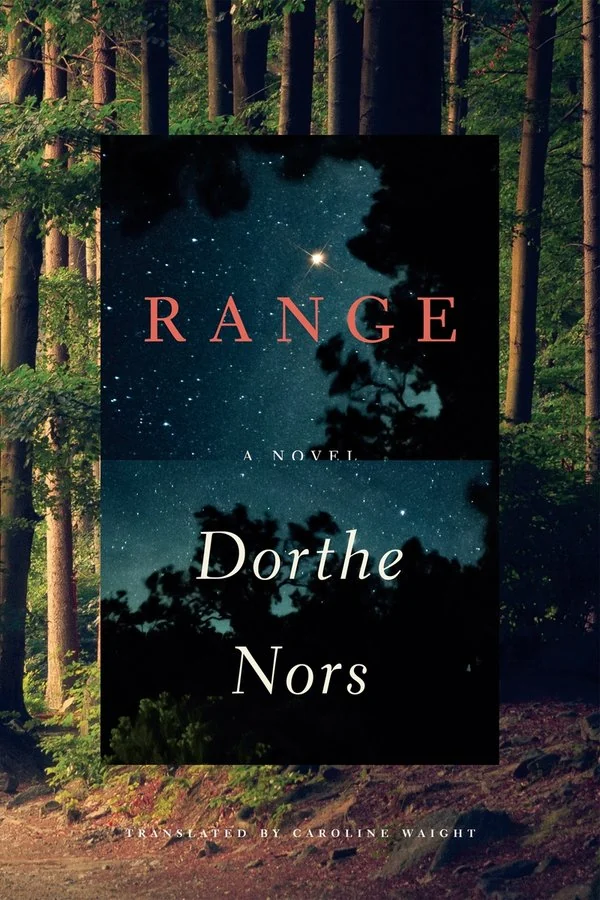
By DORTHE NORS
Review by CASEY WALKER
The story situation in Dorthe Nors’ novel Range is simple enough—Gunn Haven, astronomer, on partial leave from her university job in the city, moves out to the countryside to study the stars.
I carried the novel with me for a week through Portland, Oregon, where even on clear September nights the stars were usually less noticeable than the Vaux’s swifts rooking in the unlit chimneys. I kept thinking of other, starrier places I’d lived. The desert I grew up in, where I’d regularly drive out to sandy washes to witness meteor showers, and on other nights climb up to my roof with a small telescope and a flashlight, whose beam I’d covered with a sheet of red paper so as not to ruin my night vision while trying to read a star chart.
That part of my life is long done with. I’ve lived in cities ever since. I read Range under stadium lights, on the edge of a field of artificial turf, sometimes watching my daughter’s soccer practice, other times looking upward, trying to find any astral body at all, even a satellite.
The lines that kept crossing my thoughts were from Ralph Waldo Emerson’s essay ‘Nature,’ with its famous passage on stargazing:
If a man would be alone, let him look at the stars. The rays that come from those heavenly worlds, will separate between him and what he touches. One might think the atmosphere was made transparent with this design, to give man, in the heavenly bodies, the perpetual presence of the sublime. Seen in the streets of cities, how great they are! If the stars should appear one night in a thousand years, how would men believe and adore; and preserve for many generations the remembrance of the city of God which had been shown! But every night come out these envoys of beauty and light the universe with their admonishing smile.
Emerson’s dispatch is from a far less light-polluted era. You’re lucky anymore to see anything but the brightest stars from a city. But this sentiment still seems to me true: if the stars appeared once in a thousand years, the miracle of them would be a global furor. As it is, we waste them, blotting them out with neon, halogen, and our little blue screens.
Nors is a spare writer, and often a gloriously odd one, prone to tangents. Her voice doesn’t sound anything like Emerson, though she is equally alert to the transcendental wonder of her inquiries into both the night sky and what we could call our inner cosmos. Her sentences have a particle collider’s way of smashing small bits of the universe together to produce new configurations of thought. Here is Gunn looking up into the night:
The night sky was a paradise of signs […] a living piece of archaeology, and the longer Gunn could spend gazing out at it, the better her grasp of the root of time. Burst by burst, flock of rooks by flock of rooks, and here I hang, she thought, tidally locked for the night, with my face turned to the earth like the moon itself. I am somewhere in between them, hanging from a sewing thread, ready to fall or rise. What do I know? What do I know that I don’t know? What would I like to know?
Those last three sentences, heavily underlined in my copy, return numerous times in the novel. You could call them a refrain, but maybe it’s better to say they’re in orbit, returning regularly on a course.
Whether Gunn’s life is on course, and where she might be in her own orbit, is one of the book’s embedded questions. This is a novel of midlife: Gunn has a teaching career, and a research vocation, but she’s grown restless with seminars, university life, city life. She thinks a lot about her rejection of motherhood, and the tyranny of social beliefs around it. She’s writing a book—her contribution to the field of astronomy—but the overwhelming question at the back of her mind seems to be: Is this all there is?
And so, Gunn has moved out to the countryside, to a house willed to her by an old friend of her mother’s. The people nearest to her often seem further away than the satellite data she reads from deep space. “Gunn liked silence,” Nors writes, “but not the kind between people.” Certain of Gunn’s rural neighbors take exception to the presence of this interloping professor from the city. Is the dead bird in her mailbox one that trapped itself or one that someone shoved inside as a warning? Did her neighbor stick that ‘For Sale’ sign in front of her house as an act of hostility? Nor has Gunn made things easy for herself. She is alternately prying and solitary, suspicious of social performance and disingenuously warm, withholding and welcoming. Most of all, her neighbors’ ways are a mystery to her: “probably there was a lot there you weren’t supposed to ask about, a whole set of values you could fall foul of,” she thinks. “Unwritten rules, vague kinships, old alliances. You couldn’t know, or she couldn’t.”
Flitting across Gunn’s mind at regular intervals is a student she calls ‘the boy,’ with whom she is emotionally entangled. The exact contours of the relationship between them are, for long stretches of the novel, murky—has something untoward happened between them? Is that why Gunn is on partial leave from the university? The novel, or Gunn, remains evasive on this point. Whatever has happened between them, Gunn has known the boy since he was young, and feels for him a semi-parental affection and responsibility she has a hard time naming or drawing boundaries around. On the few occasions we see her return to the university, she evades any question she is asked about the boy by colleagues and acquaintances.
What we do know is that she has sent the boy away to wander the world for himself and that she is paying for his trip, both materially and emotionally. The boy is under strict orders to only contact Gunn with his coordinates, and every message from him sends her to a computer, where she plugs in the numbers to track his movements, as she would an astral body. She discovers that he is transiting westward across the United States, a movement which gives the novel, otherwise rooted in the Danish countryside, a small seasoning of the American frontier and its latter-day inheritor, the American road novel.
I don’t really need to tell you, at this late date in literary history, that Nors’ novel doesn’t boil over with tightly-plotted incident. We’re well over a hundred years into the turn away from burning plotty fossil fuels to power novels’ engines. The sunlight and shadow of consciousness, the powers of patterning and motif as against Freytag’s pyramid of inciting incidents and denouements, narrative momentum built on fractals of memory or unhinged monologuing or deep, quotidian description—this is the well-established terrain of novels not sold in airports. I could probably have also just said Nors is Danish. Novels from Denmark have, in general, drifted much further from 19th-century story entanglements than American ones.
Even meditative novels, though, need to find ways to keep the pages turning—a novel still deals in narrative, after all. What powers Range from page to page is a constant push-and-pull between the telescopic and the microscopic. It’s a book where cow shit and starlight inhabit the same page because they are part of the same universe, where when water is put to a boil for spaghetti we are also reminded that if a human body were to approach the event horizon of a black hole it would be stretched into long strands resembling those noodles. The shifts in scale between these two realities—which are, in fact, the same reality—are most arresting when they are juxtaposed: “now the tractor’s headlamps are lit, and all across the universe there are suns collapsing and exploding.”
This stylistic feat of the book, the oscillation between microscope and telescope within the same sentence, gives the novel a sense of cosmicity that deepens everything Nors turns her gaze to. Gunn is equally preoccupied by gamma-ray bursts and the annoyingly deep tire ruts the farmer next door is leaving on the old milk run path with his tractor. Her mind is set on the stars, but she never leaves this earth.
There has been a small spate of well-regarded literary novels about outer space of late—Samantha Harvey’s Booker Prize-winning Orbital, Richard Powers’s Bewilderment. There’s also a boomlet of novels-of-dailiness from Scandinavia now appearing in English translation—think Knausgaard’s My Struggle or Solvej Balle’s On the Calculation of Volume. Nors’s book is a kind of interweaving of these two forms—the astral and the quotidian—though when compared with her fellow Scandinavians she is far more reticent than Knausgaard and plain weirder than Balle. What Gunn’s narrative voice reminded me of most was David Markson’s novel Wittgenstein’s Mistress, narrated by a roving woman who might be the last person on earth, or who might be losing her mind. Gunn possesses the same oddity, intelligence, and loneliness you find in Markson’s narrator. Gunn talks to her plants. She spies on people. She escalates a potentially dangerous feud with an unhinged neighbor, pushing it towards crisis. She hides in the woods with a borrowed cake dish, waiting for a moment an acquaintance is otherwise occupied, so she can leave the dish on the porch without having to knock and make small talk. She lines up her groceries on the checkout counter so that they make neat geometric forms.
What gives the novel its sense of tension and release, questions posed and, if not answered, then at least reconfigured, is best described as a structure of orbits. Bits of language return, recurring ideas about surveillance and privacy, explorations of country sociality and city impingements, meditations on deep time and the moral necessity of curiosity. All of these preoccupations revolve on a course, as the stars and planets do, but also the way our thoughts do, as we lie awake at night. As Gunn studies gamma-ray bursts from the earliest universe, she wrestles with the basic understanding that people go away from us, and they have to, and we miss them, and no amount of looking into the universe will ever make that any easier.
Range gave me one of those reading experiences that feels like standing at the cusp of an enormous mental reconfiguration. “What was all this for?” Gunn asks, though not because she believes such a question is answerable. If there is a central question around which the novel orbits, it’s this: There are billions of stars out there, and there are billions of neural connections within us, and we are caught between these twin entanglements. So what, then, must we do?
Emerson believed that in looking at the stars we might find “the perpetual presence of the sublime.” In Range, that notion turns inward. Sublimity becomes not just something we witness in the stars, but something we find in ourselves as we desire to look, as we try to understand. The novel suggests that curiosity is a moral value unto itself, even, or especially, when it can’t be satisfied.
“Curiosity above all,” Gunn says, and I can’t think of any better mantra. Sublimity is in the questions.
Casey Walker’s new novel Mexicali is forthcoming from Knopf in 2028. He is the author of the novel Last Days in Shanghai and has published reviews and essays in The Believer, The New York Times, and El País, among others. He holds a PhD in English Literature from Princeton University and an MFA from the Iowa Writers’ Workshop.