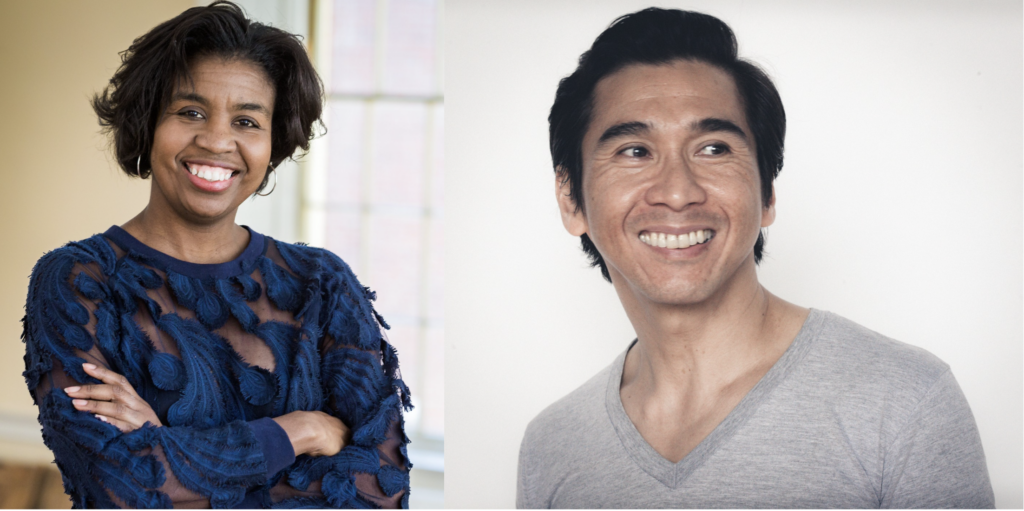
January O’Neil (left) and Joseph O. Legaspi (right)
In the mid-90s, JOSEPH O. LEGASPI and JANUARY O’NEIL met hovering over a cheese plate at the graduate school orientation of NYU’s creative writing program. They have been friends and champions for each other ever since. On the recent release of Joseph’s third full-length collection, Amphibian, the two formally met on Zoom to discuss the book, persistence, survival, legacy, and the long arc of their friendship.
January Gill O’Neil (JGO): The title Amphibian feels like a key to the entire collection. What does an amphibian allow you to explore?
Joseph O. Legaspi (JOL): Amphibians, of course, are a class of vertebrate, ectothermic animals that include frogs, salamanders, and newts—creatures that initially start life in water and, as they grow, move onto land. The idea of this book is to explore what I call “amphibious living”: being able to live, survive, and thrive across these different landscapes. When I think about “amphibious living,” it extends to how immigrants live, and, by extension, how queer people live—in a way, the sum of me. How do we find ourselves in very different terrains, constantly? And we’re always navigating them. How do we maneuver in those spaces?
JGO: It seems like in this book you’re comfortable in many spaces, with many ideas of home. One thing I admire is that you never settle into a single version of it. It feels very fluid, something you work hard for but it’s also elusive. Did writing these poems change your understanding of belonging? I was rereading this morning and thinking about the line in “Feasting”— “This country’s foreign to me, but I’m not foreign to it.” That feels like a theme running through the whole book.
JOL: I love this question. The seed of this book was sown during my Fulbright months in the Philippines in 2015, my first extensive return to the country of my birth. I view it as reverse immigration: a one-point-five-generation boy who at twelve immigrated from the Philippines to America, lived on American soil for thirty years, and then returned to the motherland. What does a “return” do to you, psychically and emotionally? When I went back, I knew I was no longer a full-fledged Filipino, and what does that even mean? But I also knew I was not a full-fledged American, and what does that mean? I brought my husband, a white man from Nebraska, and I observed how he was treated, how he maneuvered the tropics. So the sense of home—there’s fluidity to it. As that quote says, there was a foreignness I felt trudging through those islands, but also an innate sense of belonging. I felt culturally comfortable, able to interact. And yet there were many instances where I felt off—the Philippines a jarring, puzzling place.
JGO: I was thinking that this is a book for now. Those questions of immigration, of reverse immigration, of connection and disconnection. I wonder what you would have written if you were starting this book today. How different are we from when you did your Fulbright?
JOL: This book is almost ten years in the making, from conception to publication. Since then, the world has imploded. The way immigrants are treated now—it’s always been there, but right now it’s so much more public, intentional, and weaponized. The animosity and suspicion toward immigrants have been adopted at the highest political levels. Art is my way to express and hopefully counteract the narratives. That’s why I think this book, beyond the personal, will resonate—those connections of family, and memories of home. I think I have overtly political poems in the book, as well. “Manongs’ Lament” traces the early immigration of Filipinos to the West Coast. What I’m trying to do with Amphibian, more so than in my earlier books, is let the personal and the familial branch out into larger perspectives: environmental, political, cultural. It questions citizenship, borders, and who belongs where. It turns to nature for evidence of belonging, evidence that immigrants and queer people are natural states of being. That’s the whole idea of the amphibian: being able to live in various terrains.
The animosity and suspicion toward immigrants have been adopted at the highest political levels. Art is my way to express and hopefully counteract the narratives.”
The book is divided into five sections: Land, Shore, Water, Ether, and Air. Land is grounding, something readers can immediately be familiarized with. Shore is the in-between place, leading to Water. And then the final two sections, Ether and Air, tend to be more ethereal. The skies show the magical, irrational aspects.
JGO: Do you have a favorite poem or two in this collection? Now that the book is out and you’re reading publicly, have your favorites evolved?
JOL: For the record, they’re all my favorites. They’re all my babies. But two in particular I feel do really well in public. The first is “Hamburger.” I love reading it live. There’s such a buildup, such momentum, and it’s a deeply political poem. When the ending lands, I can feel the audience with me the whole way. The poem is quintessential me: personal and familial, which comments on the larger American scope of immigration and belonging. And with the L.A. Olympics coming in 2028—I already have tickets!—The poem feels like a full circle for me.
The second is “Kissing My Father.” I’ve only read it a few times publicly because I always think I’ll hold it together, and I never do. It’s about my father’s funeral in 2003. The poem was a hard birth, maybe even a Caesarean birth. The poem was always in the ether of my mind, requiring multiple attempts over the years, and it didn’t really culminate until two or three years before the book came out.
JGO: I love it because you’re saying the unsayable—the taboo thing you’re not supposed to say about a complicated relationship, the love and responsibility all bound up together.
Let’s talk about a form that you’ve used a few times in Amphibian. I teach zuihitsu more as a lyric essay—it’s a way to ease students into writing. But could you talk about how you came to the form? Did you start writing and then realize, wait, I have a bunch of zuihitsu? Or did you decide you wanted a consistent form throughout?
JOL: I didn’t choose the form; the form chose me. I know that’s a cliché, but it’s true. It came to me during the pandemic. For readers who may not know: zuihitsu is a Japanese form consisting of loosely connected fragments, written in a kind of stream of consciousness with a brush-stroke effect. During the pandemic, I was just writing fragments. That was all I was capable of. I couldn’t put anything into cohesion or totality because, well, we all couldn’t understand what was going on. A plague comes, what, every hundred years? And we happened to be here for it.
I was reading Kimiko Hahn, who has written a great deal in this mode, and I thought, Wait. I needed a governing device for all these fragments. The zuihitsu was the connective thread. The fragments were like pieces of branches from the same tree floating down a river. Of course, ironically, the pandemic is the governing subject.
There have been discussions about whether the zuihitsu is a poetic form or a lyric essay—I get it either way. I also love the prose poem, and the square form of these poems felt right because there was little or no room to breathe during the pandemic. You were contained in that block.
“Zuihitsu: Jackson Heights, Spring 2020” actually originated as a commissioned piece. Daniel Simon, the editor of World Literature Today, asked multiple writers to do a kind of reportage on the places they were during the pandemic. The original version was more extensive, witness-driven, and a documentary, a hybrid. For the book, I pulled out most of the documentary materials and concentrated on the lyrical aspects. So a poem really can have a second life, re-formed and reimagined.
JGO: I’m struck by how often the poems move between the personal and the collective. In poems like “Eye” and “Sketches from a Childhood,” a family story suddenly becomes a national story; a storm becomes a meditation on diaspora. Is that movement instinctive for you, or something you work for in the craft?
JOL: I don’t think it’s instinctive. I mean, instinctive in the way I innately believe I am not separate from the world. But I also intended to explore themes in Amphibian: one was the idea of movement itself—what movement is, the crossings of borders, the transfers of bodies and what it costs, for immigrants and queer people especially. In “Eye,” the point of view is that of a Filipino American removed from the devastation of the motherland. So it’s this kind of benign, powerless witness to a catastrophe. There’s tension there: a sensationalism in how devastation is rendered in American media versus what it is actually like on the ground.
JGO: At what point did you realize these poems were working together, that there was a book? Was it early on when you were shaping it or when you turned it in?
JOL: Early on, I had a good sense of the themes I was exploring, my particular obsessions. How the natural world itself is the pure evidence for belonging. “Amphibians,” the title poem, definitely became the anchor, the main driver of the collection. The expansion of those themes and how to organize them into a book came later. I didn’t have the five sections until the second or third round of sending the manuscript out. In my revisions, I knew I needed an organizing principle. Places and landscapes came to the fore. Some placements are obvious—“Eye” goes in Water, of course. But then I had this grouping of more surrealist, ethereal poems, and Ether is not really a location in the traditional sense. It’s the absence of location. It’s the otherness, the liminal space. “Family, an Ars Poetica,” which opens that section, lives in the mind. Maybe the mind is its own location?
And Air. I really wanted the book to float. To be in an atmospheric, heavenly plane by the end. The final poem, “Amphibians,” ends with rain, “completely at home / in the rain.” Rain is the intermediary of all these landscapes: it falls from the sky, it’s water, and it pelts and soaks the earth. It covers all the grounds.
It questions citizenship, borders, and who belongs where. It turns to nature for evidence of belonging, that immigrants and queer people are natural states of being. That’s the whole idea of the amphibian: being able to live in various terrains.”
JGO: That’s beautiful.
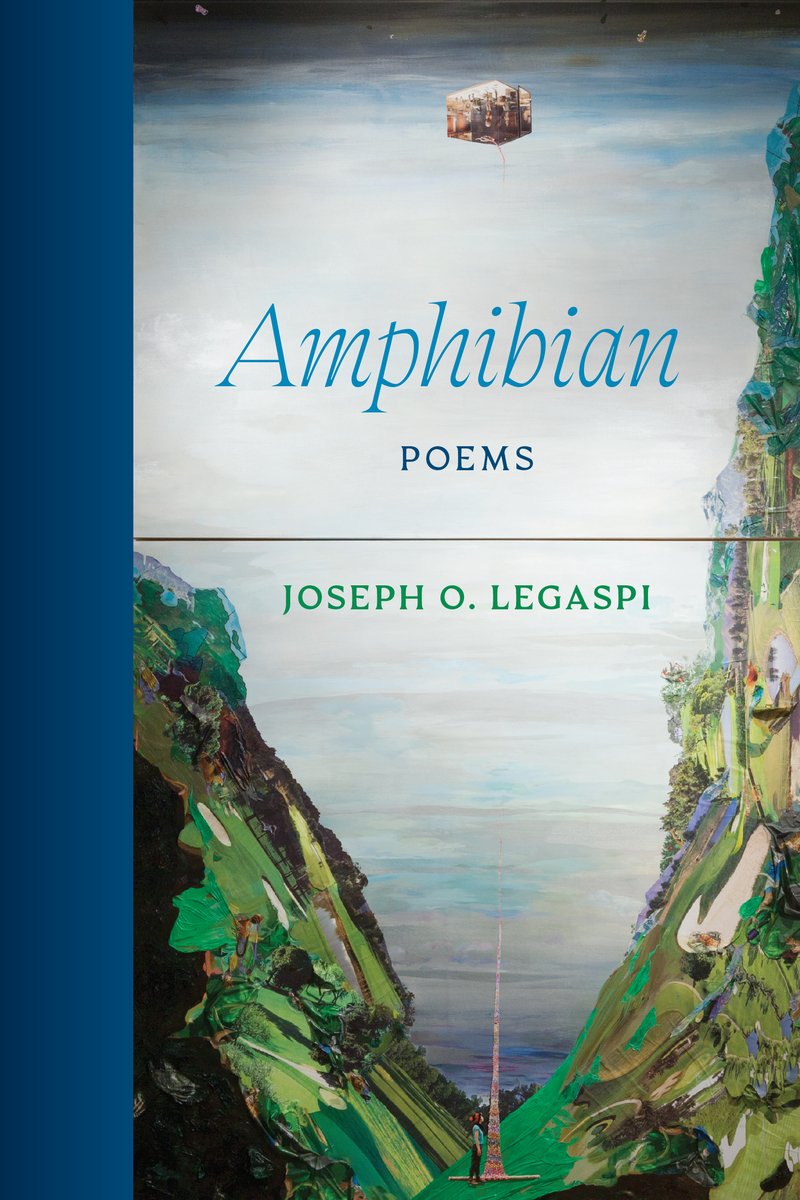
Let’s talk about the cover. Covers can determine whether a reader picks up a book, and we have to live with them. Tell me about this one.
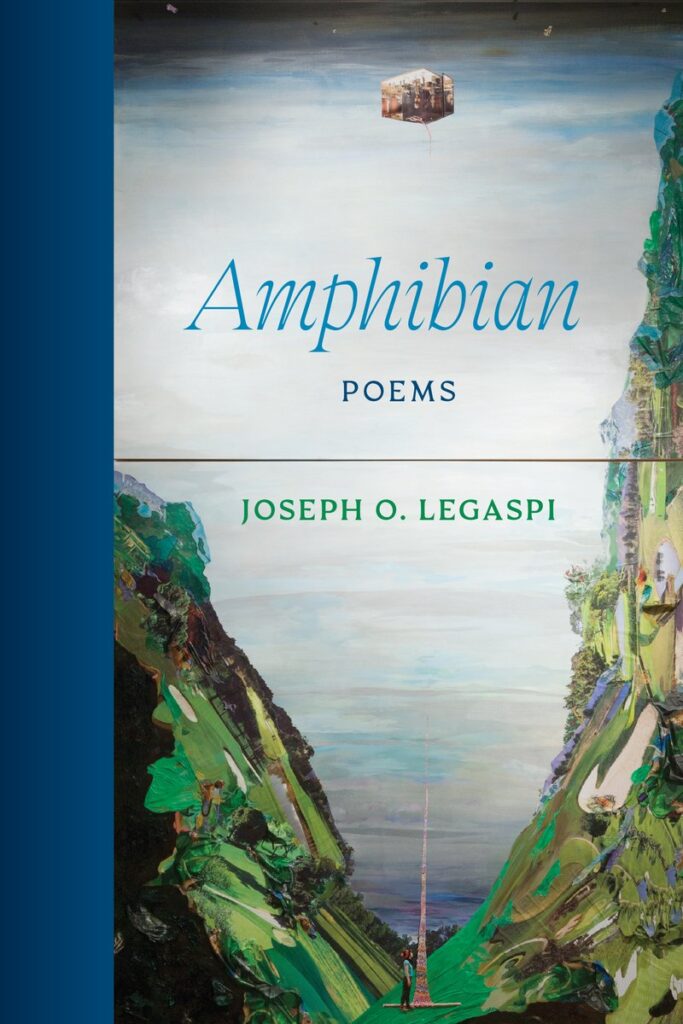
JOL: I love this cover. It’s by Camille Hoffman, a Filipina American visual artist based in New York City—very talented. She was actually suggested by my husband, David, and he forwarded me the image, and I immediately thought: That’s it! The piece is multi-elemental—mountainous, watery, oceanic, forested, layered, ethereal, and surreal. It encompasses all the terrestrial, emotional, and psychological landscapes in Amphibian.
JGO: It’s been thirty years since we were at NYU. You’ve published several books and have become such an important part of the literary community.
JOL: I’m heartened by the fact that you and I persisted. In our writing. In publishing. In being literary citizens. We each have our own separate lives, our families, full-time employment. For us to have centered our lives in poetry is astounding to me. I feel like wherever I turn up, poetry will be there. That’s comforting. More than comforting: centering.
I’m grateful for NYU, for Sharon Olds, Philip Levine, and Galway Kinnell, who are still very present in my everyday life. I think the appreciation for this craft that we gathered from NYU compelled us to serve this community. You’ve been on boards: AWP, the Massachusetts Poetry Festival. You’ve built communities, local and national. I’ve tried to do the same. What people don’t always see is the unpaid labor, hard work, discipline, faith, and sacrifices in terms of our own writing time. There were years when I wasn’t writing because building a community was what felt most important. The toil and trouble. It’s not seen.
JGO: I often say it takes a lot of work to make things look seamless. Nobody realizes how much effort goes into putting something together. And weirdly, that’s how it’s supposed to be. You never really get the credit. But the work you put into the literary community just goes beyond you, which is an amazing legacy to give the next generation.
JOL: Drop the mic. We still have a ways to go, so who knows what’s next.
JGO: We’ve known each other long enough to have seen each other through multiple hairstyles, apartments, relationships, jobs, and books. What’s one thing friendship has taught you that poetry couldn’t?
JOL: A good friend travels with you. Movement. We’ve known each other for thirty years. We’ve seen each other grow, succeed, and fail. Poetry is great. But a poem encapsulates a certain moment, a certain image. A good friendship—our friendship—has endured and traveled through time and space and places. We still like each other. We love each other. It’s not ephemeral. And a good poem is never ephemeral either, but in a way, it’s contained. Our friendship has had a trajectory, and it’s ongoing. It circumnavigates.
January Gill O’Neil is a professor at Salem State University and the author of Glitter Road, Rewilding, Misery Islands, and Underlife, all published by CavanKerry Press. Her work has appeared in The New York Times Magazine, The New Yorker, Poetry, The Nation, and American Poetry Review.
Joseph O. Legaspi authored the poetry collections Amphibian, Threshold and Imago, and three chapbooks: Postcards; Aviary, Bestiary; and Subways. A Fulbright and New York Foundation for the Arts fellow, he cofounded Kundiman. Legaspi works at Columbia University, teaches at Fordham University, and resides in Queens, New York.