April is poetry month! To kick it off, we have new poems by our contributors, CARSON WOLFE, BENJAMIN PALOFF, and JEHANNE DUBROW!
Table of Contents:
—Jehanne Dubrow, “Encounter” and “Winter Rye”
—Benjamin Paloff, “Of the Art of Conferring”
—Carson Wolfe, “I Rank Places by How Much They Charge for Pringles”
Encounter
By Jehanne Dubrow
I am walking the new neighborhood,
passing the lawn signs that promise
to make something great again. There are
thrushes in the trees like grumbling foliage.
There are trashcans openmouthed.
For years, I’ve been drafting a book
about trauma, how words may form
a likeness of the mind that’s torn—
the past tears easily as paper, I write.
And don’t the leaves on the ground
resemble ripped poems, as if the weather
keeps trying to find the right phrase,
all those crumpled revisions of the seasons.
The red flags are flapping on the block.
But I favor the gesture of birds hunched
over branches, the insistent blue of their wings.
Today, I will finish the book about trauma.
I’ve spent all afternoon looking for more
fragments, these perforations, I write.
In our country, poets aren’t killed for poems.
They aren’t sent to prison. But in the cities
of my childhood—Warsaw, for instance—
a poet would describe a ceaseless field
to mean the state, its silence overgrown,
the blade that cuts all stems to the same height.
Near the end of my book, I write
it’s easy to forget everything else but grief.
I think we should remember the Polish poets
smoking their black-market cigarettes,
burned stanzas between their lips.
They could stare across grassland to see
what was winging up ahead, birds
and their fabled voices, glass splinters of song,
in the distance, a creature running,
this small resistance among thorns.
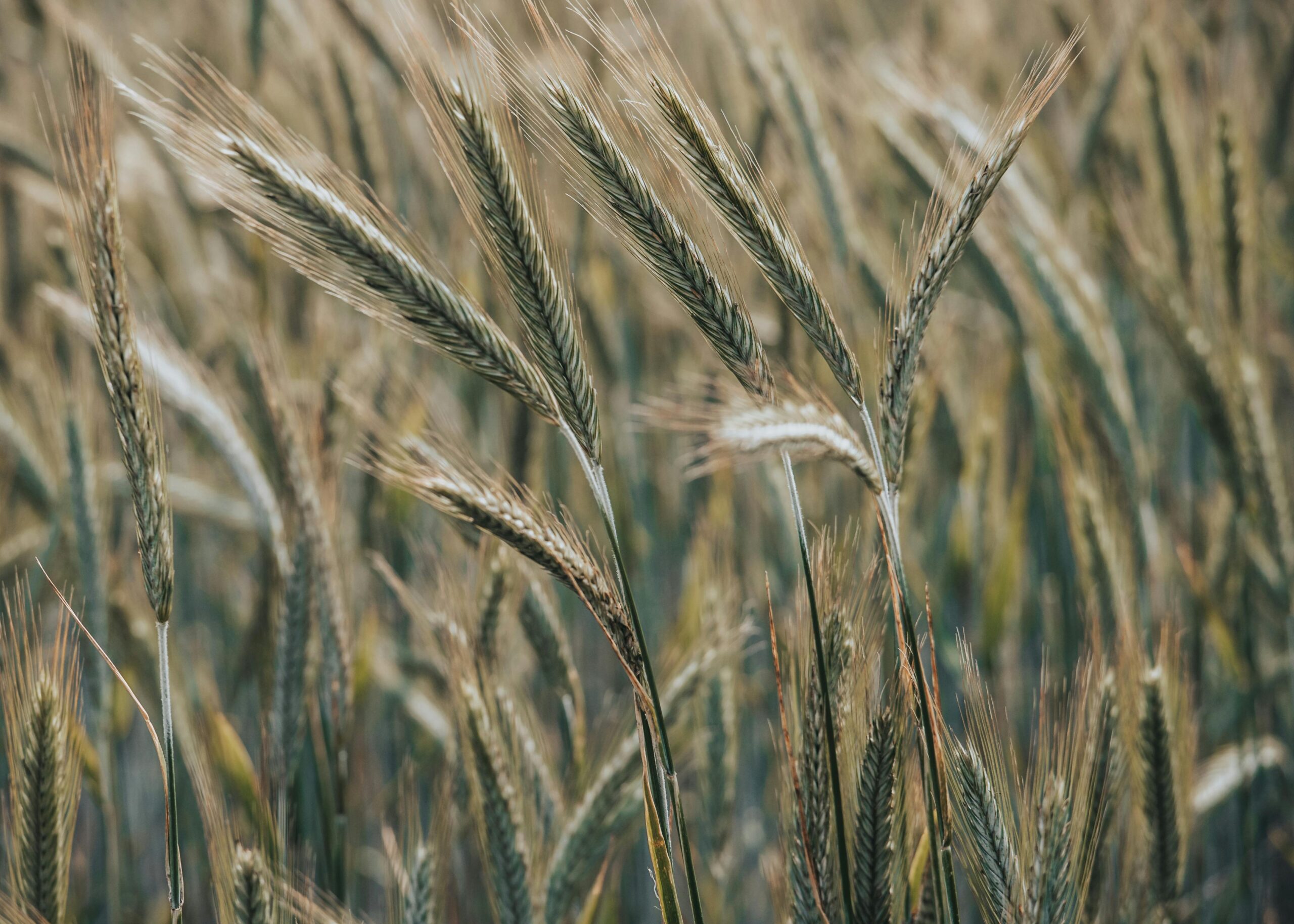
Winter Rye
By Jehanne Dubrow
We seed the ground in October
with cereal rye as it’s known,
the soil like a barely curving bowl.
For weeks, there’s nothing
but uncertain earth. And we worry
the autumn rain might wash away
this hopefulness we’ve sown,
we who so often watch the basil
wilt into rot—no matter how we try,
the plants overtaken with spider mites,
their small passion for devouring,
their webs like delicate wires—
until all we can do is dig up
the dead things. But a month in,
we find the first green threads of rye.
Like the green of caterpillars.
Like a green lacewing held steady
on a branch. Or the prophetic green
of hummingbirds hovering,
brief angels in the garden.
The rye stems are soft beneath
our footsteps, deep-rooted,
we read, and resilient. All season,
the green surface keeps catastrophe
from eroding what is left.
Of the Art of Conferring
By Benjamin Paloff
for Anton Shammas
| Having written so many hundreds of letters of recommendation, each shadowed by my fear of repetition, of the inevitability of repetition, that I could measure out my life, or a part of my life, in letters of recommendation, in wincing at the half-imagined echo of coffee spoons I’ve mostly given up, having lived now so many letters of recommendation that I have to stay mindful, mindful of sugar, mindful even of artificial sweetness, while also avoiding the bitter, the dry, the overly oxidized and employing increasingly laboratory methods to make things right, doing the right thing, yes, but also doing the thing the right way, while talking, self-consciously talking around the appearance of snobbery, so that at least whomever I am recommending now, because they ask, if they ask nicely, and they keep on asking, with or without enough lead time, will not sound, not that anyone would read such a letter aloud, or maybe even to the end, like everyone else I have performed this ritual for, or like me, after all these letters still asking for more, more present in scattered filing cabinets and hard drives than I could ever be in offices one need not have a letter of recommendation to enter, a suspicious character who, to enter, must be introduced, referenced, certified, legitimated, by the naturalized construction worker in recovery, the partially sainted target of the secret police, the fashionably unfaithful and various painters of continents they’ve abandoned, each of the persons referenced above worldly and having assumed, through the letters of recommendation their teachers have written for them, titles then entitling them, and even requiring, that they write the letters I have signed away any right to see, so that I not appear to be the suspicious person I remain, irreparably, in the unshakable feeling that I have disappointed them all. |
I Rank Places by How Much They Charge for Pringles
By Carson Wolfe
On the island of Exuma, they’re imported
to Georgetown and cost eight dollars American.
Tourists will pay these prices, as would I,
if I could have. A small trade for familiarity.
As a kid I had a pink glittery case to protect
them from being crushed in my lunchbox.
My nanna put the Original Flavour out for nibbles
every Christmas. She was on her deathbed
in England while I was with a man old enough
to be my grandfather. He paid for my tropical passion
salad, side of plantain, bahama mama, a tube of sour
cream & onion. Once you pop you can’t stop.
We sat alone on the terrace of my rental,
there was no light on that island when the sun
went down. He cupped my face with both hands,
kissed me so hard his stubble dented my cheeks.
How lonely he was, how delicate my neck felt,
head gripped in his hands like a Grecian urn,
Pringle tube on the nightstand, thick and green,
like a wad of Benjamins. I know a guy who tips
his upside down, shuffles his Pringles to the top
for clean and easy picking. I stick my arm right
to the bottom, seasoned to my elbow, lick my fingers.
Jehanne Dubrow is the author of three books of nonfiction and ten poetry collections, including most recently Civilians. She is also the author of The Wounded Line: A Guide to Writing Poems of Trauma and serves as Editor of “Writing From Trauma,” an interdisciplinary series of craft books published by University of New Mexico Press. Her writing has appeared in New England Review, Southern Review, and Ploughshares. She is a Distinguished Research Professor and a Professor of Creative Writing at the University of North Texas.
Benjamin Paloff is the author of the poetry collections And His Orchestra and The Politics, and of several nonfiction books, most recently Worlds Apart: Genre and the Ethics of Representing Camps, Ghettos, and Besieged Citiesand Bakhtin’s Adventure: An Essay on Life without Meaning. His third poetry collection, vs. Computer, is forthcoming from Archimboldi in 2026.
Carson Wolfe is a Mancunian poet and Grand Prize Winner of The Disquiet Literary Program 2024. Their work has appeared with POETRY, The Rumpus, The Common, and Rattle, amongst others. In 2023, they won New Writing North’s Debut Poetry Prize, received awards from The Aurora Poetry Prize, The Edward Thomas Fellowship, and were longlisted in The Poetry Society’s National Competition. Their book Coin Laundry at Midnight, is forthcoming with Button Poetry in spring 2026.