By YANG JIAN
Translated by STEPHEN HAVEN and LI YONGYI
They said:
“Tear off the erhu strings,
Smash its body.”
We ended up without music.


By YANG JIAN
Translated by STEPHEN HAVEN and LI YONGYI
They said:
“Tear off the erhu strings,
Smash its body.”
We ended up without music.

By DAVID LEHMAN
The drill instructor was not in a good mood. He had had a mi-
graine all weekend. The weather sucked. He hated sports and there
were going to be no pleasantries about the Yanks, the Mets, the
Knicks, the Nets, or any other team. He knew as I knew that every-
thing depended on one thing: the book. You went by the book. Fol-
low orders and stay out of trouble.

By MAZEN KERBAJ
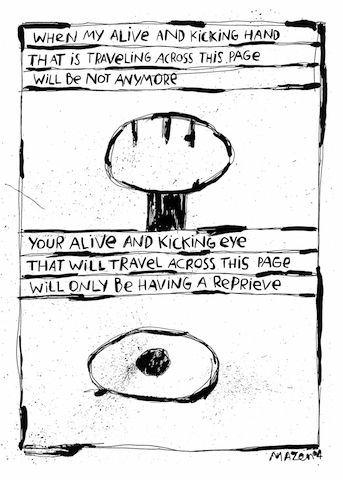
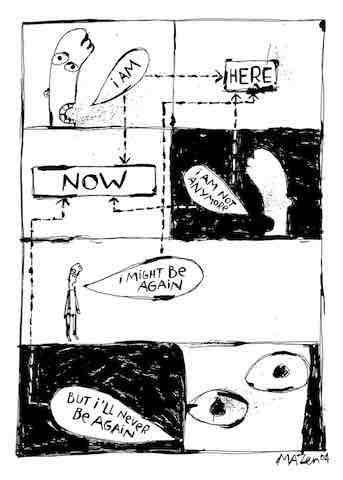
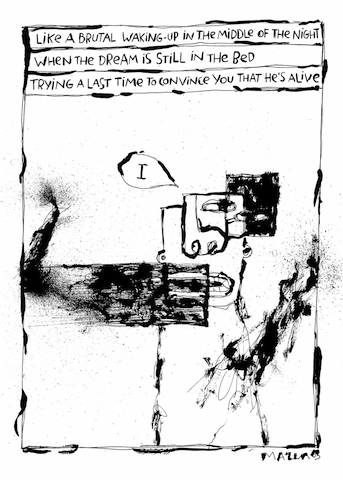
Mazen Kerbaj is a Lebanese comics artist, visual artist, and musician born in Beirut in 1975. Kerbaj has authored more than fifteen books. His work has been published in anthologies, newspapers, and magazines, and translated into more than ten languages. His paintings, drawings, videos, performances, and installations have been shown around the globe.

By BEN SHATTUCK
On Nantucket, eighty-year-old Connie Congdon and I sat in her dim living room looking at the 120-year-old plaster dildo that a mason had found in her chimney. It now rested in a pink dress box on her lap. At my feet, three sweet-faced Australian shepherd dogs snapped at houseflies. A catbird sang in the street. Her house is an old colonial buried deep in a nest of lanes in the historic downtown.
Connie said she usually kept the box in the pantry, near the urn of her daughter’s cat, Spanky. In the box were the other antiques the mason had found with the dildo: six charred envelopes from the 1890s addressed to Captain James B. Coffin; letters from the same James B. Coffin to Grover Cleveland and Assistant Secretary of State Edwin Dehl; a dirty and frayed shirt collar; a pipe that still smelled of tobacco when I fit my nose in the bowl; and a green glass laudanum bottle. These items must have been hidden in the chimney by James’s wife, Martha “Mattie” Coffin, sometime between when the letters were dated and when she died in 1928. The fireplace was later sealed up, and a closet was built in front of it. With these valuables, Connie kept a CD recording of her late husband, Tom, being interviewed about the dildo for Nantucket Public Radio. “It’s the only recording I have of his voice,” she said.

On the same side
turn a car
into a parallelogram,
an oft-read Bible,
a shelf of books
with a few
missing, a man
sitting and a woman
standing. Her hand
is on his shoulder.

Sara London reads her poem “Basta” from Issue 09 of The Common.

By EDIE MEIDAV
Sinking lower in the club’s hot tub and today a birthday marks his face one notch less recognizable when anyway, meeting someone these days means who you say you are matters both less and more. Who cares, really? Get older and it becomes easier to say who you are not. No king of industry, that myth abandoned before anyone finished saying Constantinople, but who even says Constantinople anymore, such flourish abandoned in his particular past as a history major, an epoch in which windmilling toward the future seemed to matter, toting around the flag of belief that what happened before could actually help you later. Now just a service-minded bumbler close to retirement going around to enlighten the masses and so what if certain efforts fizzled? Could happen to anyone.

This is how my mother tells it. Jesse Owens taught her to run. I am thirteen. I have just come back from track practice. I have no skill at anything athletic. But junior high for me has been a series of attempts to assimilate. That year in the yearbook, there isn’t a club I’m not in—Chess Club, Stamp Collecting, French Club, Honors Society—and because track is the only sport you do not have to try out for, they’ll take anyone, I sit in the front row of the photo, a dark spot in the expanse of white faces.

My relationship with Joni Mitchell and her music moves through two stages. My early admiration for her—in the seventies—in some ways anticipated the zeitgeist. Then I stopped listening to her for about a quarter of a century. I began to rediscover Mitchell’s work in the new millennium, when, by coincidence, so was the rest of the world.

Don’t miss an issue! Subscribe to The Common.