My relationship with Joni Mitchell and her music moves through two stages. My early admiration for her—in the seventies—in some ways anticipated the zeitgeist. Then I stopped listening to her for about a quarter of a century. I began to rediscover Mitchell’s work in the new millennium, when, by coincidence, so was the rest of the world.
Issues
The Common Statement

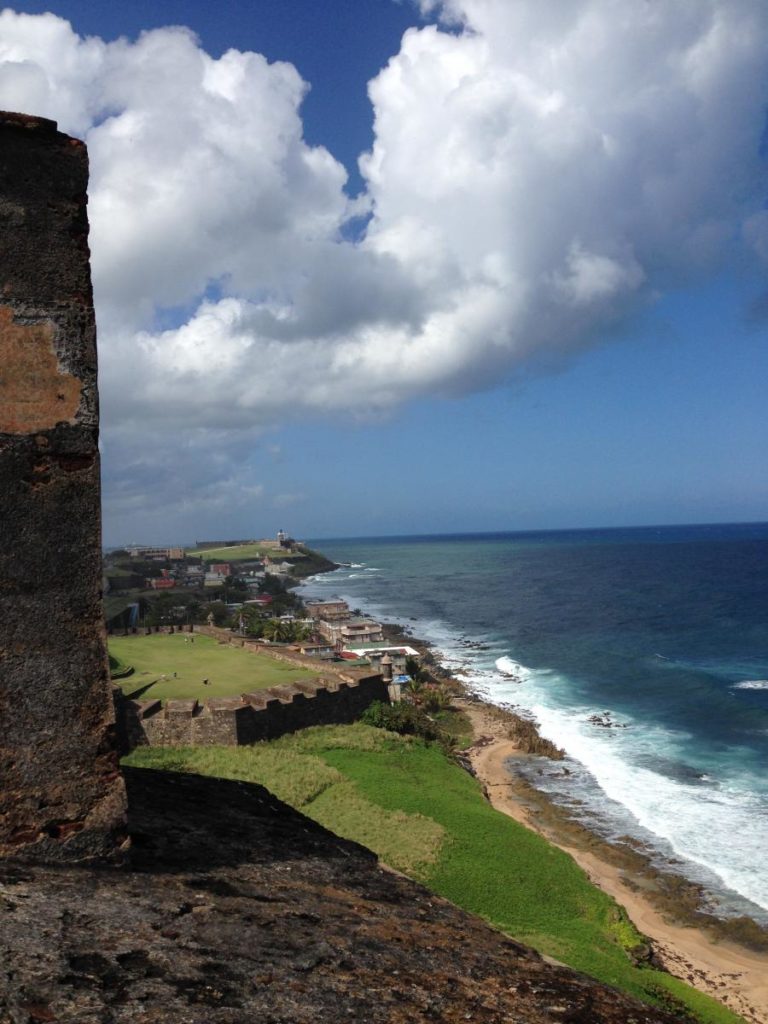
El Morro guards the northwestern tip of the old city, a headland with sparkling three-sixty views. Poised to fire cannons and guns against approaching sea invaders, the stone castle—six zigzagging levels, walls thick as hallways—was built by the Spanish starting in the early 1500s. El Morro protected Spain’s “porto rico,” the harbor crucial to any European empire seeking a foothold in the resource-rich Caribbean basin. But while El Morro protected San Juan from a seaside attack, the city’s eastern flank remained exposed to ambush by land, a weakness exploited by the British in 1598, then the Dutch in 1625. The Dutch succeeded in burning the city to the ground, but no one ever captured El Morro, whose now pleasant grassy lawn was, several times over, a bloody battlefield. After these near catastrophes, Spain began a second fort, Castillo San Cristóbal, at the city’s northeastern headland. Spain held Puerto Rico until the Spanish-American War, when the U.S. intervened in Cuba’s struggle for independence. During a few short, calamitous months in 1898, Spain lost to the U.S. its Pacific and Caribbean lands, including the Philippines, Puerto Rico, Guam, and, temporarily, a nominally independent Cuba. An empire of nearly four hundred years dissolved like cobwebs in rain.
Bone Almanac
That black telephone would ring and ring,
fixed to its wall. It was a ring that roamed
the mind, while night drummed down
its list of last and lost events, circadian
paths that tangled where they tried to pass,
crossed and uncrossed hours.
Some Proof of Love
Dear little day later,
Can’t you keep up?
There is no going back
so don’t insist. The view’s bound
by the block, fenced for now
but then will come
and new alarms
will set off and stop.
The Ice Hotel
I love you, I say, after the quarrel but before
falling asleep. And within that small victory
I can feel my chest muscles tightening,
as my breath rises before me like a cartoon cloud
awaiting the articulation of the storm.
The First Last Light in the Sky
Not a sunrise rose, half itself and half
The horizon, dragging its bulk, its lights
And salts, from under shifting sheets of sea,
Leveling the sky into shallow moats
Of sounds, flecks of birds, beginning again
To believe all brief and sideways dreaming
Poetry Never Stops Defining and Redefining Its Terrain (English & Spanish)
By LUIS MUÑOZ
POETRY NEVER STOPS DEFINING AND REDEFINING ITS TERRAIN
Poetry never stops defining and redefining its terrain. It has done so throughout history, since Aristotle, Cascales, or Antonio Minturno. But this task, which seems like a kind of prison sentence, is also a fountain of intensity, a force.
What Always Pulls at Me (English & Spanish)
By LUIS MUÑOZ
WHAT ALWAYS PULLS AT ME
What always pulls at me, like a persistent hand tugging on my shirt sleeve or at my pant leg, is the poem I haven’t written. Hey, it asks me, when is it my turn?
The blank code of my unwritten poem is inflated with announcements of what it could be and swagger. Much more than a poem already written, where limitations have already ended up imposing themselves and where initial intentions end up lowering their head in embarrassment…
The Dictator’s Bedroom
“The bunker was the reality of totalitarianism, its hideous remnant and reminder. The beheaded, violated, mutilated ghosts of Nicaragua bore witness, every day, to what used to happen here, and must never happen again.”
—Salman Rushdie, The Jaguar Smile
In the early hours of July 17, 1979, Anastasio Somoza snapped shut the last of his suitcases, preparing to leave. He took one last look at his newspaper; little things like pens, paper clips, and dust lay scattered around the desk, his daily mess. He’d expected this departure for days, yet he was still rushed; he was irritated and scared. In the bunker office, the stiff leather furniture and the leather-covered walls gleamed as the dim ceiling light flickered. Behind him, caught in the somber solitude of that late night of surrender, hung a large relief map of Nicaragua, the country he had “inherited” and ruled, and was now abandoning. The country whose people he had abused, tortured, waged war against. The country that was now aflame at his doorstep.