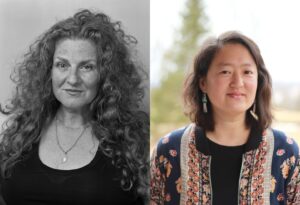
Eve Alexandra (left) and Sarah Audsley (right)
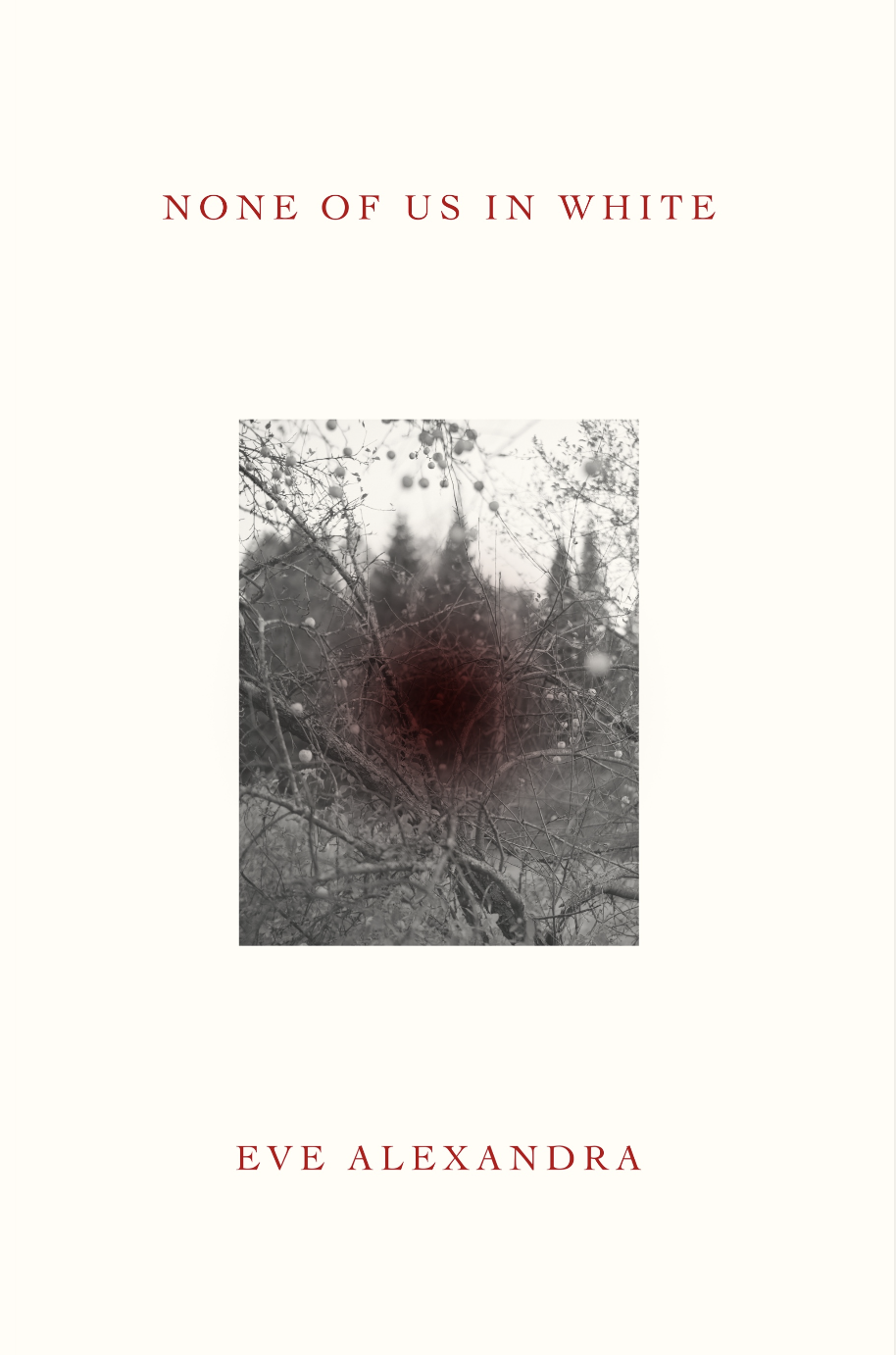
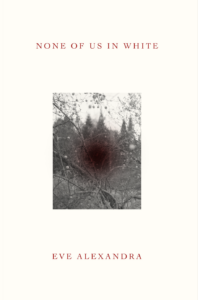
SARAH AUDSLEY and EVE ALEXANDRA, both poets based in Vermont, share a complicated connection to the landscape and the place they call home. Each leverages the pastoral; however, both poets upend the pastoral’s tradition to explore identity, gender, familial relationships, grief, and their connection (or dislocation) to place. None of Us in White, recipient of the Two Sylvias Press Wilder Prize and published in 2025, is Eve Alexandra’s second poetry collection. Carl Phillips’ quotation, “Brokenness you do surprise me,” is the epigraph with which Alexandra introduces and envisions her collection as it investigates grief and reaches towards elegy with an unsettled sense of belonging.
Sarah Audsley (SA): Rabbits and deer occur frequently throughout None of Us in White, and the naming of trees and plants is central. What is your relationship to the pastoral tradition in poetry?
Eve Alexandra (EA): It did not come easily. Although I grew up in Vermont and much of that childhood landscape informs my poems—wading in the Browns River with the cows coming down, feral lilacs, wild irises, dead deer everywhere—I felt an unease or lack of connection, perhaps feeling unclaimed by Vermont’s landscape. I desperately wanted to escape the small town I grew up in (Vermont was a very different place in the seventies and eighties), so I applied only to colleges in New York. I lived in Manhattan, then Pittsburgh, and New Haven. I would now identify that unease in my early years as difference, as queerness. And I still feel it with my family or in the reception of my work.
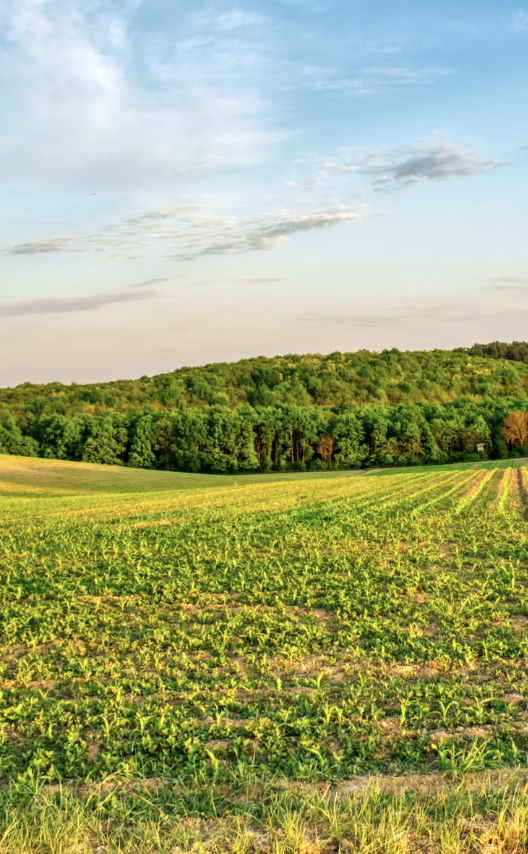
But when my marriage ended abruptly one night, when my daughter’s other mother literally walked out the door, I was gutted and terrified to suddenly become a single mother of a young child. So I came home. Vermont and that small town became a refuge. When I came back, I was comforted by the landscape, the familiar wildflowers, and the rivers. And deer appeared everywhere as a metaphor. It’s not that my unease with the pastoral suddenly evaporated, but I identified with the landscape and was comforted by its small beauties. I thought of John Clare becoming an amateur botanist, so attuned and intimate with the land around him. For me, it was the ritual of walking my dog and coming to know each tree, where the berries were, and where the rabbit died. There seemed to be no barrier between my grief and the natural world. There’s a line from “Collision” — “we are all invasive and beautiful.” The veil between my grief and the natural world was very thin. And yes, I think there’s a reclamation of the queer pastoral through this feeling of belonging. I know this place so well. My body lives here and is part of this land. I can name those trees, rivers, and flowers.
It’s not that my unease with the pastoral suddenly evaporated, but I identified with the landscape and was comforted by its small beauties.”
SA: How does it feel to move from the first book, which often featured a third-person “she” speaker, to this second book’s focus on the first-person “I?” In other words, how has your relationship to the “lyric I” changed over time?
EA: My first book, The Drowned Girl, was very informed by my MFA and evolved from that MFA manuscript. When I began my MFA, it was a very anti-confessional moment. I remember an interview I gave after The Drowned Girl’s publication; I said something like, “It’s not like I have a broken heart and go and write about it.” Well, life and grief will humble you. I have a broken heart, and I wrote about it. With The Drowned Girl, I was very interested in a female speaker, often “the girl” as a kind of archetype, almost a kind of performance. I had been an actress in my early twenties, and I think inhabiting a character came easily to me. It was empowering. I just couldn’t keep that up in None of Us in White. Perhaps, like with the landscape, there was no veil. In those difficult years after my divorce and then the death of my father, I leaned toward poets who modeled an intense vulnerability and clarity that comes from intimacy with grief—Sharon Olds, Marie Howe, Linda Gregg. There is much in The Drowned Girl that is invented, not so in this new book. I can’t detach myself from these poems, and I am both proud and a little embarrassed to say that.
SA: Could you talk about the book’s structure? In particular, I am interested in the interstitial moments of the “charms” that are stitched throughout the collection.
EA: The “charms” are almost breaths and certainly spells (which might be the first poems). One of my students called them “word bouquets,” which I love, and certainly they are collections of the odd and disparate. I started the “charms” when I was having trouble writing full-length poems, and I think I was doing a “write a poem a day” challenge. Two weeks in, I was struggling. So they were initially an exercise, but then they became their own thing, and I have many, many more that aren’t in the book. I keep finding them on post-its and in books. They pull from the natural world but are often mysterious and erotic too—so yes, they are spells. I think of them as haunting the full-length poems, maybe, of which the charms are both inside and outside. They are witchy. My friend the visual artist Michel Droge and I have talked about making the charms into elaborate boxes. I love the idea of expanding my practice beyond the page.
SA: None of Us in White – would you like to talk about finding/choosing the title for your book?
EA: This book was written over many years and had many incarnations and many titles—Deer Tongue, Slaughter, Invasive and Beautiful, The Hawthorn Crown. Nothing felt quite right, and then my friend the poet Holly Painter asked, “What’s your favorite poem in the collection?” My favorite changes all the time, of course, but at that moment it was “Passionem.” And Holly magically plucked the line out of the poem. It feels right for many reasons, both in the poem and in life. The title is both a wish and a recognition. It’s both wanting something, but acknowledging we are all impure by this point. Both mourning and wedding, but maybe more mourning than wedding. I am forever changed by the dissolution of my marriage and the death of my father, but there is still beauty and love in unexpected forms. The epigraph from Carl Phillips, of course, Brokenness you do surprise me—all of the pain and all of its gifts.
SA: How do you think about crafting the “erotic” in poetry? Specifically, how do you go about writing queer erotic poems? What are the craft choices you are making?
EA: I honestly don’t know if there’s an intentional choice or strategy. I am a writer who embraces beauty and sensuality. I am a maximalist by nature. I do look to the natural world to evoke and describe desire in this book—“Pastoral,” “Whitetail,” and “Crewel” come to mind. And I think the kind of violence I’m interested in investigating is inflicted by desire, both at its pinnacle and in its aftermath. I am interested in the energy of poetic line and eroticism. My first book was full of prose poems, and there are a few here too, but I found myself letting the line go where it wanted to go. In terms of queer eroticism and lesbian sexuality, I wanted to be frank.
SA: What does it mean to you to write as a queer poet? (You mentioned writing for a queer reader, and not translating for another type of reader.)
EA: Yes, I made a conscious decision not to translate for a straight reader. This connects to the eroticism question, of course. In my first book, I was aware of seducing a reader who was not necessarily queer, and even though I was a very out lesbian, I think as a much younger woman and poet, I wanted to—or was cultured to—be likable, to be attractive, to participate in the dominant paradigm in some way. And perhaps this goes back to performance or the distance of “she” in which the speaker is doing a kind of deflection, I think. In None of Us in White, that veil is gone.
I think there’s a reclamation of the queer pastoral through this feeling of belonging. I know this place so well. My body lives here and is part of this land. I can name those trees, rivers, and flowers.”
I think of Audre Lorde’s, “your silence will not protect you.” So the issue of embodiment is very central to me as a queer poet. It’s important to be honest about sex, about women loving women—so there’s fisting, clitorises, and oral sex. People often talk about my poems as “sexy” or “erotic,” and I wonder sometimes if that’s because they are explicitly queer. I might be perceived as writing about sex when I’m actually investigating intimacy.
SA: Can you talk about the elegiac turn the poems make that happens at the end of the book? What about the elegy allows for poetic closure or an opening? Why turn towards elegy?
EA: I had my first sabbatical in the Spring of 2019. I was working on this manuscript, and then my father died. I was devastated. I adored him, and he died far too young of a cruel disease. I mention the sabbatical because later, in reviewing my report, the committee noted (with a slightly scolding tone) I had “strayed from my initial project,” which I thought was absurd. My father died. How could I not write about it? I think it’s the poet Mark Doty, though I might be wrong, who said something like “The elegy is not just about mourning, but it also means to praise to sing.” My father’s death is, in a way, part of the beauty of the world. After my divorce, my father cared for my daughter and me. He was my constant, and after he died, I felt a concrete loneliness. I still feel it as a single mother. The last poem, “Nest,” is a litany of all that. For a long time, I had the image of my father as a hawk appearing as I drove north on 91, but I didn’t have a poem to put it in. Then my friend the photographer Bill McDowell told me a story about photographing the far edges of the land surrounding Dannemora prison, where he saw countless graves and birdhouses. And then with the gift of that story, the poem was complete and, in a way, so was the book. I do think the book opens and closes with the elegiac. Brokenness you do surprise me…
Eve Alexandra’s None of Us in White won the Two Sylvias Press Wilder Prize. Her first book, The Drowned Girl, was selected by C.K. Williams for the Wick Poetry Prize. Alexandra’s poems have appeared in Narrative, Cape Cod Review, Harvard Review, and American Poetry Review. She teaches creative writing and literature at the University of Vermont.
Sarah Audsley is the author of Landlock X. A Korean American adoptee, a graduate of the MFA Program for Writers at Warren Wilson College, and a member of The Starlings Collective, Audsley lives and works in northern Vermont.