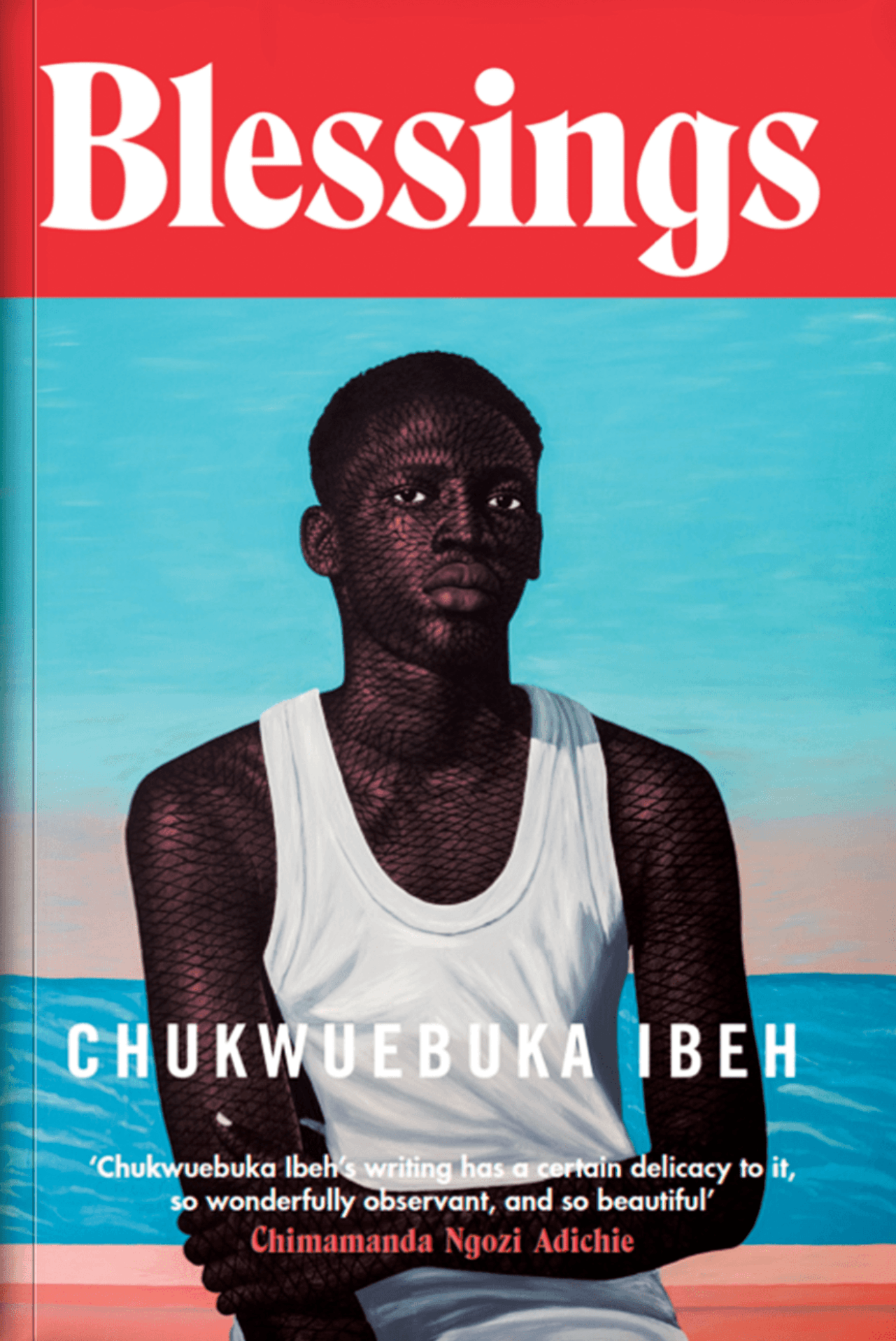
DAVID EMEKA and CHUKWUEBUKA IBEH first connected in 2020, after Emeka read Ibeh’s Gerald Kraak-shortlisted story, The Ache of Longing. Emeka had raved about it to a mutual friend, who encouraged him to send Ibeh a DM. He did, and they continued messaging on Twitter about shared goals and interests. Later, Emeka was accepted into the Washington University MFA program in St. Louis, where Chukwuebuka was enrolled. Ibeh didn’t know then, but Emeka applied to the program with a story Ibeh had provided feedback on. They’ve continued to share work since, and enjoyed many adventures as well.
For this interview, Emeka and Ibeh spoke over two days when Ibeh visited St. Louis for Christmas. Their initial conversation unfolded in Ibeh’s wonderfully warm apartment, and they continued connecting over email after Ibeh’s return to Lewisburg, PA, where he currently teaches.
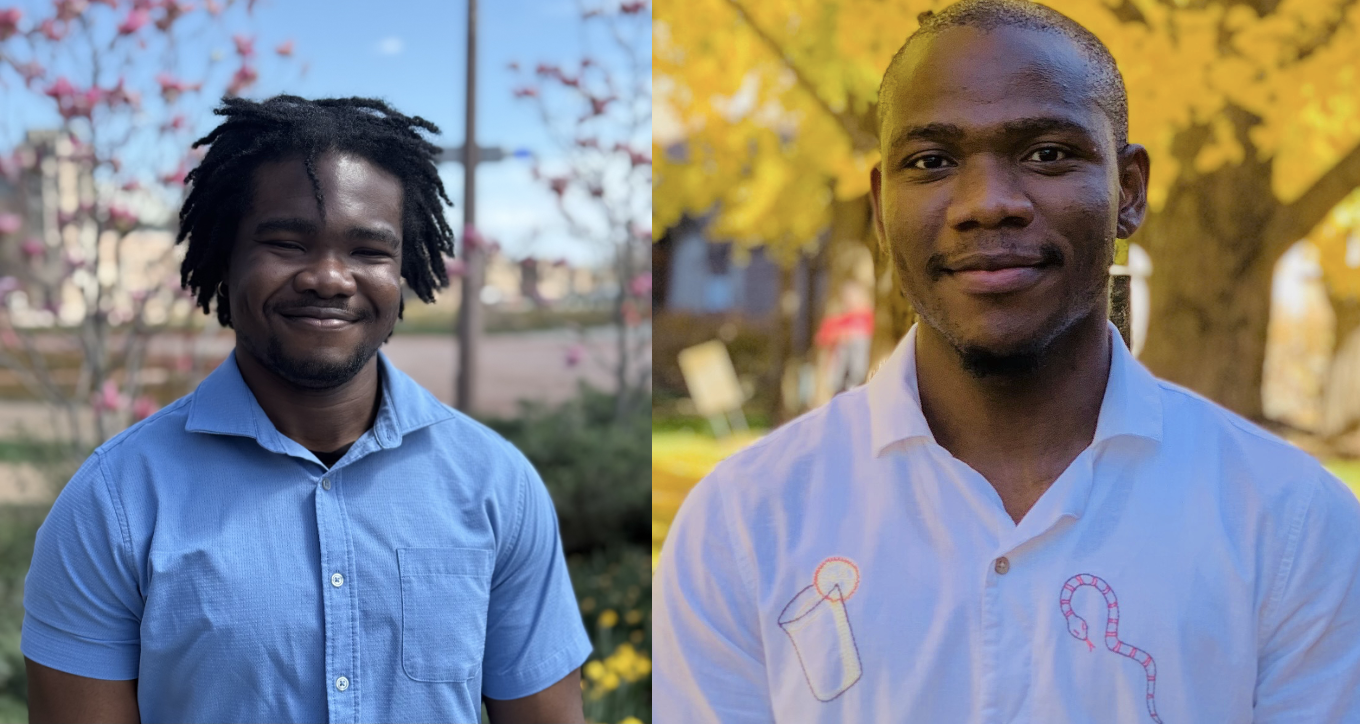
David Emeka (left) and Chukwuebuka Ibeh (right)
Chukwuebuka Ibeh (CI): Congratulations on your Outpost residency! How did you feel coming out of it? What was your routine like?
David Emeka (DE): Thank you so much, Ebuka. Vermont was wonderful, and the Outpost residency even more so. I keep thinking about the meals, the warmth I felt from everyone there. The grounds—the trees, the cornfields, the mountains in the distance—were spectacular. I do some of my best thinking when walking, so I’d swaddle myself in a blanket and pace among the trees, just meditating. And then there was this hammock—that was my favorite spot. When my ideas had collected to supersaturation, I’d go into the hammock and cover myself with the blanket and write. I’m a morning person, but I love to write in the dark. Every day I woke up at dawn to write, had breakfast, paced and wrote and read, jogged around the neighborhood, then returned for dinner. Sometimes we cooked for each other—I would make sourdough bread, or D’mani Thomas, the other fellow, would make tacos. We took walks under the stunning sunsets. It was a splendid time.
CI: It truly sounds beautiful. How did this process translate when you returned home?
DE: You know, I was a little shocked by the apartment buildings in my little corner of St. Louis. I was shocked by all the cars. I went to Bennington College twice, and to restaurants or grocery stores, so I wasn’t secluded from all of modern life. I think it’s that whenever I ventured beyond the residency premises, it was with an awareness of the rarity of those vistas. Their ubiquity was what stunned me in St. Louis. I could feel the dusty dormancy of certain social parts of my brain. I wanted so much to return.
I worked hard not to lose my writing self in the storm of rediscovered domestic obligations. I think I’ve become more ruthless about downtime: Instagram, Grindr…I’m acutely sensitive now to the time-meaning proportionality of those venues.
CI: Can you talk about your process? What’s the journey from idea to a finished page?
DE: I often begin with a question, something at the edge of my understanding. A philosophical or moral complexity, or just plain curiosity. One of the stories I worked the hardest on last year began with me being perplexed by beauty. The meaning of beauty in popular discourse. I had come to a point where I thought: I don’t know what “hot” means; I don’t know what all these words that are supposed to describe human beauty truly signify. With that story, as with many others, I began with random sentences falling throughout the days, essayistic exposition in my notes app, searching out the material’s contours. I have to vomit tons of words before anything resembling a shape emerges, and then I revise manically. A story is complete when I feel a situation has fully intersected with and transformed and illuminated a character’s life.
A Little Life dramatizes all that, and there are greater avenues for meaning. It remains a bleak book, but it’s also one of the greatest depictions of friendship I’ve read. It’s multiple things. I don’t know that triumph is always the greatest meaning a story can offer.”
CI: That’s fascinating. I wonder then, since you mention starting out in essays, if you make a determination of genre with subject matter simultaneously, or does one come before the other?
DE: Fiction is my instinctive tool for thinking about the world. But the primary determiner of an idea’s exploration in an essay or a story—whether or not I give up the fictional project—is in its relationship to time. I think ideas are limited by human expression in time, with death being the ultimate limiter, and thus the ultimate meaning-maker. There are certain problems I simply can’t think about in an essay. I’d need a character to be constrained by specificities of conflict and setting and time, which is the thing that gives all narrative forms shape. The exact degree of this intensity and duration is what I have to figure out in early drafts.
As to enduring subject matters, I’m very interested in suffering, I’m interested in hope and love and all the positive sources of meaning, but I think a person suffering at the intersection of many of life’s discriminations would die. I think there are certain problems you can’t recover from. That’s pretty bleak, but then a book like A Little Life dramatizes all that, and there are greater avenues for meaning. It remains a bleak book, but it’s also one of the greatest depictions of friendship I’ve read. It’s multiple things. I don’t know that triumph is always the greatest meaning a story can offer.
CI: What is the ideal form for you, the short story or the novel? Are there any complementary or contrasting considerations?
DE: I love both. I don’t know if I’m able to write a typical short story, though. I keep trying and failing. Most of what I end up with are novelettes. On the level of the sentence or paragraph, I’m drawn to density, the kinds of simultaneous attachments density makes possible, which can’t resolve its terms in under five thousand words. A great short story can contain as much meaning as a novel —the forms differ not primarily in page length, but in how many juggling balls a situation requires to fulfill itself. There are many sparse novels in the world.
CI: Let’s talk style. Your writing sometimes employs what I can best describe as “extensive interiority exploration,” by which I mean we get entire paragraphs and sometimes pages trailing a character’s ‘ramblings’ on a given subject matter. Why does this mode appeal to you? Do you worry about limitations?
DE: Haha. I like the way you put it. I used to think of my goal as being exhaustive, but extensiveness might be more attainable. I’m very interested in the depiction of consciousness. I’m interested in thinking. It’s very fun for me to try to recapture a kind of thinking that seems loose and disorganized but deterministic towards its goal. The fun’s in not knowing what this goal is, and once learned, to sort of reverse-engineer, or tinker, the journey towards it. As a teenager, I was very drawn to David Foster Wallace, and I was drawn to Garth Greenwell. They both have these incredibly smart, constantly thinking narrators who always surprise themselves, who don’t fully know themselves.
But I’m also drawn to other traditions in realist fiction. If I were to try to render my mother’s interiority, for example, it would be nothing like mine; I’d have to utilize different tools. I have a bias towards certain traditions of depicting consciousness, likely stemming from the technologies I needed to think my way out of homophobia and Christianity, but I really don’t think of myself as having a fixed style or wanting a style. Nigeria and sexual desire are the chief abiding interests of my fiction, and in Nigeria, we have different kinds of English, different registers and styles. I want to explore them all.
CI: What other writers do you draw influence from? What do you take from them?
DE: I’ve just spoken about Wallace and Greenwell. I don’t think about Wallace as much lately, but he’s a part of my DNA. Garth Greenwell’s my favorite living writer. I think a lot about his books, which are lit up by sex and morality and language, my favorite things in the world to think about.
I aspire to Marlon James’s sprawl and inventiveness. Chimamanda Adichie, I think, is an influence on any Nigerian who began trying to write in the 2010s.
I did a lot of copy work when I was younger. I’d sit and write down whole passages by writers I loved. I needed to figure them out from first principles. A great story has an unimpeachable unity to it, but if you pay close attention, you can start to discern something of its origins and scaffolding. Narrative is simply a chamber of meaning, and style is an amalgam of meaning-making gestures. Bettering one’s writing is, I think, a matter of heightening or sharpening one’s perception of human meaning and containing as much of that meaning as one can in the smallest possible narrative space.
Jhumpa Lahiri is my newest obsession. I’ve blown off the ears of anyone who would listen to me about the architecture of her stories. A reviewer described them as being “as elegantly constructed as any fine proof in mathematics,” and as a backslidden engineer who’s obsessed with math, I can say there’s no better metaphor.
CI: I remember talking your head off about Lahiri, and you’d go, “yeah, she’s good but not mind-blowing,” and then suddenly you were calling me at 11 p.m. to dissect Hell-Heaven.
DE: Hell-Heaven is a spectacular story! But let’s not get into that here. I’ll say one more thing about influences: I love tracing overlaps and genealogies. I know Lahiri read a lot of Gallant and Chekhov and Joyce and Garcia-Marquez while working on Interpreter of Maladies. And so then I went reading those authors to see what sensibilities stuck and what got filtered out. Joyce and Garcia-Marquez, I already loved but didn’t think to place near Lahiri. I found Gallant impermeable. I couldn’t see how Jhumpa was smitten by The Ice Wagon Going Down The Street. But I’m persistent. Literature rewards all my vices.
CI: When did you decide, ultimately, that engineering had to take a backseat to literature?
DE: I think it has always taken the back seat. I began intensely writing in the six months between secondary school and university, and in that time, my love for chemistry as a foundational thinking tool was supplanted. It didn’t help that the learning conditions at my university were atrocious. I was a private school kid experiencing the dysfunction of the Nigerian higher education system for the first time, as well as living in a hostel with boys four years my senior, who terrified me with their capacity for homophobic violence. In the first two years, I took general courses where it was impossible to hear the lecturer in class, so I read novels during the day and my engineering books at night. I loved working, however briefly, as an engineer, but getting into an MFA sealed that path for me.
…it’s so much more joyful now. The moment a story begins, you’re engaging with a mind; the story’s only an arena. It’s like music. It’s an orchestra.”
CI: What was your MFA experience like? What do you think is the value of an MFA for a writer?
DE: I think the MFA gives you the gift of time, and the gift of peers similarly committed to writing. It was especially useful for me, coming from a STEM background. Most of my writing until then had been self-taught. In the MFA, I learned to articulate my thoughts about stories. I discovered new writers. Because you’re critiquing unfinished work, you become something of a surgeon. As a reader in the world, you encounter finished books that have gone through workshops and friends and agents and editors, and so they’re as near as God’s word upon arrival in your hands. But if one aims to be a good workshop participant, one has to learn to read constructively, making the whole narrative world up from scratch. Or at least that was my experience. I’m also the kind of person who’s more motivated to do certain kinds of work on behalf of someone else than themself.
And now that’s just how I read everything. I used to be afraid to encounter the phrase “reading like a writer.” I thought, God no, all the joy’s going to be taken away, it will become robotic. But it’s so much more joyful now. The moment a story begins, you’re engaging with a mind; the story’s only an arena. It’s like music. It’s an orchestra.
It was important, too, that I had such curious colleagues and instructors. I experimented with writing stories in Nigerian pidgin, and everyone did the research to try to understand it. I wrote stories engorged with sex, and people were game. It was the most fun two years of my academic life.
CI: What do you think is intrinsic to a young writer’s development?
DE: Love. One has to love the work—not the end product, but the process. That’s the only thing that will keep you writing when everything feels bleak. One has to be able to rip out tens of thousands of words—time and hard labor—in pursuit of excellence. I think curiosity’s another necessary trait. You spend so much time dissecting other people’s work, and then you have to forget all of that when writing yours. There can’t be any formulas. You’re making the world anew. Every brick in it must be germane, conversing with every other brick. You can’t fully parse the role of laid-down sentences if you’re beyond them. You must continuously ask questions of language and open your ears, waiting for its quiet response.
CI: What are you currently working on?
DE: I’ve just completed a short novel, and I’m working on a collection of stories about contemporary Nigeria. In my lofty moments, I think of it as my response to Joyce’s Dubliners. But gay.
David Emeka is a Nigerian writer. A graduate of the Washington University in St Louis MFA program, his work has been published in Lolwe, The Republic, Adroit Journal, and Epiphany Magazine, and received support from Tin House and The Outpost Foundation. He is working on a novel and a story collection.
Chukwuebuka Ibeh is a writer from Port Harcourt, Nigeria. His writing has appeared in McSweeney’s, New England Review of Books, and Lolwe, amongst others. His debut novel, Blessings, was published by Viking in 2024.