
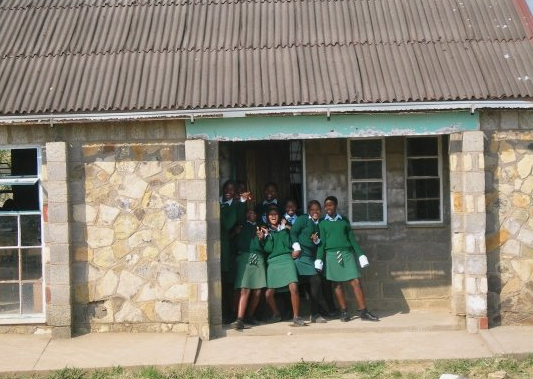
The village sits in the throat of the Maloti mountains, which hum pink with the setting sun. From east to west, the mountains resemble many fists, the knuckles as peaks, the fingers as slopes, the space between a deep emerald.
Tsepiso—fifteen, lover of algebraic maths, The Bold and the Beautiful, and the Greek-American singer Yanni—must walk to the village pump and return home before dark. Thabang, her neighbor, who saves sweets for her from the Chinese shop, intends to marry Tsepiso. This news drifted through the village like a Sunlight soap bubble, and so Tsepiso’s mother has warned her to be home early. Otherwise, Thabang will take her into the maize fields, lay her down, and make her a wife.
Last year, Tsepiso’s deskmate with the soiled shoes, Lebohang, went missing when she went to her latrine in the dark. Her parents, afraid to look for fear of village gossip, did not report her missing. She arrived with an unknown man two days later, quiet, with a bruise around her eye and a new blue skirt. Tsepiso began to urinate in a bucket in the evenings, and Lebohang did not return to school.
Next, Palesa, the light-skinned girl in Form D, informed the other girls at lunch that she intended to become married to her mohlankana, Tsebo. Tsepiso was sitting next to Palesa as they shared pap and peas, and she remembered the hiss of heat that transferred between their shoulders as Palesa spoke. Tsebo knew true love, Palesa said, and she was tired of cooking and fetching water while her mother worked at the cell phone shop. Tsepiso knew Tsebo, a dark-skinned boy who was known for winning the school multiplication contest, and who had once touched her knee during a game of cards. As Palesa talked, Tsepiso looked at Palesa’s ribbed stockings and imagined Tsebo’s fingers running up the cotton ridges, under her skirt. Two weeks later, Palesa and Tsebo moved to a house in town with an indoor toilet. Palesa did not return to school.
But when a man grabbed Rethabile’s arm to force her to the room behind his shop at the taxi rank, she scraped her nails across his face. For a week, his cheek shone with a red line that looked like the red worm sweets from South Africa, and the other men laughed at his failure. After a meeting with the village chief and Rethabile’s parents, the man was instructed to leave Rethabile alone. If Thabang tried to drag Tsepiso into the maize, her mother warned, Tsepiso must also refuse. Mo shapa, her mother said, snapping her wrist so the knuckles of her fingers cracked together. Whip him.
Tonight, after the pump, Tsepiso wishes to watch The Bold and the Beautiful, her favorite American show. Her home sits at the edge of the maize fields, overlooking the village. Her mother sleeps in a round room with a thatch roof, but her own room is next door. The tin roof prevents her from studying in the rain because of the noise, but it is hers alone. If she became married, would Thabang consent to have her continue her studies? As a girl, Tsepiso read to him in the evening. Each night, she would wait for the sound of his sheep’s bells and hooves to signal his return, a silver needle of sound threading the flat plane of the village quiet. His favorite story was a passage from Tsepiso’s examination papers that described the interior of an airplane, something neither of them had seen. More recently, they discussed the political news, sitting underneath his radio with five black dials.
Fast fast, her mother says, pushing her out of the gate. She wears a floral skirt and a Ramones T-shirt, mended with a new patterned collar. A bucket rests on her head. She turns left, stepping on the raised mounds of grass, careful not to touch the strands of barbed wire that border the yards.
Thabang’s sheep pen is empty, his house dark.
Despite herself, she listens for the sound of Thabang’s sheep.
She listens, her two ears twin pinpricks of fear and desire, but the stillness remains.
As she walks, the edge of sunlight runs ahead of her, casting the pump in shadow. She avoids looking up to greet her neighbors who whisper as she passes. In her peripheral vision, she pictures them as night-sky phenomena, dark shapes orbiting around cooking fires.
The pump stands on a concrete square at a dip in the valley. It was built with Western money, the project of a long-departed aid worker with a pink head. Neat perpendicular lines line the base, an anomaly in a village of haphazard roads. A concrete gully pulls the pump run-off water into the grasses below, avoiding the usual circle of mud. When Tsepiso pumps, throwing her bodyweight into the up and down motion, she thinks of all the smooth edges and silver structures of America, like the hospital machinery in Alexa’s room in The Bold and the Beautiful. Sometimes, she imagines that the pump is a plug at the bottom of a sink in the valley, and if she pumps hard enough, she could slip down the drain.
At the pump is Lebohang, the girl who was taken on her way to the latrine. Lebohang’s husband, a thin man with three Rastafari necklaces and a nephew in London, does not have any sheep or a TV to watch The Bold and the Beautiful. As she bends over her water bucket, Tsepiso can see Lebohang’s baby, strapped to her back in a blanket and a pink velour jumpsuit. The baby sweats and sleeps.
Hey-la, Lebohang greets her. It is late.
Ay, Tsepiso replies, and places her bucket on the ground. Lebohang swings her body to start the water’s flow. The baby rocks with the movement, undisturbed.
Everyone says Thabang is ready. He is coming to take you. Lebohang peers at Tsepiso’s face to read her expression in the dimming light.
Is that what you want?
Tsepiso looks down and makes a sound low in her throat.
On the way back, Tsepiso walks on the rough part of the path, pressing her bare feet into the edges of rocks, an experiment in pain. She can hear the lap of the water in the bucket on her head, a sound that extends to the inside of her thoughts, unheard by men.
Once, on television, there was a lake in an underground cave in the United Kingdom. She imagines herself there now, free from the decisions of others, resting her toes on the tall cone-shaped rocks, breathing a private air. Thabang’s intent, her mother’s warning, and the village’s gossip disappear, and she waits only for herself, her choices uncluttered and clear.
At the top of the ridge, she can tell that her mother has turned on the television. She thinks about Alexa, resting in her hospital bed, her face dark with makeup. Alexa, of course, is waiting for Antonio, though her amnesia makes her forget. Antonio wants to make Alexa his wife, so he sits with her, holding her hand, looking at his watch.
In the village, after marriage, women acquire the name of their unborn first son, chosen by their in-laws. Mamafa, Mathabiso. Mother of Mafa, mother of Thabiso. Tsepiso wonders what it will feel like to have this new name inside of her, filling her stomach. She imagines a small boy collecting rotting peaches under the darkening trees.
Thabang’s house remains empty. Almost home, she stops, knowing that this bubble of quiet might be the last one. She hesitates, examining her thoughts. Tsepiso thinks of the day Lebohang returned with her new husband, with her blue skirt and bruised face; she thinks of Tsebo’s hands on Palesa’s ribbed stockings and the red scrape of Rethabile’s nails.
Whip him, her mother said.
A needle of sound pricks the quiet and threads up to the maize field, to Thabang.
Tsepiso places her water bucket on the ground.
Inside her house, in an American hospital on TV, Alexa waits, her mind blank, surrounded by glistening machines.
Tsepiso waits.
As the last sunbeam wraps behind the mountains, she hears bells and hooves.
Elizabeth Brus is a writer and recovering teacher. You can find her work in New Orleans Review, Evergreen Review, Cleaver Magazine, McSweeney’s Internet Tendency, Fiction International, The Normal School, and elsewhere. She served with the United States Peace Corps in Lesotho from 2005–07 and lives with her family in Brooklyn, New York. Contact her on socials @elizabethbruswriter.