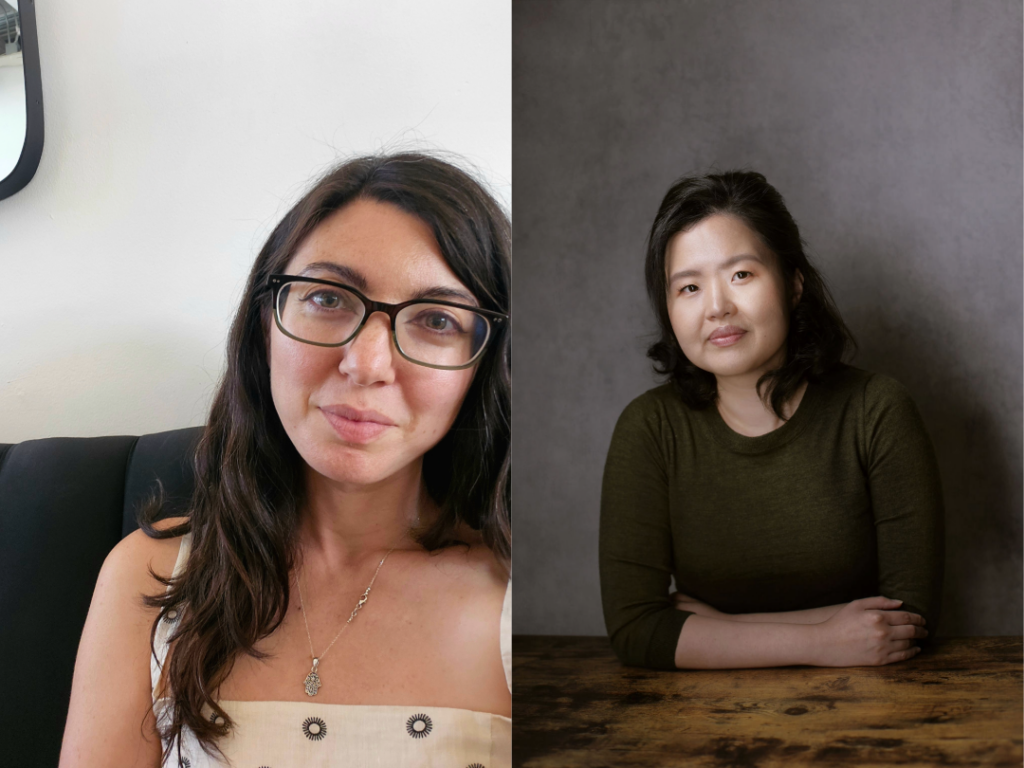
Allison Pitinii Davis (left) and Rosanna Young Oh (right)
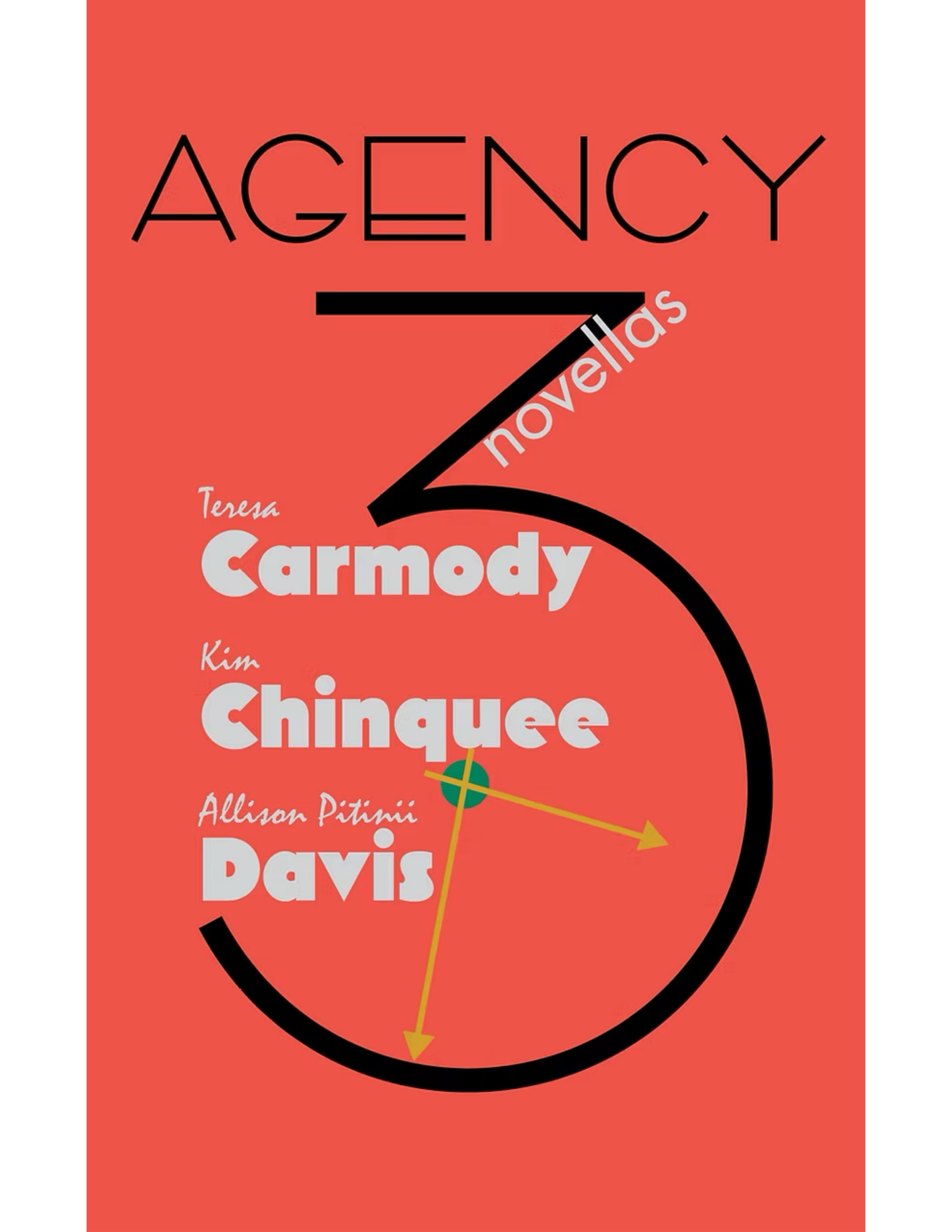
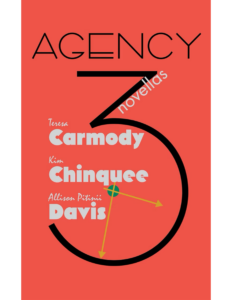
ALLISON PITINII DAVIS and ROSANNA YOUNG OH explore how Davis’ personal connection to Youngstown, Ohio and scholarly interest in labor inspired her debut novella, Business. They discuss representing the Rust Belt in literature, their identities as eldest daughters who worked for their family businesses, and the dignity and ethos of the working-class communities that raised them. Allison Pitinii Davis is the author of the poetry collection Line Study of a Motel Clerk , Poppy Seeds, and Business, a novella in Agency 3: Novellas . She serves as a Visiting Assistant Professor of Poetry at Ohio State University.
Rosanna Young Oh (RYO): Allison, I was moved by the emotionally complex portraits of the characters in Business, which focuses on the lives of working-class young women in Youngstown, Ohio, in the 1970s. The book is less about capitalism than it is about labor and the ecosystem of the mom-and-pops that co-exist with one another. Together, they seem to constitute a village, where no one can mind their own proverbial business. No individual is separate from the collective and, to me, the way some characters try to liberate themselves from their communities forms the emotional core of the book. For example, when Alexa, the daughter of a laundry owner, tells Lia, the daughter of a motel owner, the truth about her affair with Ben, the consequences impact her family.
You are also the award-winning author of the poetry collection Line Study of a Motel Clerk, which engages similar themes of place, identity, labor, and working-class America. I am curious to learn more about the inspiration and process for writing your novella.
Allison Pitinii Davis (APD): Both sides of my family ran businesses, so I grew up with like 20 cousins and lots of aunts and uncles and grandparents who were trying to keep a laundry and trucking motel open after the entire Youngstown area went through industrial collapse. So yes, “an ecosystem”—thank you for that wording.
“No individual is separate from the collective”—you would think that someone growing up in this situation would be aware of it, but I grew up in it, and so did my parents, and so did my grandparents, so it was normal to me. I never had reason to consider who I was outside of the collective—the important thing was that I was a good daughter, a good eldest sister.
I started the novella in spring 2015 when I was wrapping up a fellowship at Stanford. I had just finished reading Saul Bellow’s Seize The Day on Caltrain. I remember not really understanding it yet also feeling totally under its trance, its frantic pile-up. I sat down on a campus bench and wrote a few pages in the voice of a cousin of Alexa, a character who ended up being cut.
I finished the first draft of the novella the next year at the Fine Arts Work Center, the same time I was working on proofs of Line Study of a Motel Clerk.
I didn’t look at the novella again until 2019 when I workshopped it as a PhD student at the University of Tennessee. It was the first fiction workshop that I’d taken since undergrad—I was terrified. The novella wouldn’t exist without the feedback and support of my classmates. I consolidated a bunch of characters, reworked the ending, and changed Ben’s personality three times.
A few drafts later, I showed the manuscript to Christine Kelley at Baobab Press, who published Line Study and is one of the only people I trust to explain to me what my work is trying to do. I got the call from her that she wanted to publish it when I was sitting on my porch in Wheeling, West Virginia. I remember feeling happy for the characters, that they would get to have this existence independent of me. The brilliant Danilo Thomas edited the work. The party scene, which I’d always struggled with—he was just like “What does Alexa want?” There’s a lot of movement at the party, because I thought plot equals “make things keep happening.” But once I approached the plot as “Alexa’s desire to understand is the engine that propels us from place to place,” the scene was solved.
So that’s the composition history, which spanned a decade and four states. I think the takeaway is that you can write in solitude, but eventually, you need to let other people in. You need to give people a chance to help you and believe in you.
Plot-wise, there are countless inspirations. You know the Marianne Moore line that poetry is “imaginary gardens with real toads in them”? Fiction, for me, is the other way around—the places and situations are real; the characters are pretend. Many locations in the book are inspired by real places, many of them also Youngstown, Ohio family businesses. And the genesis of the Lia/Alexa dynamic is from back in college in Cincinnati. A guy broke up with his long-term girlfriend and then briefly dated me until he realized I was a prude nerd. One night, his ex cornered me at a house party and told me off. She was way prettier than me, way more popular—I’m crying, and she’s just like “stop crying so I can yell at you!” We were all Jews from Northeast Ohio.
So that’s the composition history, which spanned a decade and four states. I think the takeaway is that you can write in solitude, but eventually, you need to let other people in. You need to give people a chance to help you and believe in you.”
Another inspiration was the 70 and 80s Youngstown working-class bar scene and its bands, like Left End. My parents met at a Left End concert at the downtown Youngstown Agora Club, so that entire situation has always loomed large in my psyche. And of course, the motel and laundry are based on the actual trucking motel and laundry in my family, the same ones in Line Study. It’s not an accident that I wrote about them twice—Business is about working-class female interiority and erotics, but the motel and the laundry are communal places that I tie to a much more collective part of my identity. So the only way I could write about private life in these family spaces was through fiction—I needed space to write as “one person,” whereas Line Study feels like I had a million ancestors looming over me at all times—as you put it, “No individual is separate from the collective.” Business was written from a private consciousness, whereas Line Study was written from a populated consciousness. I always tell my students that the first book is about your guilt and the second book is about your desire. You have to get through the first book to reach the psychological freedom of the second.
RYO: The book takes place in the late 70s on “the eve of Youngstown, Ohio’s deindustrialization.” I was reminded of Richard Hugo’s essay “The Triggering Town” and Sandra Beasley’s article, “Prioritizing Place,” in which she defines regionalism as more than just a checklist of attributes. What makes a poem a Southern one? For example, it isn’t what she calls “a strategic deployment of y’all.” What role does regionalism play in your writing? What makes Youngstown, Ohio, or the Rust Belt the place that it is?
APD: I took a workshop with Sandra Beasley—she’s amazing. Other writers who taught me how to think about place—Rebecca Gayle Howell, Christina Fisanick, Joy Priest, Cait Weiss Orcutt, Rochelle Hurt, Karen Schubert, Phil Terman, Essy Stone, Shelley Wong, Natasha Trethewey, and others.
I think about the regionalism question a lot. I’ve said before that I feel like the Rust Belt is like a sexuality. Jack Gilbert was writing about Pittsburgh when he said, “Why the erotic matters so much. Not as pleasure but a way to get to something darker.” My current manuscript, about the global rust belt and postindustrial psychogeographies, gets deeper into these ideas.
I’ll also say that I don’t write about the Rust Belt because I love it, though I do—I write about it because I know it well enough to have characters move through it. I can trust its dimensions in my mind without having to measure them.
RYO: Like you, I am the eldest daughter in a family that owns and still runs a small business. In the Golden Age of Big Tech and Corporate America, growing up the way we did—helping our families, living with their expectations—seems rare. It’s amazing how precisely Business captures the extent to which our families can shape our moral imagination, how we can’t help worrying about whether the consequences of our actions might impact our families. How has your family business shaped your sense of self, and how has it informed your writing?
APD: Your book about your family’s grocery, The Corrected Version, is one of my favorite books. A goal in life is to write a poem inspired by your poem “The Gift,” but I have a feeling I won’t be able to write it until I’m old. Just trying to return to the situation is emotionally difficult. I remember when I asked you to read “The Gift” for my students, and you said you were unsure you’d be able to get through it, which took me aback—that you, too, still remember the rawness of the emotion yet were able to write the poem anyway. That really upped the stakes for me, for what I need to demand of myself to make art, to depict a family business with precision. Thank you for modeling it.
As you know, growing up in a family business “shapes our moral imagination.” You capture this so well in your own collection, the tension between the gritty, all-consuming work and the dignity of being your own boss. I think this tension informed my writing in terms of temperament—running a family business requires a self-reliance verging on self-destruction. If you don’t like the motel, my dad will pay you to leave—that’s how much he stands by his business. He is extremely serious about what he does—from cleaning a motel toilet to hospitality—and I try to bring that to everything I do.
APD: Growing up as the oldest daughter of a family that ran a trucking motel, it was implicit that I was representing my family. I internalized this sense that it was sort of my job to prove people wrong about any ideas they might have. My parents never directly said this to me—it was something I learned through osmosis any time I’d hear a disparaging remark about the motel. So this translated into me feeling like it was my job to fulfill a role—to be prude, smart, invulnerable. To be, at best, impressive, and at worst, uneventful.
So I was really interested in thinking about eldest daughters in small businesses who are trying to individuate into young adults under this familial pressure. For both Lia and Alexa, their true selfhood sort of has to go incognito—there’s not really room in their everyday lives to be themselves. They are in businesses that are open 365 days a year, and they are in these families 365 days a year. They don’t get time off from what they were born into. I was interested in having them talk to each other, because they can see through each other by virtue of growing up wearing the same masks. They unmask each other in ways that others cannot.
And they approach their familial roles differently. Lia leans into it—she wants to take over the business, wants it to be her life, needs anyone involved with her to align with her own vision. She’s not going to let anything—including her own humanity—get in her way. Lia sort of crushes out her own feelings like a cigarette. Whereas Alexa is more honest with herself in a defeated way. Alexa would be thrilled to sink into her own shame, but she needs someone else to give her permission because she’s too virtuous to go there herself. That’s why neither one of them can be with Ben—Lia needs Ben to uphold her dignity, which he refuses to do. And Alexa needs Ben to give her permission to ditch her dignity, which he refuses to do. Ben experiences Lia and Alexa as individuals; Lia and Alexa experience selfhood as inseparable from the family unit.
RYO: One of the first things we learn about Ben is that he is Jewish, which complicates his relationship with Alexa, who is Greek. The book implies that their relationship is unorthodox because they are supposed to date or marry within their own cultures. Would you like to share more about how both communities started and grew in Youngstown, Ohio?
APD: My mom is from a completely Greek family, and my dad is from a completely Jewish family. My mom converted, so I’m Jewish, but I always joke that I feel Jewish in a Greek way. Both sides of my family were initially nervous about my parents’ marriage.
Jews and Greeks both came en masse to northeast Ohio in the late 1800s, though some came earlier. Because of the work provided by steel mills, many immigrants came to the area from Lebanon, Ireland, Italy, Poland, etc. Both Greeks and Jews in Youngstown—some worked in the steel mills, but both groups predominantly ran businesses that served the steelworkers. So my story is one of many.
RYO: Who are some influences for you, and whose work do you think your writing engages with?
APD: The major influence on the novella, from length to tone to class issues, is Goodbye, Columbus by Philip Roth. I think of Lia as a poor version of Brenda Patimkin, whose father runs Patimkin Kitchen and Bathroom Sinks. I was also influenced by The Assistant by Bernard Malamud, one of the greatest books about family businesses. I think of Alexa as being a Youngstown version of Helen Bober, whose father runs a grocery. So in my novella, it’s as if Goodbye, Columbus’ Brenda Patimkin and The Assistant’s Helen Bober got to meet.
As far as contemporary fiction, Elena Ferrante’s Neapolitan Novels are such a rich examination of working-class women trying to navigate life together. I read it after the novella was already out, but I loved Elisa Shua Dusapin’s Winter in Sokcho, which is narrated by a young woman who works at a hotel.
For me, to be from a place is to be in tune with its pressures and precisions. Writing about a place is like a quality of linguistic precision. I write about Youngstown because I feel like the pressure it exerts on language is accurate.”
RYO: From our conversations, I know that you are proud of where you come from. Alexa says a wonderfully poetic quote when arguing with Ben: “You just don’t get it, what it means to be from a place.” And then I remembered the last paragraph of your acknowledgments in Line Study, in which you describe your family as “the kind of family where, if you run into your uncle downtown, he’ll buy you a beer and tell you stories for hours.” I feel like I know your family already! What does it mean to be from a place for you? And what does it mean to you and your own community that you are representing them in your work?
APD: I feel like I know your family, too. I hope I get to meet them someday, Rosanna.
For me, to be from a place is to be in tune with its pressures and precisions. Writing about a place is a quality of linguistic precision. I write about Youngstown because I feel like the pressure it exerts on language is accurate.
I think of the book as an ethnic postindustrial fairy tale, which is why nothing works out and every character is cynical. I wanted a book my mom would like. Really, though, by the time I was done with the book, I knew that I had written the book for Lia’s character. Like if I didn’t get the book published, Lia would roll her eyes at me and be like, “I knew I shouldn’t have trusted you to write me.” So yeah, I feel like as long as I did an okay job creating and representing her as a character in all her complexity, then I did my job. I hope that representing her thoughtfully will allow the book to connect to anyone trying to make it through this world with their integrity intact.
Allison Pitinii Davis is the author of the poetry collection Line Study of a Motel Clerk, Poppy Seeds, and Business, a novella in Agency 3: Novellas. She serves as a Visiting Assistant Professor of Poetry at Ohio State University.
Rosanna Young Oh is the author of The Corrected Version. She currently teaches in the M.F.A. program at the City College of New York, CUNY.