By RACHEL HADAS
Reviewed by REEVE LINDBERGH
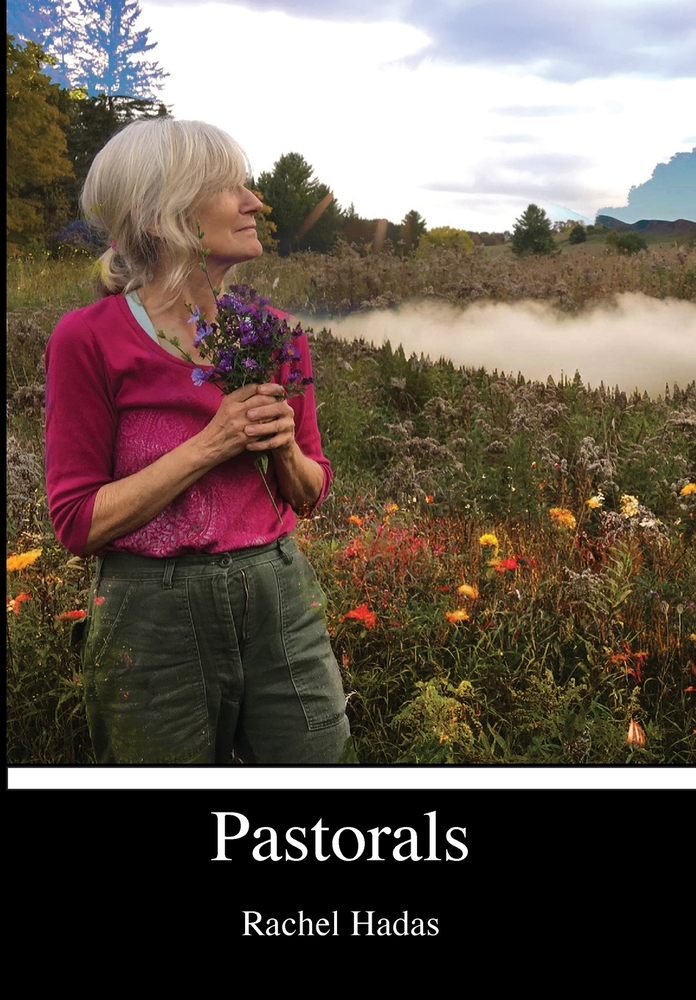
Rachel Hadas is a close friend, someone I have known since the early 1970’s, and a summer neighbor in rural Vermont. She lives in a house that has belonged to her family, one generation following the other for many decades. Her new book, Pastorals, is an exquisitely written collection of brief reflections and meditations essentially but not exclusively centered on the house.
“Can one feel nostalgic for the present, especially when it’s layered so palpably over the past?” The writer asks herself this at the beginning of the book. Within the present as she lives and writes are the unseen presences of those who have visited or inhabited the same dwelling in the same place. They are not exactly ghosts but instead “the presence of an absence,” something Hadas feels at odd moments indoors or out: while going up the stairs; in the midst of picking blackberries on the hill; on the way down the dirt road to the mailbox. She likens these “seasonal phantoms” in her summer house to the ghosts in Walter De La Mere’s poem “The Listeners,” a poem that had puzzled but did not frighten her when she read it as a child. Readers of Pastorals will learn quickly that Hadas’s memory is filled with the poetry and prose of every age and nation along with her own beloved family ghosts.
Rachel Hadas is a poet, essayist and translator as well as Professor Emerita at Rutgers-Newark, where she taught for about forty years. A reader might not know these things about her from reading Pastorals, were it not for the multiplicity of references made from her reading. Here she is mainly immersed in her family identities: daughter, mother, sister, wife. Some of the people with whom she has shared the house have gone. Her mother and father have both been dead for years, though their presence-in-absence can still be felt by their daughter: her mother weeding in the garden; her father, the late scholar Moses Hadas, “sitting at a rickety table, typing with two fingers.” There are more immediate presences too. Her husband Shalom Gorewitz, teacher and filmmaker, is working in his studio. This room once belonged to her son Jonathan, who will visit with his wife Julia later in the summer and will someday inherit the house.
Others are here as well, not ghosts but guests, so many over the years of this family summer home. Hadas refers to the house as “a dingy farmhouse on a back road,” and then lightens and enlivens it, filling it to the brim with people from her memories and her dreams, including those she thinks of as the “friendly phantoms” of remembered visitors, both recent and long gone. There are, moreover, visitations from remembered readings, evocations that seem to match the house-memories in one way or another, and may cause a kind of shimmering doubleness, as when Hadas describes the changing uses of the bedrooms over the years and generations—the room in which she sleeps with her husband Shalom was previously her mother’s room, and before that it was a room of twin beds for Rachel and her sister, “with pink and rose and mauve striped bedspreads, a sort of Barbie touch more than half a century in advance.” The succession of changing purpose reminds her of lines from Keats about a perpetually deteriorating garment, a relic, of which the poet wrote, “The careful monks patch and patch it, till not a thread of the original fabric is left, but still they show it for St. Stephen’s shirt.” Hadas herself comments, “And so with this house. With families.” Perpetually changing and eternal, at exactly the same time.
Not far from where she writes are the intense and active lives of creatures who must feed and breed and in many cases raise their young before the brief summer season is over. Bees are in the bee balm, there is a robin’s nest in the chestnut oak, a hummingbird zooms back and forth across the landscape. A phoebe family has built a nest on or actually in the house itself, in an angle where the screened porch wall meets the ceiling. The phoebe seems to be a descendent of another phoebe who has done the same thing in years past.
The human family leaves the porch door open to facilitate the phoebe parents’ flight to and from the nest to feed the newly-hatched nestlings. Hadas writes, “On the table where I sit and look out through the screen at the garden, the table where I write and where I sometimes make collages, phoebe poop. (The table is directly below the new nest.) Down the backs of the lawn chairs: phoebe poop. On the floorboards of the porch; on the ratty quilt that covers the cot at the far end of the porch; phoebe poop. And a new development: on the floor on the porch by the barn an unwelcome visitor from the city, pigeon poop. We never used to have pigeons in the barn—just phoebes and swallows—or not until last fall. The particular, viscous, adhesive texture of pigeon poop was something I’d always associated with New York windowsills and awnings, but now hardened mounds of the stuff formed little mounds on the barn floor.” Later she continues in the same vein:
“Indoors, tiny ants are crawling over the kitchen counter. Trying to keep such surfaces wholly free of anything greasy or sweet is a quixotic enterprise, a battle that can’t be won.
All of this has been done before; it will all need redoing. The clean-up in life is constant. When we stop needing to mop up after those who came before us. Or to make room for those who will follow, is when we abandon the cycle.”
Then, as in every country house in summer, there are the ants, so tiny as to be almost invisible, almost imaginary at first, but then they arrive in quantity, an infinitesimal army of them everywhere, making it difficult to keep an old house in order.
There is constant activity here, creation and destruction and recreation, not unlike the work of translation in which Hadas’s father, classicist Moses Hadas was engaged during his lifetime, and quite like the work that Rachel Hadas herself does as a translator. She writes about this in a recent piece for the publication Literary Matters, “On Translation,” describing translation itself as the effort “to repurpose, to retrofit, to keep to the original beautiful structure without tearing it down; to then fill that structure with something new, something perhaps wholly different in nature and purpose—-this, I saw, is as true of translation as it is of architecture. The new stuff in the old container will inevitably be reshaped and changed by the constraints of its new surroundings.” Living in the old family house through the years actually may be another exercise in translation.
In the midst of all that is old as well as so much that is new, Hadas is writing, remembering, and reflecting. She thinks of her teaching years and recalls a mythology class at Rutgers in which she gave the students the assignment to draw a picture of the Iliad. One result was a face of Helen floating above the walls of Troy, one a neat, tent-filled rendering of the Greek camp. Another showed Astyanax in his nurse’s arms, crying, perhaps over a presentiment of his future fate. In another drawing the Iliad is a video game. Hadas remarks in reminiscence that none of these was right and none was wrong, though all were incomplete. “There is no way to include everything,” she muses, “even the Iliad includes by leaving out.” This glimpse of her perceptive and thoughtful teaching is enough to make a reader want to be a student in Hadas’s class.
Her clear voice and her deep intelligence thread this lovely book together, giving weight to every observation, shining light into the dark corners of memory, revealing both the habits and the dimensions of lost and present loved ones. Beyond this, she invokes flawlessly the everyday details of life in an old and treasured summer place, and brings her readers, too, closer to home.
Reeve Lindbergh, a daughter of aviator-authors Charles A. and Anne Morrow Lindbergh, grew up in Connecticut and moved to Vermont in 1968. She lives on an old farm near St. Johnsbury, Vermont with her husband, writer Nat Tripp, and an assortment of animals, enjoying visits from children and grandchildren. Reeve is the author of more than two dozen books for children and adults, including the memoirs Under A Wing, No More Words, and Two Lives, essays reflecting upon her own life in Vermont and the complex history of her family.