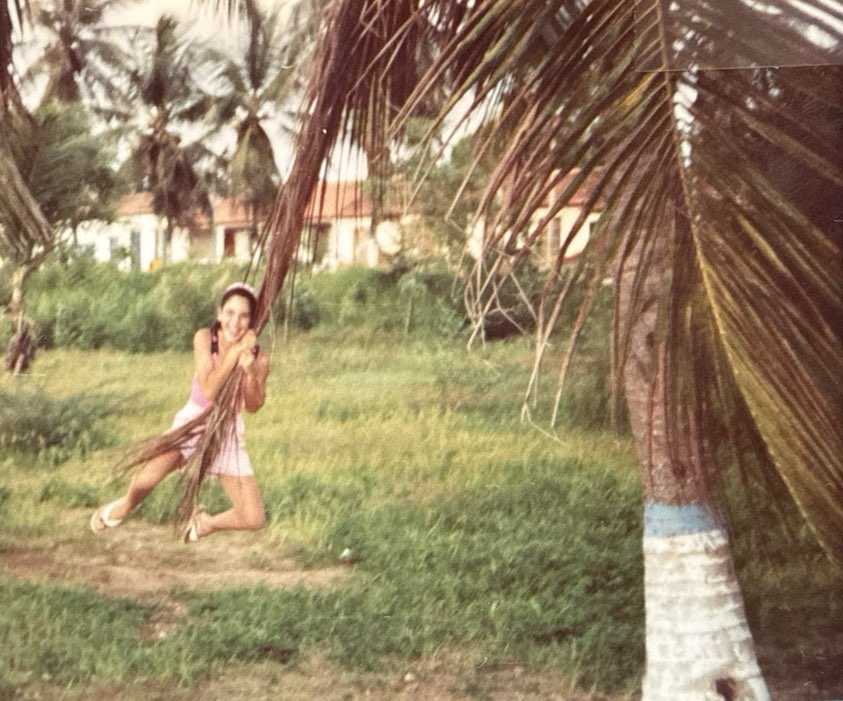
For Ana María Alonso
It was late October, and my half-sister, Nikki, and I walked arm in arm with our stepmother through the streets of Caracas. The sweet metallic smell of gasoline, ever-present in the city, mixed with the acrid sourness of tropical flowers decaying at the end of the rainy season to create a pungent indolic scent. The sun had set behind Mount Ávila while we were at the party, so we walked under the glow of streetlights toward our car parked a few blocks away. Even though Nikki and I hadn’t anticipated needing nice clothes for this visit, we’d each thrown a dress into our suitcase at the last minute. The special occasion turned out to be our step-cousin’s son’s second birthday. The click of our high heels echoed through empty streets. Armed robberies, carjackings, gang activity, and police shoot-outs had contributed to a climate of fear and insecurity amongst residents, who no longer went out after dark unless necessary. But our stepmother, Inger, never bothered with such warnings—she entrusted her life (and ours) to fate.
The three of us had posed for a photograph together by the front door that afternoon before heading out. Me in a blue and white silk dress; Nikki in black fitted cotton; and Inger in a white silk blouse, wide-leg trousers, and gold jewelry. We were overdressed for a child’s party but looking to lift our spirits. I’d borrowed some delicate pearl earrings, and Nikki wore a chunky silver pendant necklace that stood out against the black of her dress. Despite our best efforts, we couldn’t hold a candle to our Norwegian-Venezuelan stepmother, who goes by the nickname “La Vikinga” and is blessed with a kind of disheveled elegance. She can apply blue mascara to bring out her sapphire eyes and brush her thick blonde hair and be ready for any occasion. She adored our father’s favorite compliment, that she looked like she just got out of bed and was ready to get right back into it.
But, in the photo, even Inger looks tired and sad. Our mouths are smiling, but our shoulders are slumped. I can’t remember whether my father took the photo. He must have. I do remember that Nikki and I were glad for an excuse to leave the apartment after a week inside. Perhaps we were also feeling guilty about going to a party when the purpose of our visit was to say goodbye to our dying father.
Years later, when I look again at the photograph of me, Nikki, and Inger, I will note that we are arranged just as we would walk through the streets of Caracas a few hours later: the three of us side by side with La Vikinga in the middle. I will mourn the silk dress, the bloodstains that will not wash out. It will be easier to mourn the dress than to mourn my father. I will visit Venezuela one last time after that, and then never again.
When I was growing up, after my parents’ divorce, I visited my father and stepfamily in Venezuela every summer from age eight to twenty-three. Inger, his third wife, was eighteen years younger than my father. He already had three children from his previous marriages when they met, and she already had a daughter. Together they had a son, born when my father was in his mid-fifties and Inger was approaching forty. All told, my father had five children, and I was in the middle. I like to joke that I’m the youngest child, the oldest child, and a middle child. Since my stepsister, Vanessa, is only six months younger than me, and Inger used to love dressing us in the same clothes until Vanessa insisted that she stop, I like to add that I’m also a twin. In truth, for most of the year, I was raised by my mother and stepfather in Mesa, Arizona, as an only child. It was only when I visited Venezuela over the summers that I really felt like I had a sibling. Vanessa and I loved and hated each other like only sisters close in age can do.
It is challenging to explain my family to other people, so I often draw a tree with three large branches, one for each wife, that sprout smaller branches for the children. The first branch is for my father’s first wife and two children, my older half-siblings, Alec and Nikki; the second is for my mother and me; the third is for Inger and her daughter, Vanessa, and my younger half-brother, Nicolai. I draw my father as the trunk of the tree, the one thing connecting all of us.
My father grew up in Venezuela as the son of a French-Jewish refugee mother and his father, the Dutch Consul General of Maracaibo. He went to the U.S. for college and stayed through two marriages and two divorces. Disillusioned with what he saw as the hypocritical moralism of the United States, he returned to Venezuela and married Inger. As a trilingual cosmopolite and the child of a refugee, he never felt that he fully belonged anywhere in particular, but Venezuela was the closest to home he ever got. In his fifties, in the small coastal town of Puerto Píritu, my father finally settled into the life he wanted: mornings at his dairy farm, afternoon siestas in his hammock, and weekends in the crystal waters of the Caribbean.
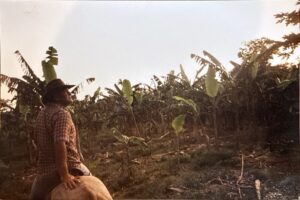
Photo courtesy of the author.
During those summers when I would visit, the tropical air was a constant companion pressing against my skin, breathing into my mouth, gathering in droplets at the base of my skull and dripping down my back. In the afternoons, after the monsoon rains finally broke, Vanessa and I would stand at the open window of our colonial-style house and listen for the bell of the ice cream vendor. We would yell for him—“Tío Rico! Tío Rico!”—and exchange coins for ice cream through the window bars. The chocolate shell always melted down our hands before we could get it all into our mouths.
If the ice cream cart wasn’t around and we could muster the energy, we might instead walk to the plaza in the center of town and order iced rice milk from the chicha vendor, holding the cold plastic cups against our cheeks. Or sometimes, if we were very lucky, we might spot some boys in the coconut grove across the street. For a couple of bolivares, one of them would shimmy up a tree and cut down two green coconuts with his machete. Somehow the liquid inside stayed cool even on the hottest days. Once we had sucked all the velvety water out with straws, the boys would crack the coconuts open and pry the creamy meat away from the shell, handing curling slices to us on the edge of a blade.
Our house was designed in typical Spanish colonial style and consisted of the maid’s quarters, an open shower, water tank, and kitchens in the rear, and two large salas (salons) in the front. In the middle, six identical bedrooms flanked an interior garden with an open roof. Visitors entered first through robust double doors at the street entrance that could be locked with a metal bar at night. Then one walked through the zaguán, a covered passageway with blue and white tiled walls that provided a transition zone between public and private. The next set of doors, which opened onto our garden and the living areas of the house, was made of a native hardwood in a rich, dark stain and had an arched top. A speakeasy, or pedestrian door, allowed us to interact with visitors without inviting them inside. All proceedings were presided over by a large crucifix affixed to the wall above the door.
In 1990, when Vanessa and I were thirteen years old, the Petróleos de Venezuela, a state-owned oil and gas company, decided to create a calendar of images from Puerto Píritu to show off the town’s many colonial buildings—whitewashed walls, azure-painted doors and windows, and low-pitched gabled roofs covered with red clay tiles. To Vanessa’s horror, the month of November featured my face, instead of hers, peeking through the speakeasy.
Although the front of our house was protected like a fortress, the interior garden was a portal for all kinds of things from the outside to get in. We lived with lines of bachacos (leaf-cutter ants) marching their way across the Spanish tile floors with leaves balanced on their backs, and I quickly learned to avoid their painful mandibles. Mosquitos and jejenes were a constant annoyance, but one that I became largely desensitized to after the first summer we were introduced, when every inch of my skin was covered in red, itchy bumps from head to toe. Bigger visitors were just as likely, from spiders the width of my palm on the walls to fruit bats hanging from the exposed wooden ceiling beams above my bed. I learned to check my shoes before putting them on and my sheets before climbing into bed at night. Iguanas, parrots, and even the occasional monkey made appearances (although the monkeys must have gotten the memo when my father threatened to shoot the next one that dared show its face after my brother’s goldfish lost its head, because we never saw one again).
The main thing that entered through the interior garden, though, was water. I visited Venezuela outside of the wet season only one time, for Christmas. Every other year, I was present for the intense but short-lived bursts of rainfall that occurred most afternoons between May and November. The four corners of the open roof above our garden would temporarily turn into small waterfalls, so inviting in the summer heat that we would use them for our daily showers. My father believed that the only thing better than the saltwater of the sea for bathing was pure tropical rainwater.
Although mornings were often spent running errands around town, Vanessa and I were forbidden from going out during the afternoon rains, due to the river of water that gushed from the top of the hill, down through the streets in front of our house, toward the ocean. Watching the torrent from our front windows, Vanessa and I witnessed chairs, roof tiles, palm fronds, and sometimes even dogs rush past us to meet their demise.
So much of the town’s day-to-day life occurred within the frames of those windows. One day, as Vanessa and I ate our ice cream, we heard Armando shouting, and a pack of dogs rounded the street corner into our view. Armando was known around Puerto Píritu as “El Borracho,” but my father had taken the time to learn his story and knew there was more to him than drink; he’d hired Armando to fix odds and ends around the house and help with any heavy lifting. A lean man, Armando was nonetheless surprisingly strong, his arm and chest muscles clearly defined under skin taut and tanned almost red from spending most of his days without a roof. Armando had also taken it upon himself to be responsible for the town’s pack of stray dogs. On this day, a male dog had become stuck inside a female while mating, and the other males, attracted to the smell of the female in heat, were attacking him. Unable to use his hind legs for much, he was in a very precarious position, and we watched as Armando attempted to fight off the other dogs with a stick. Vanessa and I found this hilarious, but our laughter called the attention of Ale, the housekeeper, who reprimanded us and sent us away. Later that evening, after receiving Ale’s account of the day, our father told us we should be ashamed of laughing at Armando. Didn’t we know to respect our elders? From then on, Vanessa and I called him “Señor Armando.”
Since my father owned a dairy farm and Inger owned a pizza restaurant, Vanessa and I were left to our own devices most days, although Ale kept a close watch and, after our brother Nicolai was born when we were fourteen, a nanny named Api was added to the household. While my father and Inger loved us deeply, they had a laissez-faire parenting approach. Both stunningly beautiful—La Vikinga with Nordic traits and my father with his contrasting Sephardic black curly hair and Dutch blue eyes—they were madly in love with themselves and each other, the kind of love that made everyone around them feel like outsiders. Their disputes and reconciliations were met with equal passion. Some nights, the sounds of their lovemaking escaped the heavy wooden doors of their bedroom. At other times, Inger would be gone for days, “to the mountains,” without word of when she’d be back, and we would have to give our sulking father a wide berth.
When it came down to it, as much as she humored our father’s Old World sense of patriarchal authority, La Vikinga was in charge. She managed our complicated family like she would an estate, with authority and organization. She governed the spirit world as deftly as the physical one. Although we often good-naturedly mocked her “boola boola” magic, we relied on Inger to remedy a sore throat with a saltwater gargle or a stomachache with castor oil. She was lighthearted, easy with affection and laughter. Complaints, fear, and pessimism were not welcome, but her faith in the goodness of life was contagious. Vanessa and I followed her into every adventure without hesitation.
One summer day, as we walked the usual strip of beach in front of our house, Inger suggested we keep going beyond the promontory. The tide was low, and we walked for hours without hats, sunscreen, or drinking water, before realizing we had to retrace our steps to get home. When we arrived, toward evening, sunburned and exhausted, our father was furious. He had been sick with worry. But Inger would not allow him to spoil the beauty of the day. Vanessa and I took her side. Even if part of me understood his reaction, I coveted Inger’s approval. Her attention was like a spotlight you never wanted to pan away. Yet there was some relief from the brightness and the heat when it did.
My father’s attentions were more subtle but equally coveted. Vanessa and I performed a dance we were too young to fully understand, vying for the love of each other’s radiant, charming, unpredictable parents. When they were away from the house and the baby was with Api, Vanessa and I entertained ourselves with books, music, and TV. Jon Bon Jovi and INXS sometimes warranted full-on dance parties complete with dress-up from our parents’ closets. Once Nicolai was old enough, we enjoyed dressing him in women’s clothing until my father caught us and forbade it. In the late afternoons, Vanessa and I might catch an American movie on TV or rent a Betamax from the local video store. Anything with Brad Pitt or Johnny Depp was top priority. Vanessa loved to bake, and before we knew it, the entire pan of brownies would be gone, their disappearance fully explained by the distraction caused by hunky movie stars.
Our parents were not fans of television or movies in those days, but sometimes on Saturdays we could get them to sit down for the variety show on Venevisión. For my first few summers, I didn’t understand much of what was being said, but I loved to imitate the drawn-out hiss of the host, Gilberto Correa, as he exclaimed it was time for “Ssssábado Ssssensacional!”
Over the years, my Spanish improved, but Vanessa never tired of teasing me for my Gringa accent. Even without meaning to, I often found ways to embarrass her in front of her friends. Since it was a common occurrence to hear the “sst sst” catcalls of men when we walked down the street, I didn’t realize when, one day, it was a group of Vanessa’s friends from school calling us, not the usual unwanted piropos. Wanting to try out the cuss words Vanessa and her primos had recently taught me, I let out a string of profanities, the combination of which had never been heard before, judging by the look on my stepsister’s face. I suspect this kind of behavior was the reason she rarely introduced me to her friends. I learned how to entertain myself, largely by writing love letters to boys back home or creating mixtapes. I found it easy enough during those years of self-centered adolescence to feel sorry for myself, a young woman in her prime whiling away her time in the middle of nowhere, while my friends back home were having suburban summers at Golfland Sunsplash.
When we weren’t at home trying to find something to do, though, Vanessa, Nicolai, and I were swept into our parents’ epic adventures: renting a lancha (small motorboat) to take us to nearby virgin islands to fish for our dinner and bathe in the mineral-rich mud; driving up into the mountains to eat schnitzel and strudel in Colonia Tovar, an unlikely German village in the middle of the tropics inhabited by the descendants of nineteenth-century immigrants; or, my favorite, a trip to Parque La Sirena, a waterfall named for its likeness to a mermaid’s tale, to let the cold, cascading water pound the top of my head until all memories of heat were forgotten.
Looking back, I can see how the language, food, and environment of Venezuela seeped into my blood and inhabited a large part of who I would become. I took it for granted. And then it was gone.
I stopped visiting regularly after the turn of the millennium, when I was twenty-three years old. Jobs, boyfriends, travel, and eventually graduate school became my priorities, plus my father was no longer paying for my plane ticket. We stayed in touch with letters and phone calls, and I kept abreast of the situation in Venezuela through the news. Hugo Chávez had been elected president a few years earlier, in 1998, and I heard either complimentary or critical assessments of his policies, depending on whom I was speaking to. Even in the very beginning, at the height of the new socialist president’s popularity, Inger and her family denounced Chávez, claiming to see what nobody else could: that he was a power-hungry upstart who would destroy the country. It was hard to argue with that assessment after Chávez began confiscating private land, censoring the media, and imprisoning the opposition, but my father still tried. He was a Chavista. I will never understand why—his whole life, from his bourgeois upbringing in Maracaibo to his current landowner status, was being threatened. Yet my father had always been a rebel, and his frustration with the politics of the United States reigned supreme. I would like to think that his experiences as a refugee also gave him a deep empathy for the downtrodden. Whatever it was, the fact that my father shared his first name with the new president became a source of pride for him and a source of chagrin for his wife and her upper-class criollo family.
In the meantime, Vanessa got married, had a baby, and moved to France to live with her in-laws. My childhood companion had suddenly become an adult, and I found it difficult to imagine Venezuela without her.
As the economy worsened, my father lost the farm, Inger lost the restaurant, and their properties suddenly had no market value. Inger’s father had died several years earlier, and my parents used their part of the inheritance to purchase an apartment in Chuao, an upscale neighborhood in the southeast of Caracas. They moved into the apartment full-time and rented out half of their house in Puerto Píritu to a bank, which knocked down the dividing walls between the bedrooms and added a large glass wall on their side of the interior garden. When even the bank rental didn’t bring in enough income, my father and Inger rented one of the salas to a Syrian immigrant family who sold cheap clothes from our front window. My parents had to be constantly vigilant for squatters, now that the Chávez administration was encouraging people to seize private property under the guise of social justice.
My Leftist friends back home praised Chávez as an indigenous leader who would take Venezuela back from its white usurpers and return it to The People. My own idealism matched theirs and my father’s, at first, but could not stand up against the brutal reality of Chávez’s tactics. Perhaps his social programs to empower the poor, nationalize the country’s resources, and challenge the influence of the United States could have worked if the Western powers hadn’t attempted to thwart his socialist agenda from the start. Or perhaps he had always just been in it for power and money. Either way, everyone was equal in Venezuela now: equally poor and equally desperate.
I knew that my father had experienced several bouts of illness related to his prostate and even a kidney surgery during this time, but he and Inger never used the word “cancer.” In 2008, when he visited me and my half-siblings in the U.S. for the first time in over twenty years, we didn’t know that it was a farewell trip. He seemed less energetic than usual, but we attributed that to old age. Even when I received the phone call from Inger the following year, I didn’t fully understand the diagnosis. I knew only that I was returning to Venezuela at age thirty-two, after almost a decade away, to say goodbye to my father.
Arriving at Simón Bolívar International Airport in Maiquetía, I entered the main hall and couldn’t help but smile as I took in the famous and very familiar mosaic floor tiles created by artist Carlos Cruz-Diez. The kinetic kaleidoscope of orange, green, blue, and black patterns led me directly into the arms of my stepfamily, as it always had, and I thought perhaps things hadn’t changed so much. But my father wasn’t there to greet me. He was too sick, Inger explained, to leave the apartment.
My half-sister, Nikki, arrived shortly after me, and Inger drove us from the airport into Caracas. As we passed the sprawling shantytowns, I saw for myself that Chávez hadn’t fulfilled his promises to the poor. The ranchos still had the same cinder block walls supporting lines of colorful laundry and corrugated metal roofs hosting satellite dishes. The same streets of mud and limited infrastructure. Only now they had increased exponentially, tumbling down the mountainsides with such force they threatened to take over the entire city.
When Nikki and I arrived at the Chuao apartment, we greeted our father without showing any surprise at his wan appearance. Although she and I had grown up with very different experiences of our father, we both knew that discretion and privacy were essential to him, and he wouldn’t want to speak directly about his illness. He was affectionate with his children, but also very formal, the result of his upbringing. Over the following days, when I tried once to broach the subject and suggest that he talk to Nicolai, only seventeen years old, about what was happening, he told me to “stay out of it.”
We also avoided any discussion of politics. The arguments that erupted at a fever pitch between him and Inger a decade before had now largely subsided into quiet grumblings and deadly silences. Nikki and I did not want to awaken that monster. We sat with our father, rubbing his feet, which were swollen with edema, and talked quietly of the latest novels we’d read and our lives back home. He seemed sad and resigned. Our father could always fall back on his stories, though, and he told us again about his family’s escape from Vichy France and the bravery of his mother, who hiked with her three children through the Pyrenees into Spain and Portugal, where they got on an ocean liner that brought them to safety in Venezuela. This was the story that gave his life meaning, and it seemed important to him to repeat it now.
Inger, on the other hand, was a live wire. Her husband and country were on their deathbeds, and her “boola boola” wasn’t working. Her fury was palpable as she struggled to accept the inevitable. She continued affixing crystals to my father’s body with Band-Aids and burning incense (he had recently forbidden candles after they started a fire in the kitchen and almost took the whole apartment with them). Inger’s altars around the house multiplied until there were no bare surfaces left. “Nicolai can stay home with Dad; you deserve a night off,” we told her, to convince her that we should attend her niece’s son’s birthday party. To give her an excuse to leave the altars to their work for just a few hours.
The party was a blur. We had some wine and birthday cake and tried to enjoy ourselves. Afterward, walking underneath the towering apartment complexes of Caracas, we did not register any danger. We did not see the man watching us, judging the value of our jewelry and our lives from inside the darkness of his car.
Of course, I knew Caracas had one of the highest crime rates in the world, but I felt invulnerable next to La Vikinga. As a child, when we made short visits to Inger’s family in the city, driving six hours through the mountains and then down into the Caracas Valley, my father would trade his T-shirts for button-downs, his cowboy hat for hair cream and cologne. Zipping up his chinos, his posture, and his voice, he became a proper boarding-school-educated man, reserved and watchful. Inger, on the other hand, came alive in the city. This was her domain, the city where she had been born and raised. She liked to tell me and Vanessa stories of her youth, weaving her motorcycle in and out from between cars, blonde hair flying without the restriction of a helmet.
Inger knew which areas of Caracas were dangerous, so as children, when we were out at night in a neighborhood that she deemed dodgy, she would make us walk through the streets single-file, several yards apart. That way, if one of us was grabbed, the other two could get away and run for help. I always hoped to get the spot in the middle with Vanessa ahead, where I could see her, and Inger protecting us from the back. The times I had to walk up front, my legs would turn to lead as I took tentative steps, terrified that it would be my fault if I led us into peril. I would try to walk like I belonged there, copying Inger’s confident posture and alert eyes. I would look for every possible angle from which an attack could come, but my vision seemed to close in rather than open out. My sense of hearing was muffled by the thudding of my heart. I don’t understand why our bodies betray us like that when threatened, closing in upon themselves and becoming completely dysfunctional.
That night, though, the three of us were huddled together in our own world. Perhaps the momentary feeling of lightness from the party distracted us. More likely my father’s dying was all-encompassing, and we paid no attention to our surroundings, our own well-being seemingly beside the point.
We had parked the old Chevrolet Century on the left side of a one-way street, against the curb of a median garden dominated by a young ceiba tree whose trunk was covered in thick, conical thorns. This tree’s great-great-great-grandmother, La Ceiba de San Francisco, has lived for over 150 years in front of the old church, Iglesia de San Francisco. She stands as a symbol of independence, because she has been there as long as the statue of Simón Bolívar, El Libertador, just a block away.
Like any child in Venezuela, I grew up with tales of the revolutionary hero of the country’s independence story. In the Plaza Bolívar, the historical center of Caracas, he sits astride a bronze horse, frozen mid-battle but forever sure of its outcome. Ironically, Bolívar is claimed by both the socialist-nationalist Bolivarian Revolution that began under President Hugo Chávez in 1999 and the anti-Chavismo opposition. For both sides, Bolívar is the symbol of Venezuela’s destiny.
As we walked toward our car and the ceiba tree, I thought of how the Indigenous peoples of the Amazon believe that the souls of the dead ascend through the tops of these trees to the afterlife. I wanted to say something about the grandmother ceiba tree and Bolívar’s statue, and which was a more apt symbol for Venezuela’s fate, but I knew attempting to talk to Inger about what was happening in the country was a mistake. The answer was always the same: “Chávez has spoiled Venezuela, but not forever! We will get rid of him soon! We are almost free again!” I didn’t want to agitate her and so kept my thoughts to myself.
We reached our parked Chevrolet and parted around it: Inger and Nikki to the driver’s side next to the median, leaving me alone on the street side as a black car approached. It was going the wrong direction, heading toward us with no headlights on. When it stopped, I could see the outline of a man behind the wheel. My suburban upbringing kicked in, and I waved and smiled, assuming the driver had realized his mistake. I heard the click as Inger unlocked the car and I reached for the door handle. My back was now to the black car, which I saw moving away in my mind’s eye. But Nikki had a strange look on her face, as though she wasn’t sure what to do. She and Inger were frozen with their hands on the car door handles.
I always imagined that my body would warn me of some impending danger. That my instincts would kick in and the hair would rise on the back of my neck like the young women in the movies, who always stiffen at the telephone or the window before slowly turning to face their attacker. I sensed nothing. I saw Inger’s face register fear. I watched Nikki back away from the car as if in slow motion.
When I look back now, the moment seems drawn out. I see myself turn, see the man walking toward me with deliberate steps. I cannot picture him clearly. I see only determined eyes and the gun as he raises it at me. I feel only the paralysis of my limbs. Inger’s scream penetrates the fog: “RUN!” And then my body is moving. I turn around, but another car parked behind us blocks my route into the garden. My right hand is suddenly pressing down hard into the cold metal of our trunk, and my legs are propelling me up and over the back of our car.
A moment of suspension, a pause in midair. This will always be my claim to glory, despite its awful circumstances: the moment that I flew. I will highlight this part of the story when repeating it to my mother and friends back in the States, to take the edge off. But, like any glorified moment, this one did not last long.
Photo courtesy of the author.
I saw myself coming down on a metal chain strung low around the garden, but it was too late to change course. As I landed on it clumsily with my right foot, my left leg shot out to catch my fall, and with a twist of my upper body, I reached out to steady myself on the ceiba tree. I heard the tearing of my dress and felt a piercing pain in my left elbow as the tree caught me in her thorny embrace. I lurched backward and stumbled over the body of my stepmother, sprawled facedown across the ground. She had tripped in her frantic attempt to get away. Inger looked up at me and tried to rise but kept falling back down, as though her arms had lost all strength. I am ashamed to admit that I did not reach for her but just stood staring. We were both in the middle of our own nightmares, seeing each other, but not quite understanding how the other was there.
I heard Nikki shouting “¡Ayuda!” and saw her standing across the street with bare feet. Somehow my brain calculated that the word she’d used for help wasn’t strong enough, and then my mouth was translating: “¡Auxilio!”—the word I had been taught to use in an emergency. Lights came on in the apartments above us, and people stepped onto their balconies, calling out. I finally thought to look behind me. The man and his black car were gone.
It took us a few moments to emerge from the fog of our panic. I helped Inger to her feet while Nikki found her shoes and joined us in the garden. We huddled together, laughing and crying and speaking all at once, trying to make sense of what had happened. We are okay, we reassured each other. We are okay. I saw blood on my dress and traced it back to a gash on my elbow. Inger’s hand hovered over her heart. “I couldn’t make myself get up. I don’t understand why I couldn’t get up.” The people on their balconies went back inside, and there was nothing to do but go home.
On the ride back to our apartment, Inger forbade us from troubling our father with the events of the evening. He would be asleep in his armchair when we arrived, she assured us, so we could go in quietly and hide the torn clothes, clean off the blood. Pretend nothing happened. After all, nothing really had happened. A man tried to rob us or abduct us, and this kind of thing was a daily occurrence in Caracas now. More evidence of Venezuela’s decline would only weaken any remaining resolve my father might have to continue living.
When we entered the apartment and my father stirred in his armchair, Inger comforted him in whispers, and he went back to sleep. We tiptoed into the back bedroom and discarded our clothes in a heap. Later, I would recover my torn and bloodied silk dress from the pile and keep it for years, tucked away in the back of my closet, even though I knew I would never wear it again. It was ruined.
We reassured Nicolai, whose teenage disposition fluctuated between curiosity, protectiveness, and his need to cover fear with anger. We bathed and surveyed the damage. My elbow was in bad shape, Nikki’s feet were cut up, and Inger had a large bruise blooming over her heart where she had fallen again and again against the hard, raised roots of the ceiba tree. We had all run for our lives, blindly and in different directions. The man hadn’t touched us, yet we were bruised and bleeding.
The next morning, my elbow was throbbing and swollen. Out of fear that it might be broken or badly sprained, I insisted on a trip to the hospital, despite the distrust that Inger held for the medical profession, particularly now that it was “overrun with unqualified Cubans.” We came up with some excuse to my father for leaving the apartment again and spent hours in the waiting room before a nurse aggressively scrubbed my cut clean, x-rayed my elbow, and sent me home with a sling. I never saw the results of the x-ray, and I couldn’t use the sling in front of my father, so it seemed that Inger had been right about the futility of the trip.
We reported the event to the police and found out that the man in the black car had assaulted several women that evening with a fake gun. That is when I began to truly understand how fear works. How a man can threaten people with violence, and they will run blind and flailing, hurting themselves and each other in their attempt to save their own lives. Chávez had raised his gun on the country just as surely as the man in the black car had pointed his at my head. Only Chávez’s gun was real, and it was loaded.
I had assumed that the Venezuela I knew and loved would always exist. Over the years, it had offered another life that I could jump into for the summer and then jump back out of when it was time to return to my mother and stepfather in Arizona. No matter the reputation of parts of the country for being dangerous, I had always felt protected. All of this was over, along with Venezuela’s glittering future full of endless possibilities. Had that Venezuela ever really existed for most Venezuelans? At the very least, Chávez forced us to ask that question. But now that the oil belonged to him, Chávez and his cadre had moved into the palaces of the exiled Creole nobility and continued oppressing the people, just under a different ideology.
I had come to Venezuela without a diagnosis for my father or the country. Now I saw the excess fluids pooling in my father’s limbs and recognized that his slow-growing prostate cancer had been left to metastasize. Meanwhile in Maracaibo, where my father had been raised, crude oil was threatening to burst out of aged wells and pipelines into Venezuela’s pristine waterways. Even if I couldn’t give this disease of neglect a name, I could see that it was killing them both.
I began to understand that my father’s illness was his way of leaving without betraying his adopted country. He couldn’t bear to watch it burn, every day facing more proof that he had been wrong about Chávez. In the end he would stay, his ashes interred at a columbarium in a country too dangerous to visit.
In the remaining days, my father and I had several opportunities to speak candidly about his dying but never took one. We spoke only of small things to avoid the impossibility of saying goodbye. I wanted to talk about how good we are at running when we are afraid. How good we are at hurting ourselves. But the secret of the assault was just one more subject we would never discuss.
On the morning of my departure, we sat together at the breakfast table in the kitchen, the black smoke stains on the walls from the recent fire a reminder of what could be lost in an instant. The ache in my left arm seemed to have spread over my whole body. I knew this was my last chance to say goodbye.
We had said many goodbyes over the years, from the first one when my father left my mother and me, to those tearful departures in the Caracas airport at the end of every summer when I wanted to take him with me, take all of it with me. But, every time, he would affectionately kiss my cheek and then stoically place me on the airplane alone. As a teenager, I had developed and nursed resentment toward my father for his geographic and emotional distance, but in my early adult years I began to recognize him as a flawed but good person and to be grateful for what he had given me: Venezuela, Spanish, Inger, my siblings. Love. Still, plenty of questions remained unspoken, and I would never have the chance again. I searched for the right words, but it all seemed too big.
My father spoke first, and it wasn’t what I expected to hear. He asked me if I might consider writing a book about what was happening to the country. A conversation, maybe, between two politicians from the U.S. and Venezuela, in which the Venezuelan would lay out a convincing argument against American imperialism and for the right of countries to control their own resources. I realized then that this was my father’s last chance to say goodbye, too—to me and to his country, leaving both with unfinished business. “Sure,” I told him. “Sure.” He saw the lie in my face and turned away. “That’s okay,” he said.
Later that day, after I packed my bags and Inger stood in the doorway ready to take me and Nikki to the airport, I held my father tightly. He kissed me affectionately on the cheek. I did not let myself cry. I said, “I will see you soon, Dad.” This time, when he caught the lie, he went along with it. “Yes, darling.” We did not, after all, say goodbye.
Even though it was much too late, my father had another kidney surgery scheduled for a month later, on Thanksgiving Day. Thanksgiving is not celebrated in Venezuela, but it was still my father’s favorite holiday, one of the few things he kept from his years in the U.S. He called me in Arizona about a week before the surgery. “I am going to celebrate Thanksgiving this year after all,” he joked on the phone. “Only, this year, I will be the turkey getting carved up!” But he didn’t make it to the surgery. He died two days before it was scheduled, his heart unwinding like an old mechanical clock until it stopped. Perhaps the prostate and the kidneys could have been fixed, but in the end his heart just couldn’t take it anymore.
I returned to Venezuela one last time the following February to mark what would have been my father’s seventy-fifth birthday by interring his ashes. All five of his children gathered at the apartment in Caracas: two brothers and two sisters and me in the middle. Instead of small altars everywhere, the entire place had become a shrine. There were his slippers at the foot of his armchair. There were his white T-shirt, beige pants, and striped suspenders folded neatly over his clothes horse. There was his toothbrush in the holder on the sink, the bristles frayed and bent, and his robe hanging on the back of the door. On his desk was the wooden day calendar with small silver knobs that, when turned, changed the month and day. He had turned it to November 23 the morning of the day he died. Inger showed us the note my father took that morning of what he ate and his creatinine level. She showed me the novel I loaned him on my previous visit, with a bookmark on page 279. My father had apparently turned the knobs on his antique desk calendar, read two chapters of Barbara Kingsolver’s The Poisonwood Bible, ate his lunch, noted sopa and the number 180 on his bloc de notas, sat down in his blue armchair, and never got back up.
Inger took us all to lunch at our father’s favorite restaurant and told us through tears how it was in the end. She had awakened from a nap when our father called to her in a strange, distant voice, and she ran to him. He hadn’t been able to speak again, so she held him while he gestured with his hands to say, “Oh my, death is here.” He seemed surprised, she told us, and it took them both a few seconds to accept it. But then she told him it was okay to let go, to move toward the light. She held him while he rolled his eyes up to the far right corner of the room, found the light he was looking for, and exhaled one last time.
Although we didn’t discuss it, nobody sat in his armchair. It stood empty in its corner like a throne that no one else occupies out of respect for the previous king. Inger kept our grandmother’s menorah burning constantly next to the small wooden box that held our father’s ashes. Bright orange birds-of-paradise hovered dangerously near the flames. A medium-sized gray rock in the shape of a perfect heart sat on top of the box as though keeping the contents inside. Inger found it when she was on a walk. “He speaks to me through stones,” she explained with wet eyes.
There was no memorial service. The five of us and Inger went together to a columbarium in the mountains to inter our father’s ashes in a small niche overlooking the city. We tried to mourn together, but in truth all of us had only ever been in the same room two or three other times in our lives. Our father had been a different father to each of us. We circled around each other, trying to take or offer comfort. The only platitude that rang true was spoken by Nicolai: “He was difficult to truly know.”
The next day, Inger gathered us again to explain that our father had not written a will, and they didn’t have much left anyway. He had always invested in gold, and there was enough for each of us to receive three coins. Later that evening, we opened our father’s desk drawers, searching for any clues to his final wishes. We found scraps of paper on which he had written love poems and averted our eyes as Inger read them out loud and slowly realized that they were not to her but to Venezuela, his lost love.
It has now been fifteen years since my last visit to Venezuela, the same number of summers that I spent there. The country has not yet risen from the ashes. Neither has my father, although sometimes I forget that he is gone, as if I am just waiting for summer to see him again. But the doorway to Venezuela opens in one direction now, and that is out. Although Chávez died in 2013, he was quickly replaced by his protégé, Nicolás Maduro, who ruled by decree for thirteen years. The opposition movement, with external support, attempted to overthrow Maduro several times, with coup plots, guarimbas (violent street protests), an assassination attempt, and a declared parallel presidency. But each attempt failed, and the people struggled to maintain any hope of change. Nearly eight million Venezuelans left the country, fleeing violence and a collapsed economy. Most made their way to Colombia and other parts of Latin America and the Caribbean, resulting in one of the largest displacements in the world. Some braved the Darién Gap—a remote stretch of dense rainforest and mountains between Colombia and Panama—and attempted to reach the United States. They took the tiles of Carlos Cruz-Diez’s airport floor with them, one piece at a time, to remember home.
My family’s apartment in Caracas and what’s left of the house on the coast are still there, impossible to inhabit, rent, or sell. Inger rents an apartment in Paris, while her four siblings remain in Caracas. Nicolai and my primos have scattered to Colombia, Argentina, Florida, and Spain. I have learned to avoid any discussion of Venezuela with my family members. They each carry around an open wound in the shape of their country, and in a certain light it also resembles the shape of my father.
In January 2026, after months of legal uncertainty and sudden deportations for Venezuelans in the United States under President Trump, Maduro and his wife were captured by U.S. special forces during a military operation in Caracas. They were taken to New York to face criminal charges. Trump declared the U.S. would oversee Venezuela’s oil industry and named Maduro’s vice president, Delcy Rodríguez, acting president. Venezuelans from Miami to Caracas took to the streets to express a mix of celebration, anger, and uncertainty, caught between hope for the potential end of the regime and a distrust in Trump’s promises of economic revival and eventual restored sovereignty. I feel caught there myself as we wait to see how the future will unfold. I can’t help but wonder what my father would think, if he were alive. I know that an American president running Venezuela is something he would never have wanted to live to see.
Just six months after Maduro’s capture, two consecutive, high-magnitude earthquakes hit near San Felipe, one hundred miles west of Caracas, sending major shockwaves into the city that toppled buildings, killing hundreds of people. My tías and tíos were thankfully unharmed, but thousands of others were injured or made homeless, and Venezuela’s already fragile critical infrastructure has stymied rescue operations. Rodríguez’s response has been sluggish, and she seems to be exploiting the tragedy to centralize her government’s power. The airport in Maiquetía was severely damaged and closed indefinitely, but somehow the Ceiba of San Francisco and the nearby statue of Simón Bolívar still stand—witnesses to whatever comes next.
I sometimes run my fingers over the raised scars left by the thorns of the ceiba tree on the back of my arm, just underneath the elbow. I suppose I should be grateful to that tree for breaking my fall. The scars she gave me are the only physical proof that I was there to see the end of it all. That I was embraced by the great-great-great-granddaughter of a tree that witnessed history as it unraveled from the beginning of a nation through its slow, agonizing decline. Sometimes in a dream she is again holding me in that painful embrace. I look up, but my father has not ascended through her branches. He is frozen there, astride a bronze horse, awaiting his children’s return.
Danielle V. Schoon is a teaching professor of sociology at The Ohio State University and an MFA candidate in creative writing. Her creative nonfiction explores migration, memory, and belonging. She is at work on a memoir that blends personal narrative, historical research, and travel writing.