Your speech
tongue in cheek, like descriptions of cocktails
in this bar full of handsome strangers
who won’t meet my eye
Morry Ajao
Saturday
Rockport, ME
Saturday
At the laundromat the whir of machines,
whorled & busy, the pleasure & difficulty
of stillness Waiting, sockless, I aspire to be
the cross-legged woman reading a magazine,
Writing into Negative Space (Absence): Tiana Nobile interviews Sarah Audsley
Tiana Nobile (left) Sarah Audsley (right)
Sarah Audsley’s debut poetry collection Landlock X (Texas Review Press, 2023) is described by Sally Keith as “formally active in its interrogation; it is as if somewhere—in poetry, in art, in translation—there is a combination for righting the painful history of adoption, for learning to live simultaneously with and against.” Audsley has received support for her work from The Rona Jaffe Foundation, Vermont Studio Center, and the Banff Centre. In this interview, long-time poet-friends TIANA NOBILE and SARAH AUDSLEY discuss writing into negative space. Their intimate conversation touches on contending with audience, silences, absence, and writing from the perspective of the adoptee experience.
The Common’s Issue 27 Launch Party
This event has passed, but you can watch a recording of it below, or here on YouTube!
The Common Spring Launch Party
Wednesday, April 24, 2024, 7pm
Friendly Reading Room, Frost Library
Amherst College, Amherst, MA
Free and open to the public, wine and snacks will be provided.
Join us for the launch of Issue 27 of The Common! We welcome essayist and AGNI editor Sven Birkerts, poet January Gill O’Neil, and fiction writer Jade Song. Issues will be available for purchase. We’ll have brief readings, a short Q&A, and lots of time to mingle!
Left to Right: Sven Birkerts, January Gill O’Neil, Jade Song
Sven Birkerts is the author of a number of books of essay and memoir. His The Miro Worm and the Mysteries of Writing will be published in October. Former Director of the Bennington Writing Seminars, he co-edits the journal AGNI. He lives in Amherst with his wife.
January Gill O’Neil is the author of Glitter Road (CavanKerry Press, 2024), Rewilding (CavanKerry Press, 2018), recognized by Mass Center for the Book as a notable poetry collection for 2018; Misery Islands (CavanKerry Press, 2014), winner of a 2015 Paterson Award for Literary Excellence; and Underlife (CavanKerry Press, 2009). The recipient of fellowships from Cave Canem and the Barbara Deming Memorial Fund, O’Neil was awarded a Massachusetts Cultural Council grant and was named the John and Renée Grisham Writer in Residence for 2019-2020 at the University of Mississippi, Oxford. She is an associate professor of English at Salem State University and is board chair of the Association of Writers and Writing Programs (2022-2024). O’Neil lives in Beverly, Massachusetts.
Jade Song is a writer, art director, and artist in New York City. Her debut novel Chlorine was published by William Morrow/HarperCollins (US) and Footnote Press (UK) in 2023 and will be translated into Chinese and French. Chlorine was selected as a New York Times Editor’s Choice, lauded as “visionary and disturbing,” and listed as a must read book by Buzzfeed, Cosmopolitan, Vanity Fair, and other outlets. Say hi @jadessong and jadessong.com.
Susan

Lake Katrine, NY
I visit with a friend as she works to empty her mother’s house, who died just days before Christmas, and each object holds a tiny piece of Susan. I come away with several treasures lovely (a hand knitted scarf, a clay donkey to hold my garlic) and practical (a metal frog for summer flower arranging, a switchplate for the guest bedroom).
This small home was itself a downsize, and these many items are the survivors of her mother’s own earlier culling, so are a little piecemeal, each one tasked with balancing an eager backstory on its tiny shoulders. More than two of anything inspires commentary, my attempt to make knowledge in place of the knowing I hadn’t sought earlier: She must have liked Edith Wharton or She had quite a collection, here. My friend’s own childhood artwork hangs in several places, and each flutters with a colored post-it; I’ve arrived too late for those.
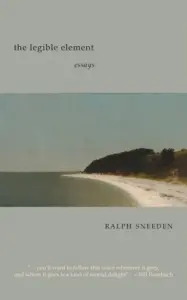
Through the Lens of the Littoral: A Review of Ralph Sneeden’s The Legible Element
By RALPH SNEEDEN
Reviewed By MATT W. MILLER
Narratively driven and lyrically evocative, The Legible Element by Ralph Sneeden is a collection of personal essays that threads stories of surfing, sailing, teaching, fishing, and even pond hockey through deep meditations about adolescence, fatherhood, marriage, family, aging, and the natural world. A kind of memoir-in-essays, the book uses these experiences and the vehicle of the “I” as a way to explore a life lived by and for water.
Sharp Shadows
This poem appears originally in Which Way Was North, published by Louisiana State University Press. Poet Anne Pierson Wiese will be a guest at Amherst College’s LitFest 2024. Register for this exciting celebration of Amherst’s literary legacy and life.
Translation: Master of the House
By AHMET HAMDI TANPİNAR
Translated by AYSEL K. BASCI
Piece appears below in English and the original Turkish.
Translator’s Note:
Ahmet Hamdi Tanpınar (1901–1962), a renowned 20th-century Turkish author, poet, essayist, intellectual, and educator, wrote two of the finest works in modern Turkish literature: The Time Regulation Institute and A Mind at Peace. In fellow Turkish author Orhan Pamuk’s 2006 Nobel Literature Prize acceptance speech, he thanked Tanpınar for his considerable influence and inspiration as a literary icon.
Shenyang: In Search of Reverse Donkeys
By TONY HAO

Shenyang, Dongbei
I wore a cream-white scarf and sat on a plastic stool… Behind me were residential buildings, NE Pharm’s apartments, windows caged behind iron lattices. From a distance, the buildings looked like a prison. Wilted leeks and cabbages were piled neatly on the windowsills: old people definitely lived there. Those cargo three-wheelers we call ‘reverse donkeys’ were chained to the rails in front of the buildings. I sat in the sun in front of the wall, my face hurting from the cold wind.
– from “Free and Easy Wandering,” by Dongbei writer Ban Yu. Translated from Chinese by me.
Literature was my introduction to Dongbei, or Northeastern China, and its capital city Shenyang. I stumbled upon its ongoing literary movement “The Dongbei Renaissance” in 2020, when I was stranded at home during the pandemic. Before then, I’d known Dongbei as Father’s birthplace and China’s industrial center. After reading my first Dongbei book, I found myself shaken by Dongbei’s history and the collective trauma of its economic collapse. Since the 1990s, China’s capitalist reform has obliterated the livelihood of millions of state-employed workers. The proletariats who built their country suddenly found themselves kicked out of their factories into a new identity: penniless unskilled social outcasts. They never imagined being abandoned by their government, which, proclaiming communism, promised every worker prosperity.
Father left Dongbei in 1973 when the state moved Grandpa’s work to Beijing, the metropolis I was born in. I couldn’t imagine what my life course would’ve been had Grandpa remained up north. As an aspiring writer and literary translator, I felt the urge to bring Dongbei to a wider audience. In the summer of 2021, after translating Ban’s 42-page story, I traveled to Shenyang for a literary pilgrimage.
My 38-year veteran cab driver Mr. Wu introduced himself by showcasing his knowledge of Shenyang’s narrowest streets without needing a map. As we drove along Qingnian Dajie, the ten-lane boulevard connecting the airport to downtown, the landscape of boundless poplar trees and crop fields was slowly replaced by newly constructed residential compounds. Mr. Wu pointed out to me the luxury apartment of Zhao Benshan, Dongbei’s most iconic comedian. I told Mr. Wu that I was an English and journalism student interested in Dongbei literature. Mr. Wu told me what the pre-collapse 1980s was like and which cultural landmarks I should visit. I asked him how I could see the old Shenyang portrayed in literature. “You won’t be able to find the old Shenyang anymore,” he said, “the time has completely changed.”
An intense feeling of unfairness gnawed at my heart as Mr. Wu drove me by the glamorous apartment buildings. They erased the city’s impoverished past but in no way offered an extravagant present available to everyone. I decided that even if I couldn’t find Shenyang’s past, at least I’d like to see a reverse donkey.
Reverse donkeys are tricycles unique to Dongbei. Unlike normal tricycles with the passenger’s seat in the front, reverse donkeys have the rider seated above one back wheel and a large freight container installed above two front wheels. Reverse donkeys are usually associated with high-intensity, low-skilled labor. Middle-aged riders squeeze their way through the narrowest lanes in old neighborhoods, hauling cargo loads taller than themselves, making only about ten dollars per ride.
The next morning, I rode a bike through the old industrial Tiexi District, where “Free and Easy Wandering” is set; the names of many roads there still contain the character for ‘workers’ (Gong, 工). On the west side of the eight-laned “Protecting-the-Workers North Street” (卫工北街Wei Gong Bei Jie), concrete apartment buildings soared into the clouds, waiting for windows to be installed. In front of the apartment buildings under construction, a blue metal framework proudly displayed the names of a real estate company, a construction company, and the effusive yet literary name of the future neighborhood: “The Majestic/Honorable Passage-of-Time” (御时光Yu Shiguang). In front of the construction site, herds of Toyotas and Nissans passed, shepherded by occasional Mercedes-Benzes and BMWs.
But only two extra blocks beyond, the streets were taken over by bikes and box vans. The pedestrian pavements were soaked in barbeque-scented water flowing from the roadside eateries. Above those neighborhood venues were rows of grey apartment buildings with crumbling exterior paint and rusting window frames. The Soviet-style former dormitory buildings were built for pragmatic use and had terrible internal lighting. Inside those poorly illuminated units, pink underwear and white baggy tank tops dangled on the clothesline above wood chests, the same wood chests I had last seen in Grandpa’s old apartment. Just like Ban’s protagonist, I quietly reacted, “Old people definitely lived there.”
Dongbei sometimes exists in China’s cultural discourse as the joker, similar to the South in America. A Faulkner quote may encapsulate how I emoted on Shenyang’s streets: “The past is never dead. It’s not even past.”
Staring at the apartment buildings, I found myself self-interrogating for finding familiarity in this real-life landscape that, to me, only existed in literature. I knew this wasn’t a place I belonged. Deep down, I knew that I might be unconsciously seeking to experience a Dongbeiness of my literary imagination. I’d always been repelled by bloggers who visited construction-site workers’ lunch stands or diners, commented on the deliciousness and cheapness of the food, and intoxicated themselves in their sense of “human connections” at these places. It was inherently violent to romanticize and consumerize what, for other people, was hardship and poverty.
My literary pilgrimage exposed me to a morally delicate position. The overbaked idea of the survivor’s guilt—surviving China’s tide of history—could not entirely encapsulate what I pondered. In America, my foreign passport gave me the authority to write about China and translate from Chinese, and my family tie with Dongbei was what drove me to explore the region. But when I found myself on the steamy and mildly odorous streets beneath Shenyang’s parasol trees, I realized that I needed to acknowledge—perhaps even confront—the possibility of gazing in my process of translation. No matter how I could claim my passion and connection, I had never needed to live a Dongbei life I aimed to translate. I found myself always questioning: how have I earned the right to work on my project? How do I know I’ll be able to represent Dongbei to an English-language audience not only via literature but also through the heaviness of its history?
I eventually discovered a reverse donkey next to an old warehouse—it traversed the narrow neighborhood lanes as if a normal tricycle was moving backward. An old man wearing a red t-shirt transported a pile of cardboard boxes in the freight box in front of him. A few feet away from him was a white $150K Range Rover. I had no idea how it squeezed through the narrow lanes in the neighborhood. I remembered what Mr. Wu told me about Dongbei’s heyday in the eighties, when he drove through these same neighborhoods on holiday evenings, how people crowded onto the streets to find taxis to go to galas and parties.
The cardboard boxes wobbled on the reverse donkey. I held my breath, hoping that they wouldn’t fall and spill on the streets.
Born in Beijing and living in Connecticut, Tony Hao is a literary translator of Chinese-language prose. His translation of Ban Yu’s Dongbei fiction has appeared in Crayon, the sister magazine of British literary journal Litro. He recently graduated from Yale, where he majored in English and studied fiction writing and literary translation
Review: Landscapes
By CHRISTINE LAI
Reviewed by S. ELIZABETH SIGLER

The walls of the art gallery behind the rotunda are lined with large paintings of gods and goddesses that loom above the viewer, giving the sense that the mythological figures are larger than life. On its own wall—separate from its goddess-themed counterparts—is an 1817 oil painting by Jacques-Louis David. “Cupid and Psyche” is an arresting image that shows a teenage Cupid smirking at viewers—like he’s letting them in on a joke—as he tosses an arm over Psyche. Both of the painting’s subjects are fully naked. Psyche is asleep, so the viewer can only guess how she would feel if she were to realize how Cupid is showing off his “sexual conquest” by slinging his arm between her breasts.