Photo courtesy of author
Red Lake, Croatia
“Why are they so persistent in trying to explore the unknowable?”
~Comment from a villager, following the latest Red Lake expedition
Time of Childhood
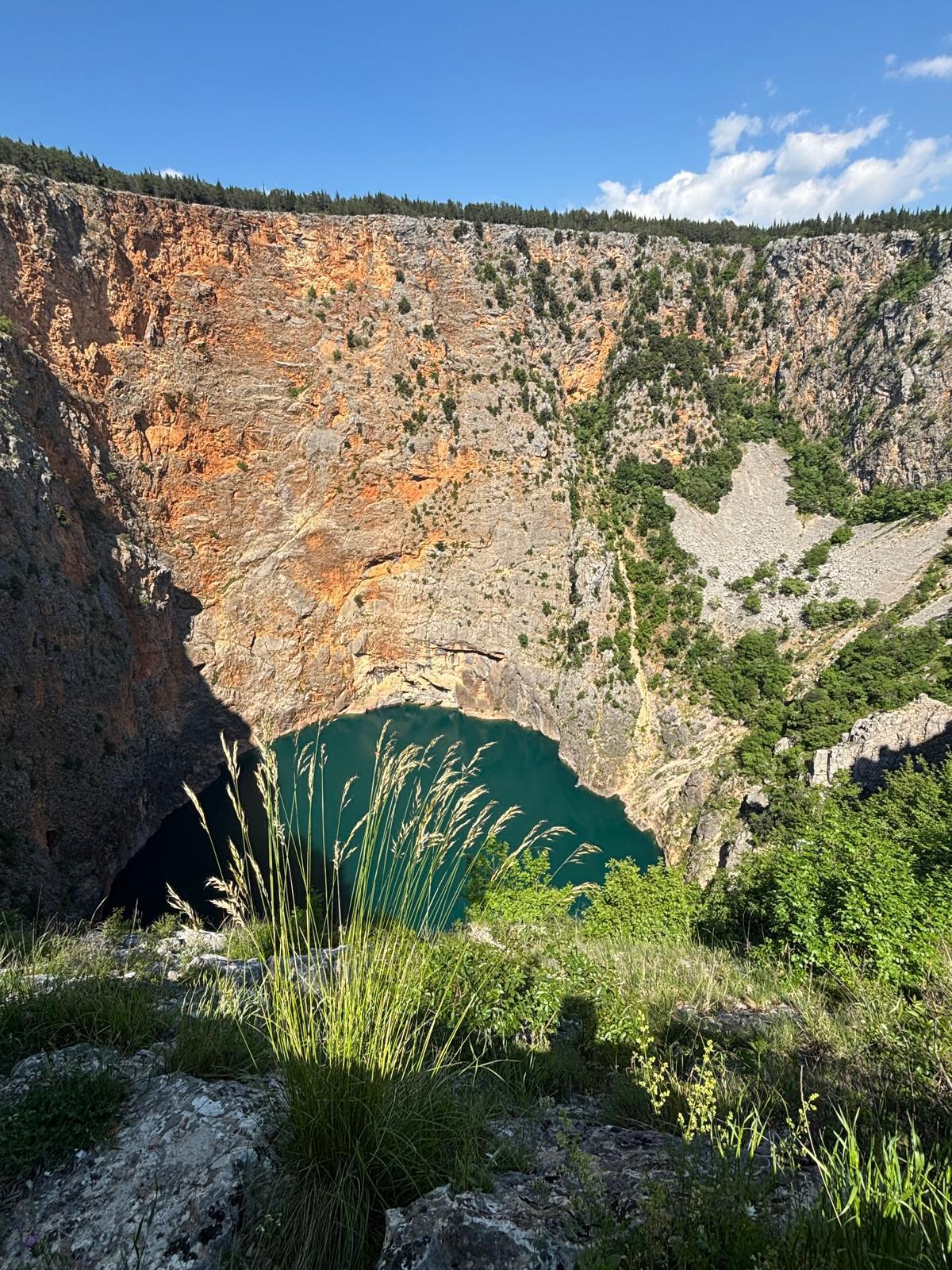
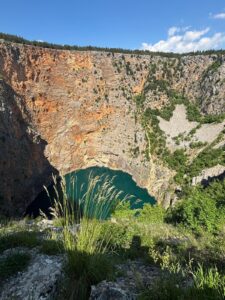
I first saw the Red Lake from above—its stillness startling, almost too complete. I was a child climbing up from the valley below, light slanting from the west as we neared the rim. Adults warned us not to get too close. The wind could lift you, they said—or the lake could draw you in. It didn’t matter that it was a crater, not a vortex. Hush settled over us, even as children. We knew something lived there. Not a monster, but a memory too large for one name.
The cliffs were red, iron-stained, and shadowed. The name stuck. Crveno Jezero. The Red Lake. The water was a deep teal, shifting to jade where it met the light. A color like modra galica—copper sulfate—the powder villagers used to protect grapevines. It was beautiful. And strange. A kind of beauty that resisted being touched.
And then the myth: Gavan, the cruel nobleman, who refused a beggar bread and whose palace was swallowed whole. His wife tried to save her jewelry and was taken too.
Their story is buried in the lake, they say. When you toss a stone in, it doesn’t land. It veers. Slips sideways. Disappears. Some say magnetic fields. Others say the lake judges what’s thrown in. I’ve never seen a stone land. And I’ve tried. The lake holds memory the way the cliffs hold iron: by becoming it.
Time of War
Years later, war came. Yugoslavia cracked open, slowly and then all at once. I returned as an adult, part of a humanitarian mission. Tanks lined the roads; maps were redrawn in ink and blood. Even then, the lake remained still. But its silence felt different—less mysterious, more watchful. It witnessed. We stood at the rim again, tossing stones. My husband beside me, newly arrived from California. This time, I wasn’t sure if the stones veered—or if we had. The lake refused to echo back our questions. It held its secrets.
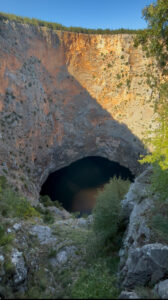
Photo courtesy of author
Time of Explorers
And now, this spring, another team has arrived with cables, cameras, and a 100-kilo mini-submarine. Their goal: map the lake’s floor. Reveal what still lies beneath. They descended to 245 meters, nearly as deep as the great French diver Frédéric Swierczynski had reached in 2017. But again, the lake withheld the final measure. The team ran out of cable. Just forty meters more, they said. But the lake remained quiet.
Still, they found something: a ledge at 220 meters. A vast, flat “skalin,” as they called it—a step, a shelf, a threshold to something deeper. No one knows what lies below. Not yet. And maybe not ever. As one team member said, “Next time, we’ll come better prepared.” But the lake is always more prepared. Its power is not in what it reveals, but in what it chooses to keep.
Stipe Božić was there too, Croatia’s most celebrated climber and documentarian who climbed Everest twice. He entered the lake’s mouth many times and still calls it an enigma. This time, he filmed again—another record of what’s almost seen. Another attempt to trace the shifting edge of a myth.
Time of Reflection
Standing at the rim once more—years after the war, decades after childhood, weeks after the expedition to the bottom, I realized: the lake hasn’t changed. But we have. We’ve sent in soldiers, scientists, submarines. We’ve brought offerings of sonar and story. But the water remains calm. Refusing our precision. Welcoming only awe.
Some say the Red Lake was formed by a collapsed cave, the ceiling fallen into itself. But I prefer the story of Gavan. Not because it’s true, but because it reminds us of what happens when we stop listening. To each other. To land. To history. To warning.
Maybe the lake doesn’t want us to reach the bottom. Maybe its mystery is the message. The veering stones, the vanished depths—they’re not errors in calculation. They’re an invitation. To humility. To witness. To remembering what can’t be measured.
Four visits. Four layers. A child, a witness, an explorer, a seeker. And always, the lake. Untouched. Unmoved. Still pulling sideways what we think we know.
Some stones don’t fall.
Some stories don’t end.
Some places remind us why.
Maria B. Olujic, Ph.D., is an anthropologist and writer who emigrated from communist Yugoslavia to the United States as a child and later returned to serve as Deputy Minister of Science and Technology in wartime Croatia. Her writing examines gendered violence, inherited silence, and the stories held in land and language. Her work appears in AGNI, Brevity, Panorama, Dorothy Parker’s Ashes, Plant-Human Quarterly, Sky Island Journal, Catamaran, Penstricken, Beyond Words Magazine, and 100 Word Story, among others. Her memoir, Fields of Lavender, Rivers of Fire: A Memoir of War, Womanhood, and Bearing Witness, is under editorial review. www.mariaolujic.com