Three Poems by Mary Angelino

By MARY ANGELINO


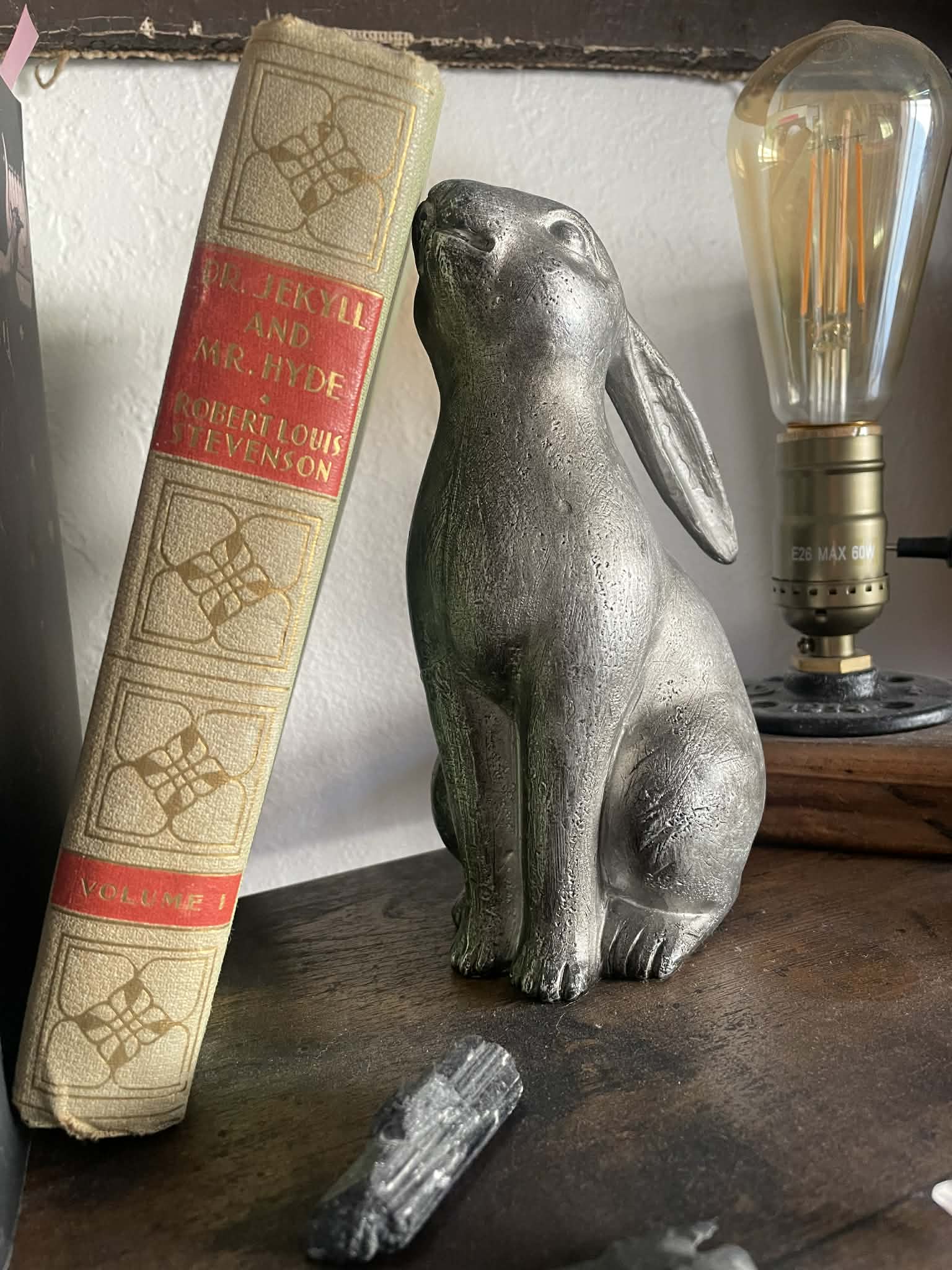
A sculpture bunny leaning against a book


#giftinspo for Cottagecore Girls

Dispatch from Santa Clarita, California,
    nowhere near a cozy forest cottage, August, 2025

Nose heavenward, ears like capsized canoes,
I unbox a silver-gray rabbit, painted to look

metal and heavy. My new useless
bookend. Plastic. Stiff and unsteady—

I would have missed it on a shelf, out shopping
like people used to do, maybe held its weight

in my palms like coins (another gesture
obsolete). It strains to hold the books up

with its chest and muzzle—how earnest it is,
how vulnerable, how easily the algorithm’s sharp beak

found me, small and soft, in Instagram’s tall grasses.


At the Museum, the Girl Imagines Married Life

after John Singer Sargents Robert Lewis Stevenson and His Wife,  
 a dispatch from Crystal Bridges Museum in Bentonville, AR, July 2023

It’s right after they fought                                 or shared a laugh,
the room with its grip                                       on whatever just passed. 
Unnamed and veiled,                                        His Wife has turned from him—
What did he ask?                                               What keeps her silent?
The frames above her                                        (quick smears recast)
are mute                                                             as the empty hall,
flecks of light                                                     leading to rooms
I’ll never see. He looks                                      caught, trapped mid-pace,
but nothing blocks                                            the widening doorway. He faces me
(that careful hand by his mouth)                      and could speak, though
if he did—                                                          in whispers, aimed at the ground.


Girlhood as a Room Folding in on Itself

after Jonathon Schippers visiting exhibit, Slow Room,   
   a dispatch from Crystal Bridges Museum, Bentonville, AR, March 2015

I.

The woman comes back each week

                                                                                        to look at me, to look

at regret—that motor stuck in the living

                                                         room wall, ropes tied

to each object, spooling everything in. She

                                                                       comes back to watch

what leaving does. Today, her portrait

                                                                       splinters—last month, it was only

askew; the old hope chest

                                                                       groans, doesn’t seem to have moved,

but her porcelain plate that hung on the wall

                                                                                    like a moon

is rubble, gone. Ropes smother

                                                                      the secondhand couch, tighten and pull,

and have shattered Nonna’s bowl (the last

                                                                                of the fragile to go).

The rug catches and tightens around

                                                                the piano’s dead weight. What’s left

is heavy but small enough to carry

                                                                       in a suitcase, to save.

II.


                                      stuck                                              tied

to each object,                                     She comes back to watch 

                                               portraits splinter —

                        hope                    doesn’t seem to have moved,

but her                 plate             on the wall

is rubble,

                                                (the last

    rug catches      tightens around              dead weight.

                                                              a suitcase,


III.


            come back                               look

at

what leaving does                 —

     her porcelain                        moon

is          gone.


Mary Angelino’s publications include Fairy Tale Review, The Southern Review, and The Arkansas International, where she was nominated for a Pushcart Prize. Her work has appeared in the Best New Poets 2017, 2015, and 2010 anthologies, and her full-length manuscript has been longlisted for the Lauria/Frasca Prize, the Crab Orchard First Book Award, the Pleiades Editor’s Prize, and the Miller Williams Prize. She teaches creative writing at her community college alma mater, College of the Canyons, in Santa Clarita, California. Learn more about her writing life at maryangelino.com.
From the beginning, The Common has brought you transportive writing and exciting new voices. We are committed to supporting writers and maintaining free, unrestricted access to our website, but we can’t do it without you. Become an integral part of our global community of readers and writers by donating today. No amount is too small. Thank you!

Three Poems by Mary Angelino

Related Posts

Headshots of all the Authors and translators featured

June 2026 Poetry Feature: New Poems From Our Contributors

JEFFREY HARRISON
you wrote when you sent me your haiku. / If only I could send this poem to you, / and you could pick it up at American Express / the way, in 1989, I picked up your letter / at their office near the Spanish Steps / a few doors from the house where Keats died.

Cover of Long Island Girls by Gabrielle Korn

Pink Days

GABRIELLE KORN
The truth is Susan likes Tower Records better, even if it is a chain. First, the size: this huge open space with endless possibility. Also, they always have everything she wants. And the best part is no one judges her. The people who work at Katie’s place don’t even say hi

The Vampire Before NAFTA: A Review of The Voice of Blood

ASHLEY HONEYSETT
The short story collection The Voice of Blood is the first book by Mexican writer Gabriela Rábago Palafox to be translated into English, 35 years after its original publication. Rábago Palafox achieved some recognition in Mexico, winning a number of awards including the prestigious Puebla prize, but was not widely recognized in her lifetime.