By RIMA BRUSI
Translated from the Spanish by JESSICA POWELL
Excerpted from Phantoms
In January 1970, two months before my conception, John Lennon and Yoko Ono shaved their heads, and a few weeks later they released the single “Instant Karma!”
If this thing I’m writing were a script, my parents’ acid-filled days on New York’s Lower East Side would be accompanied by this song. This is what I’m thinking about today as I talk to my mother, Teté, on the phone. This is mainly how we communicate: in-person visits rarely go well for us. In fact, our life together has always been more or less a disaster. We maintain our relationship, what remains of it, with the help of the telephone and letters.
Teté wants to make clear something she considers very important and revealing: that I was conceived during an acid trip. LSD. She didn’t take a lot each time, she adds, but she took it often, and both she and my father were definitely tripping, she says, when they made me.
I’ve never dropped acid, so while Teté tells me the story, I take notes on the things I’ll ask her when she’s done talking: How do you take acid? I think you ingest it (do you drink it? lick it? suck it? swallow it? what does “drop” even mean?), that you don’t smoke it or inject it, but I’m not totally sure. Like so many other children of baby boomers, I tend to be more innocent and straitlaced than my parents.
While Teté explains (yes, you drink it, lick it, suck it, swallow it), I, as always, am a little distracted, my mind on more than one thing. I’m listening to her, but I’m also working on my playlist, a list of songs that were popular during the time I lived with Teté, for me to listen to as I write about these things. I tell her about it so she can help me choose the music, and she tells me that the acid trip of my conception was accompanied by Pink Floyd’s The Dark Side of the Moon. This information doesn’t sound right to me, so I do a quick Wikipedia search to check the date.
“That can’t be right, Teté, because that album didn’t come out until 1973, and we’ve already determined that you conceived me on March 4th, 1970.”
We know that was the date because Teté remembers that the following day, as she was contemplating her possible pregnancy, she heard on the radio that the Puerto Rican police had killed a young student named Antonia Martínez in Río Piedras. In fact, she tells me, when she heard the news, she decided to name me Antonia, and that was my name in utero until Teté read the novel Green Mansions, in which the protagonist, Rima, speaks to the birds and is burned alive.
My names were inspired by two murdered girls. The chosen names could be trying to say something about my mother’s personality. About her paranoia and her fatalism. Or maybe, in her timid, macabre way, Teté was simply saying that there was life in her womb and that it was a girl.
“If the album you were listening to was by Pink Floyd, it must have been a different one…. Maybe Ummagumma, which came out in October of 1969?”
“It could be…. What does Ummagumma mean?”
Teté laughs. She is always or almost always depressed or something like that, something clinical, I’m not sure what, but whatever it is doesn’t stop her from having fun with language, with the sonority of certain words, with the spark, the musicality or absurdity of certain expressions. This is something we share. I laugh too, repeating the word Ummagumma two or three times. I tell her: “It says here on Wikipedia that it means ‘sex.’”
Our amusement swells. She answers, laughing: “It might be, then. It’s certainly appropriate.”
Teté remembers the musical accompaniment being Pink Floyd, but I still think “Instant Karma!” is perfect. We’re both wrong, of course: me because I wasn’t there, and she because she remembers background music that hadn’t been made yet. That’s how memory is; that’s how the fragile and dynamic edifice of memory is constructed.
I don’t think of the “karma” from the song like the karma of the spiritual fads and religious traditions that influenced my parents and their peers during their youths in the United States and Latin America. I’m thinking more about the unexpected but inexorable connection between a decision, no matter how small and arbitrary it may be, and its consequences.
I’m thinking along the lines of what happens to Jacques, a character in a Diderot play. In The Art of the Novel, Milan Kundera tells of how, one fine day, Diderot’s Jacques decides to seduce his buddy’s girlfriend and then gets happily drunk. When Jacques’s father finds out, he gives him a thrashing, leaving him irritated and resentful. So resentful of his father is Jacques that, upon seeing a military regiment pass by, he decides to enlist. During his first battle, he takes a bullet to the knee. He limps for the rest of his life.
So, Kundera explains, Jacques thought he was embarking on a romantic adventure, but he was really taking his first steps down the road toward his own disablement. “He could never recognize himself in his action. Between the act and himself, a fissure opens.” This is the “karma” I’m thinking about when I’m interrupted by Teté’s somewhat exasperated voice; she’s realized—as so many times before—that my mind has wandered.
“Look! Listen to me! I’m telling you that you were conceived during an acid trip. You have to tell your doctor.”
She’s saying this because I’m hallucinating a phantom smell, a chemical scent that no one else can smell, and along with this smell has come a compulsion to write constantly and a mercurial mood that pulls me back and forth daily between the sun and the abyss. These symptoms have led me and my poor head headlong to the doctor. Teté is telling me about the acid trip at the moment of my conception because she thinks this information is relevant for him to understand what’s happening to me. For my part, I think the entire story—with the acid, the marijuana, my parents’ escape to New York, their return to Puerto Rico soon after, their separation, my life with Teté—is important simply because all stories are important, they’re all worthy of being written, and it’s my task to write this one. I don’t know if it’s because I know the story, because it defines me or because it obsesses me. But my doctor does not and will not know anything about the acid trip. There’s no reason to complicate the man’s life. In any case, knowing wouldn’t change his prescription for the antiepileptic.
Teté is insistent.
“The ovum is sensitive, and this was something that happened to you when you were an ovum. I was just thinking about it the other day, about when you were an ovum…. They put me in the asylum and electrocuted me when you were an ovum; then we went to New York and dropped all of that acid when you were an ovum ….”
I laugh to try to defuse the situation a little. If I seem skeptical, it could offend her. Our conversations are delicate dances, minds in flight and bare feet on a tightwire of cordiality and sanity. I say: “That explains so many things!”
“Ha, ha, don’t kid yourself, Rima. Girls are born with all their eggs. When they electrocuted Rimita the ovum, they were also electrocuting your children. The acid affected you, and it could also affect your children.”
When she says “electrocuted,” she’s referring to the electroshock therapy she says they administered to her in a Puerto Rican mental hospital when she was a teenager, back in the 1960s. She doesn’t remember what her symptoms were before she was admitted to that psychiatric hospital. Well, it’s not so much that she doesn’t remember, but rather that, according to her, she didn’t have any. “Being a hippie, maybe,” she adds. “Smoking marijuana, cutting class, having sex, that kind of thing.”
The acid, for its part, played an important role—if not in my own symptoms, at least in the plot of my own biography—even before my conception: the idea itself of getting pregnant and the decision to do it each occurred during LSD trips. The communication of that idea to the guy who would be my father, on another trip. He didn’t appear particularly interested in the news. Teté thinks the acid was distracting him or that he simply didn’t believe her. But her mind was made up.
It’s not clear to me why Teté wanted to be pregnant. But the fact is she decided to get pregnant, stopped taking the pill, announced it to my father, and the two of them went out to look for the clean, good-quality mattress they’d seen tossed on the street somewhere on the Lower East Side, carried it back to the apartment and there, accompanied by that music that I imagine was “Instant Karma!” and she imagines was The Dark Side of the Moon but which was really neither, they dropped acid and conceived me.
“The walls turned to liquid … they turned all different colors.”
Teté says that, a little while later, she felt something in her belly like the torque of an industrial machine or of a washing machine at the end of the cycle, something that compresses and twists and solidifies. That’s how she knew she was pregnant.
Once she knew, Teté decided then and there to quit using LSD. No more acid.
On the other hand, she didn’t quit marijuana or alcohol or cigarettes or coffee. She was of the opinion that those things didn’t have a major effect on a fetus. She also didn’t stop using heroin from time to time. These things, she suggests to me now, pensive, I should maybe also mention to my doctor.
“You have to tell him how you lived before you were born. Tell him there was always weed in the house, there was always a gun in the house. That the house was always a disaster and there was a terrible feeling that the world was going to end, that everything was fucked, that everything was going to get worse. I think I’m the one who should write that book of yours, write about Rimita living with traffickers, with outlaws. My book is going to begin with the electrocution of the ovum. With that end-of-the-world feeling, which has to do a lot of fucking damage to a baby. What you should do is go to Al-Anon. Do you know what Al-Anon is?”
Yes, I know what Al-Anon is, and, no, I don’t want to go. What I want is to write, to create something using these revelations and my memories as raw material. They say that creating heals. But how to construct a memory—in Spanish, memorias, a word that means both “memories” and “memoir”—that begins, that must begin, before my own memories?
I have clues. A few photos. Three, to be exact. And the memory of other photos lost long ago, destroyed or disappeared. I also have tenuous, halting, fragile access to Teté’s mind, a mind that some have declared ill, broken.
In one of the lost photos, Teté is standing in what appears to be a 1970s kitchen, orange and green, brushing her mane of straight black hair, her head tilted to one side, her eyes fixed not on the camera but on some spot on the floor. She’s a thin, attractive young woman with sharp, slightly Amerindian features; big hands and long, slender fingers. That’s what she looked like, I think, when she went to New York with my dad. When she made a light decision with heavy consequences, one that would change her life and begin mine.
Carbon-14
Teté wanted to leave. She needed something else, another life, another place. The landlord didn’t want her there, her mother (my grandmother Lala) was dead, daily life was gloomy and repetitive, the gray floor burned her feet. The mothers and teachers at my grammar school treated her, treated us, with a certain distance, shooting her reproving glances. Her friends no longer came to visit. Lala’s death had left Teté alone, with no support other than Heriberto, her bearded, abusive boyfriend. Teté didn’t have any university degrees or marketable skills, and she suffered frequent “spells” that left her sprawled on the bed, exhausted from pain and nausea.
Unemployment was on the rise in Puerto Rico. The following year, 1976, it would reach a record 20 percent.
Then there was my “illness,” a mysterious syndrome that began with Lala’s death and included a baffling cough, falling out of bed, enuresis, and new and never-before-seen tantrums. The doctor mentioned asthma and anxiety, but Teté never trusted doctors. The explanation, she said, lay elsewhere. Modern society was sick: the air, the culture and life were polluted. Teté wanted to live somewhere good, healthy, clean, where we would have oxygen and vegetable gardens, where I would recover and have friends to play with.
Heriberto agreed. He talked about his passions, his vocations, his resistance to participating in the world of capitalism and proletarianization. “What do they want—for us to work in a factory?” He wanted to be a potter, he insisted. For her part, Teté had decided that she would learn to grow plants and use them to heal people.
“We have to leave. We have to leave.” That’s what they talked about all the time, and always in that urgent tone.
They had a small stipend from Lala’s life insurance policy. In Puerto Rico, that provided barely enough for us to eat, but… what about somewhere in Latin America?
I remember long, almost happy days during which I ate cheese and they discussed possible destinations: Mexico, Bolivia, Peru. Somewhere green and clean where they could benefit from the exchange rate with respect to the dollar and also, incidentally, from the help of the Indians (the presence of “Indians” was a nonnegotiable requisite), and devote themselves to pottery, planting, and healing. They would homeschool me, and we, as a family, would dedicate ourselves to the land—to the earth, to the clay. We would grow all our own food and marijuana. We would be happy, immersed in an Indigenous and pure lifestyle, the antonym of and antidote to the suffocating modernity of the U.S. colony that was Puerto Rico.
A friend, whose opinion they respected so much that they let him drink all their beer and smoke all their weed, recommended Colombia as the best option because it was more traditional and had more Indians. It was a good place, “especially to raise the little girl,” the friend assured them.
Today I wonder how the Colombians saw us during our initial stops in Barranquilla and Santa Marta, which cultural filters they would have used to interpret the image of the long-haired couple going from bar to bar asking about Indians and potters and healers. I suspect it wasn’t all that uncommon to run into American hippies in search of the “natural” life, but even so, it must have been confusing, those Spanish-speaking hippies with vague aspirations of being Indigenous potters. In any case, at some point, in some bar, someone offered to put them in contact with an “Indian” named Pedro Narváez.
Pedro said he knew about pottery, horticulture, and healing, and he invited Heriberto to move us to his small compound where, apparently, other hippies had stayed in the past. Teté would have preferred for us to go live with the Arhuaco, who were “more Indian” than Pedro and who lived in the Sierra Nevada. Some Arhuaco spoke Spanish, Teté once told me, but the majority spoke Chibcha, their own language. They dressed in white. But the Arhuaco weren’t interested in fraternizing with hippies. Furthermore, Pedro Narváez’s people offered another advantage: they had tons of marijuana. And so we went with him to his compound, which was in the village of Palomino, half a day’s ride by bus and on foot from Santa Marta.
Pedro and his extended family (they were the ones who made up the “compound”) didn’t look like the images my child’s mind had assigned to the category of “Indians,” images I’d probably acquired from dubious sources such as the popular Mazola corn oil ads: copper-colored skin, straight hair, loincloths, everyone looking more or less alike. Generally speaking, they all looked different from one another—some had paler skin, while others were darker; there were noses both snub and aquiline, curly and straight hair, and more or less almond-shaped eyes. They looked like Puerto Ricans: poor, skinny, in second- or third- or fourth-hand clothing. We began to look more and more like them, too, and as time went on I grew wilder and wilder: I bathed only in the river, occasionally, and never with soap. I wore the same little dress every day and my hair filled with lice.
Those were a real problem and a source of discord, those lice that found me so sweet. They went from my head to Teté’s and from there to Heriberto’s hair and beard. He grew irate whenever he felt them biting, and though it implied a certain degree of danger, this made me very happy. Teté would delouse my head every once in a while, and I would do the same for her, but even with four hands it was almost impossible to delouse Heriberto, because he was unlucky enough to have louse-colored hair.
It was from Heriberto that I learned the word cocotazo, “a whack on the head”—it was the direct object in many of the sentences that constituted our dialogues. His rage was mostly provoked by expressions, words, or actions, glances at or away from him, anything he interpreted as a “lack of respect.” But he was also annoyed by all laziness except his own; by the habit (mine) of peeing in my hammock while I was asleep; by the distance between our imagined lifestyle and the poverty of our daily life in Colombia, a life he’d imagined as Indigenous, not indigent; by how difficult planting, carpentry, and pottery turned out to be; by the control Pedro asserted over the marijuana because it was the compound’s main source of income and he couldn’t allow those hippie freeloaders to smoke it all….
That’s how we arrived in Colombia and in Palomino: looking for Arhuacos, but settling for those generic Indians dressed in Salvation Army clothes, members of an uncertain tribe who treated us with a mixture of curiosity and indifference. We came looking for the natural life, seeking health, especially for the little girl, me.
We had to hightail it out of Palomino and Colombia without finding any Arhuacos, because the little girl became gravely ill: first with sores that covered my entire body, the scars from which I still bear to this day; followed by an infection in my right leg; and finally, fever and delirium. Back in Puerto Rico, they took me to a hospital, where I was treated for sepsis. “Just in the nick of time,” the pediatrician said, in the same accusatory tone my teachers used at school, the same doctor who would later treat my cases of impetigo, German measles, and several bouts of pneumonia.
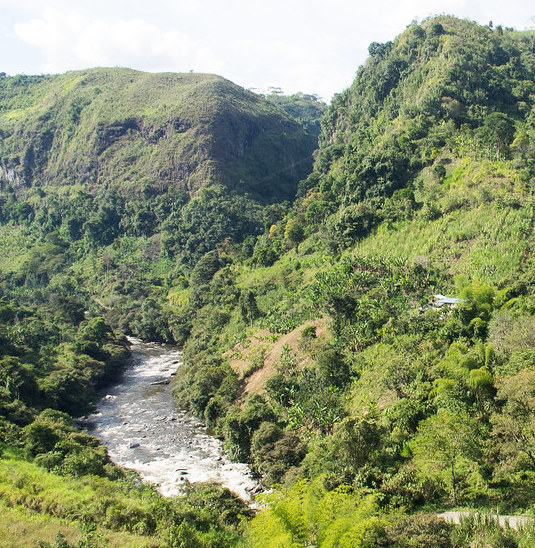
I have very few memories of Colombia and Palomino. More than anything, I have a collection of omissions, linked one to another by the echoes of certain sounds and the fragments of certain landscapes: Teté crying, Heriberto bellowing, and me spending more and more time far from the village, down by the river, where the monkeys and the birds lived in the tallest treetops of my life and in the world, where the rocks were slippery, flat, in perfect grays and ochres.
The Narváez Indians’ pottery turned out to consist mainly of the production of little animals, which, along with the marijuana, they sold to intermediaries who in turn sold them to tourists as “authentic, carbon-dated, Indigenous artifacts.” Thus, the heart of the compound’s economy was a clearing near Pedro’s cabin, with a garden, a few mounds of partially processed marijuana, and holes in the ground—some covered over with wooden planks I never dared look beneath, others covered with blankets and filled with little animals ready to be sold. Pedro would sometimes sit there and drink aguardiente with his trusted circle of men and intermediaries, celebrating sales with louds bursts of laughter, sometimes punctuated by the adjective “¡pendejos, pendejos!” and the phrase “carbon-14, carbon-14!” The pendejos, the aguardiente and the carbon-14 put them all in an excellent mood and were occasion for more than one fiesta.
Translated by Jessica Powell
Excerpted from Phantoms by Rima Brusi, translated by Jessica Powell, published on November 30, 2026. Copyright © 2026 by Rima Brusi. Used by arrangement with Arte Público Press (artepublicopress.com). All rights reserved
Rima Brusi is a Puerto Rican writer and scholar whose work moves between creative nonfiction, ethnography, and applied research. Her book Fantasmas won a PEN Puerto Rico Premio Nacional in 2020. She is a professor at Northern Arizona University.
Jessica Powell is the translator of Pedro Cabiya’s Reinbou; Sergio Missana’s The Transentients; and Gabriela Wiener’s Nine Moons, a Kirkus Best Nonfiction pick. She received a 2011 NEA Translation Fellowship for Antonio Benítez-Rojo’s Woman in Battle Dress, later a PEN Center USA finalist. Her translation of Cabiya’s Wicked Weeds was a finalist for the 2017 Best Translated Book Award. Other projects include Pablo Neruda’s Venture of the Infinite Man and co-translations of works by Adolfo Bioy Casares and Silvina Ocampo.