By TOLA SYLVAN
Photo courtesy of author
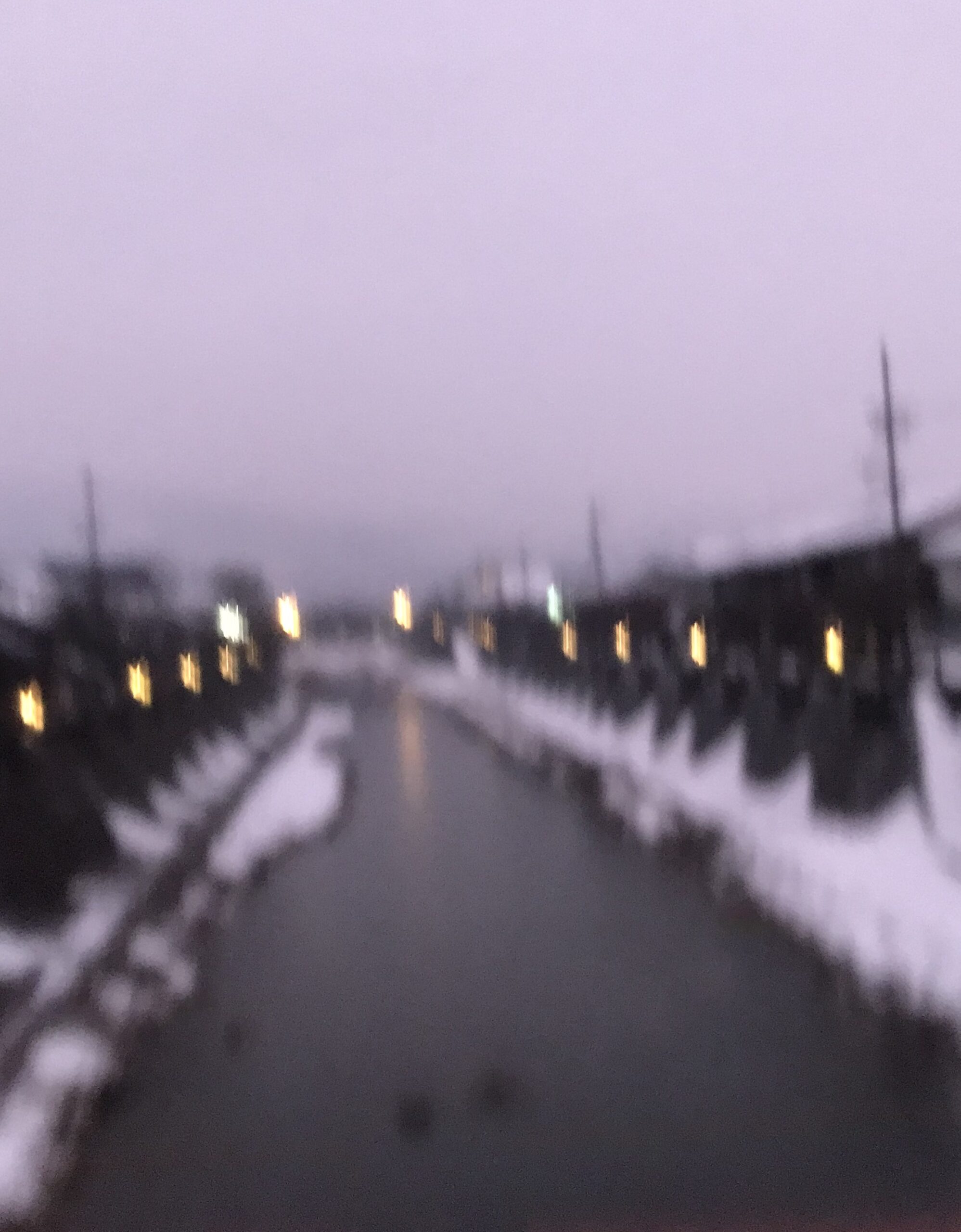
Hida Furukawa, Japan 2025
I
I make a list of some observations:
the baby’s cheek, below it
spidery veins like a leaf
stalk of tempura (crab or shrimp? something pink)
pale yellow like a new bud in spring
II
I am interested in the long translucent nails of the girl that wound up in a place. Don’t we all? Sometimes the stories are particular, sometimes they are grand, like rubble sliding down the face of a cliff. She seemed local, like a diamond in the hand. The edges of her kept the snow and the trudge and the tourism out. She brought me a small tall cup of sesame cream.
III
My nails are painted and wrinkled, they remind me of a gym floor.
IV
What is a winter wonderland? It is a place incredible, only wonderable. Is it possible for the boughs to support such weight and softness. Or for that feather to then fall glinting as a knife. The impression of dripping and drying. The smooth cool blue of the lake, behind it, always behind it.
I am like a thread through the snow if the thread were a train, and if sewing held any perspective. Sometimes, we are relegated to pinholes. We attach one thing to another. We don’t get to breathe.
The cabin with its wide windows seems designed for breathing and seeing. Here you are, moving through space, being. Nothing is asked of you, though you may smooth out pages of a book on your knees, or settle back with sound. Here you are, you must maintain your full being, in order to be moved through space, and into new dripping time.
V
The bear is depicted on a white placard at the gate. His jowls straight as Lego pieces. The teeth perfectly straight.
The bear rises on a placard at the metal gate, above the snow. And before the snow, and after the snow. The bear certainly exists. It is composed of death, death, death, or, the outline of it, aka Danger. Crunching through any iceway, sloshing through any runway, you hear the faraway grunt or snap of a twig: this is the Idea of the Bear. This is how the Bear may approach for an Incident. It approaches through the mind, sensation. It is here and not here.
The gate also says: keep closed to keep beasts out. Out of the village with its low strung lights, its shops with sweet things painted to look like sweet things hanging from trees in memory. It is winter: still some sweet things grow on trees, hang on trees, swinging, fluorescent, deflated and pendulous.
VI
Besides being long, fluorescent, an extension of the girl (a woman, also a girl), her nails are slightly indigo. And, what’s more, they are painted with tiny small yellow and white dots, which, if you looked closely, invading her intimacy, you might discern to be daffodils, daylilies, daisies, or rose. They are feminine, no matter what. They say: here is the outside of myself, my hardshell exterior, with its wily and yet decipherable messages. They make it hard for her to type on the small screen of your phone: a dash or an underscore. Such a difference in position could be the difference between unlocking a code. Could be the difference between ever speaking again, again with the distant world.
VII
Was it a place, the small round nut, with its crispy sand exterior, its umami taste, exploding on her tongue?
VIII
The tub is not a tub itself, but a tub in another context. Black-lipped. Lined with real crispy snow. Beyond it, bending branches, a pathway trodden by warm feet, and other tubs in there and this new context, the context of a fantasy-land, dripping with sky-snow. Inside the tub, there is the outline of a body, inside of which there is burning, the confusion between heat and cold. The body is trying to stay cold. I refuse to be melted, to be scathed, the body says. Let me float alone.
IX
The barriers. They were soft grey, flanked by themselves, startled by shadowy trunks.
X
It is not difficult to move up the mountain. Contrary to the low trickle of water, pressing forth against and under concrete. The mountain, its earth, crusted in a thick layer of snow and snow-come-slosh, allows each thigh a pinhole. Prickling of the face. Light breaking beyond.
Tola Sylvan is a poet and translator. Her work appears in Ploughshares, The Iowa Review, Poetry Northwest, POETRY, and the Adroit Journal, among others.