By EDY POPPY
Reviewed by BRITTA STROMEYER
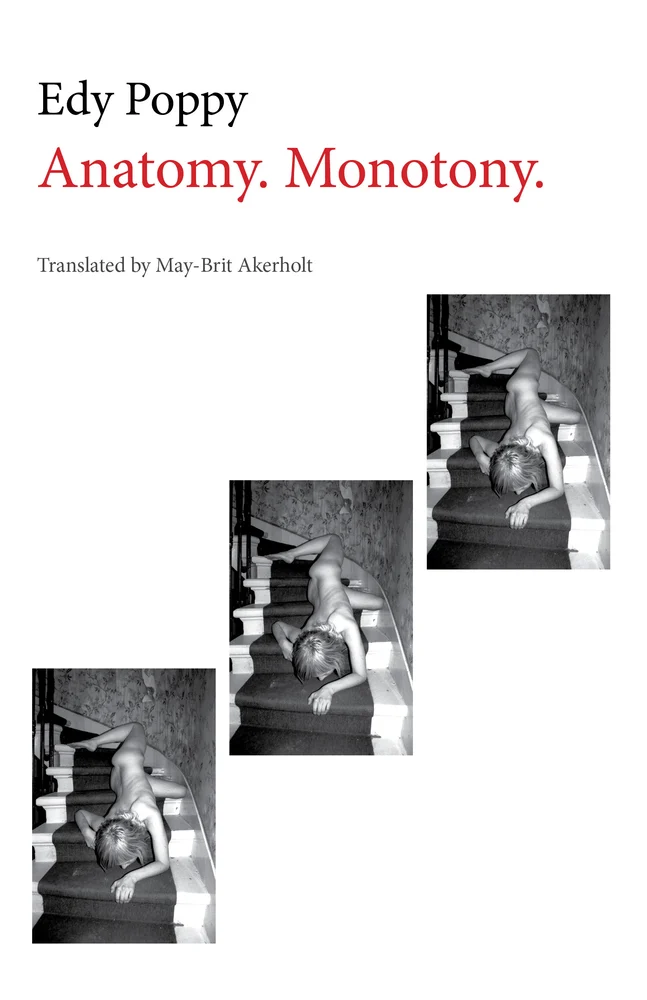
“For my husband, who has given me everything, even what I didn’t want. (He’s now my ex-husband.)” reads the dedication in Edy Poppy’s award-winning and spicy debut novel Anatomy. Monotony. It’s an irresistible hook, inviting the reader into a novel that explores the author’s experiences in an open marriage, the evolving sense of place as a search for identity, and the adventure and challenges inherent in the act of writing itself:
“I want to write about the people, the loneliness, and the language here. I feel at home but I’m a stranger, don’t belong, can’t express what I truly feel.”
Originally published in Norwegian in 2005 and later translated into English by May-Brit Akerholt in 2018, the novel challenges conventional notions of fidelity, passion, and intimacy. It is a daring story that seamlessly blends fiction with autobiographical elements, creating a narrative that is both emotionally raw and poetic. The novel has experienced a resurgence in popularity with the recent publication of Poppy’s new short story collection, Coming. Apart., released in translation this October. While these two works are structurally distinct, they are engaged in a compelling literary dialogue, and their reading experience is considerably enriched by reading them as a companion text.
Pushing the limits of sexual and social convention to forge a personal and artistic identity, Anatomy. Monotony. centers on youthful Vår, a Norwegian woman living in London with her French husband, Lou. Their callow and unconventional marriage is built on the premise of allowing both partners to explore their desires with others. Vår’s various relationships reveal her vulnerability, her need for validation, and her struggle to reconcile her identity as a wife, lover, artist, and individual. Lou is a philosophical and enigmatic figure, introspective and often emotionally reserved. His love for Vår is unwavering, yet their arrangement leads to unexpected moments of jealousy and pain.
The narrative shifts between Vår’s present turmoil and her traumatic memories of the fire that dissolved her childhood home into ashes. The text also features a novel-within-a-novel where Vår (a writer) fictionalizes a character named Ragnhild (Edy Poppy’s birth name) which mirrors Vår’s experience, blurring the lines between past and present, creation and confession, resulting in a richly textured emotional landscape. The story concludes with Vår and Lou leaving London to return to Vår’s childhood home in Norway, seeking to redefine their relationship.
The use of fragmented shifts and evocative chapter titles mirrors the restless nature of Vår’s inner world, offering a unique feeling of intimacy and immediacy. While the resulting jumps in perspective and time can be disorienting, the structure reinforces the emotional stakes and narrative layering. For example, Poppy uses the chapter titled “La Dolce Vita” with striking irony, applying it to a scene of hidden suffering for Vår. The prose opens on a strained breakfast shared by the narrator, her husband Lou, and Lou’s lover Sidney, where they cling to a fragile façade of normalcy despite the latent tension simmering between them. The narrative quickly shifts inward, detailing the narrator’s rankled emotions as she observes the interactions between Lou and Sidney.
The subsequent, equally short chapter, “Just a Few Little Scratches,” delivers an abrupt transition to Ragnhild, with the title itself pointing at emotional injury. Ragnhild’s visit to a gallery and her reflection on Frida Kahlo’s art are a reflective lens, allowing her to find artistic parallels for her own suffering. She secretly observes her husband Cyril and his mistress, Beverley, in the gallery, mirroring Vår’s emotions about Lou and Sydney:
“He doesn’t know she’s in the gallery. He comes walking toward her but doesn’t see her, because he only has eyes for Beverley. Ragnhild hides and watches them in secret. She doesn’t see what Cyril was talking about, the platonic side. What she sees is more concrete. She feels that they’re growing inside her like the roots of a tree. She wants to cut her stomach open with a knife, to get a big, cold pair of tongs and tear them out.”
The protagonist’s journey is one of urgent self-exploration as she grapples with her identities. Her relationships with Lou, The Lover, and the American reflect different facets of her personality and desires. Vår’s path is one of emotional fervor, as she ventures into a series of all-consuming and volatile relationships:
“As soon as the taxi with The Lover is out of sight, it begins to rain as a sign, a symbol, of something that’s over. I don’t care if I get wet. I like that nature is washing me clean, that my clothes become like skin on my body and my hair is glued to my face. I like the smell of wet asphalt, of exhaust and trees, of the fresh and the rotten mixed together, old piss, vomit, grass…”
Through her affairs with The Lover, a painter, and later with the American, a cellist, who both become muses for her writing, the novel probes the relationship between art and life, driven by Vår and her lovers’ reciprocal function as artistic muses in a connection that is not purely sexual. The intentional use of the small ‘t’ and capitalized ‘T’ is representative of their varying degrees of influence and importance in shaping Vår’s life. This dynamic is channeled through Vår’s writing, The Lover’s painting, and the American’s music, all of which serve as outlets for their desires. The creative process is depicted as both a refuge and a source of tension as Vår reflects:
“Writing is like creating a child: it has your blood, your genes, but in the end, it is something else, with its own personality, its own life, different starting points, but still related…”
The novel constantly negotiates the boundaries of Vår and Lou’s commitment and the testing of their emotional resilience within their open relationship. Early on, the novel grants the reader access to Vår’s troubled perspective, allowing them to witness her fundamental conflict and setting the stage for her emotional journey:
“I have to separate sex from love. I want my husband to be the only one to get both. I believe I don’t need to love anyone else, that he can take care of that side, that as well as the intellectual. Because the only thing he needs help to is the erotic, orgies, men who take me from all sides and are sexually almost bestial. I think I should be satisfied with that, because I get more than most women. Of freedom.”
I recently caught up with Edy Poppy on her U.S. book tour. Our conversation took place in person and via email and has been edited for brevity. I asked Poppy about this tension between freedom and commitment as central to the novel’s power and how she approached the portrayal of Vår’s conflict between guilt and the continued prioritization of her own desires. Poppy emphasizes that Vår is her alter ego, who inherited many of Poppy’s real-life experiences and relationships: “I always wanted to explore life to its fullest: to be an individual first of all, then an artist, before a lover or a wife. It is not that I deliberately created Lou, The Lover, and the American to expose specific sides of my narrator. Rather, it is the other way around: those people already existed in my life, and perhaps they did so because they made me engage with these different archetypes within myself.”
Poppy explains that her character Vår is driven and consumed by a thirst for adventure and unsettlement. Each setting in the novel—Montpellier, London, Amsterdam, and Bø—serves as a distinct character that actively contributes to Vår’s ongoing search for identity and stimulus. Bø, Vår’s childhood home, represents a secure, predictable past that the protagonist must escape, described by Poppy as an “identity prison.” The trauma of losing this home (which burned down when Vår and Edy Poppy were eight years old) was the original catalyst for Vår’s desire to explore the world and actively not settle. “Vår is not seeking a home in any of these places.” Poppy tells me, “She had a home once and only once, and that was her childhood home on the farm in Bø. But it burnt down when she, and I, were eight. Losing that childhood home was the beginning of writing and wanting to explore the world. Not to settle, but to unsettle.”
In contrast, Poppy tells me that Montpellier personifies the flavor of “the first wild love, heat, beach, sand between your toes, endless night in the sunset, ménage á trois,”—gentle, caring, and experimental—while London is a complex, demanding entity: “a terrible husband, but a terrific lover,” offering intense excitement but ready to pull Vår down. “London is a beautiful bitch,” Poppy adds. Amsterdam, the least known to the author and the character, becomes a place of vulnerability, exposing Vår to the territory of the American. “Amsterdam, in my story, is the mystery, the unavailable lover,” she says. Ultimately, the various settings fail to provide security; instead, they succeed in providing the necessary impetus for Vår’s restless exploration, reinforcing the novel’s perspective that the protagonist’s purpose is to continually unsettle rather than seek a stable, internal state of belonging.
Peeling back the layers, I was curious how Poppy used the evolving sense of place—the shift from major cities to the isolation of Bø—to explore the inescapability of internal struggles. “A big fear of mine was to move back to my village Bø,” Poppy replies. “There is a myth that moving around is escaping, and that staying where you are is dealing with your demons. I don’t agree. Of course, you cannot escape yourself. But that self might feel better or worse, depending on where you are, literally. I don’t feel myself in the same way if I’m in Bø, Montpellier, London or Amsterdam. Moving can be a solution. The people and the culture in a certain place might be more compatible to your personality, dreams, longings, ambitions etc., than they are somewhere else. Moving back to Bø for my alter ego Vår to finish her debut novel Anatomy. Monotony. (the novel within the novel), was not such a great idea…She couldn’t really handle herself there. But she could write about not handling herself there (like I did); a writer’s privilege, whether fictional or real.”
Anatomy. Monotony. may not offer American readers the satisfaction of a neatly tied-up ending. The narrative suggests that time doesn’t necessarily heal wounds but instead makes them less visible. I asked Poppy if this was her intention, and if she agreed with the statement, that time, while making old wounds less visible, creates new forms of emotional hurt and displacement. “Time itself is not enough to heal wounds,” she says, “You have to want to heal them, work on letting go of that pain, of your position as victim or perpetrator. Vår doesn’t always want to heal. Wounds are gold for writers. Something to deal with and to process.” Poppy points to a passage in the book:
“The ridiculousness of tragedy hurts me, while the misery of comedy makes me happy. I start to laugh. I want to laugh myself to death so I can no longer feel any fear. Tears of grief turn into tears of laughter, lovely and warm down my cold face. I don’t want to be passive, I want to be strong and independent […] My wounds haven’t healed, but that’s because I constantly pick at them, study them, describe them…And why? Because the personal is global and the global is impersonal. We’re all unique, and that’s what makes us so similar.”
Poppy’s self-proclaimed next wound is her short story collection Coming. Apart., dedicated to Poppy’s divorce from her husband. “After the collection was finished, the wound was healed, and he is now one of my best friends,” she says. The strength of Anatomy. Monotony. lies in Poppy’s bold willingness to unpack taboo topics—love, sex, and fidelity—with unflinching honesty. The prose is lyrical and evocative, capturing the messy emotions of her characters through stunning imagery and symbolism. It is a turbulent and wrenching reading experience. Poppy not only tells a story but compels the reader to question their beliefs and assumptions about the structure and limits of love and intimacy.
Britta Stromeyer is a member of the National Book Critics Circle. Her writing appears in The Common, Tupelo Quarterly, Beyond Words Magazine, Necessary Fiction, On the Seawall, Flash Fiction Magazine, Bending Genres Journal, Marin Independent Journal, and other publications. Britta has authored award-winning children’s books and holds an MFA from Dominican University, CA, an M.A. from American University, and a Certificate in Novel Writing from Stanford University.