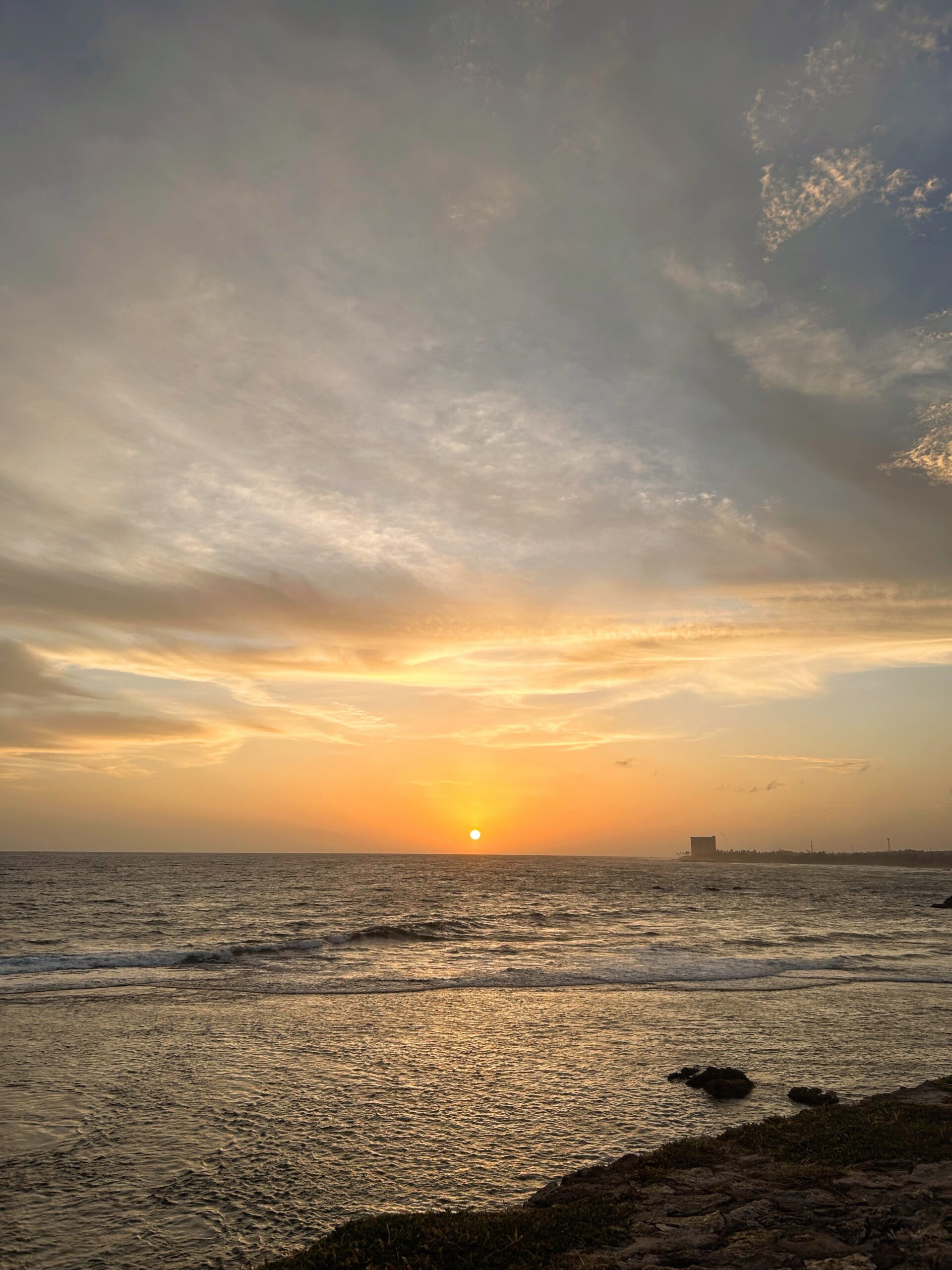
Galle Fort, Sri Lanka
Back home, the salt arrives before the sea. It rides on the evening wind, settles in your pores, and clings to the stone walls of the fort. On some evenings, when the waves are rough enough, the salt-bitter perfume of the sea accompanies a loud orchestra of sloshing and shushing, water lazily kicking the moist green moss on the bottom of the walls. Long before the sea comes into view, you taste it, saltier than the isso vade sold by the old man who pushes his cart through the fort everyday; you hear it, louder than the fretful tourists on the ramparts determined to take the perfect sunset photo for their Instagram; and you most definitely feel it, stickier than that melted Belgian chocolate ice cream from the nearby Gelato, dripping all over you.
When the sea finally reveals itself, it is sometimes a disappointment. It lies there in impossible shades of blue, hurling itself against the black rocks thirty-nine feet below the fort. You can lean over the stone walls until your stomach knots, you can watch the waves rise and collapse into white foam, you can let the salt settle onto your skin until it becomes part of you, but you cannot touch the water. Instead, the fort catches everyone in a trance, staring down and wondering how high up they are.
The wall climbers did not mind the thirty-nine feet.
They climb on to the short wall separating the green-grassed ramparts from the steep slope of the wall bordering the sea, right next to the boards saying, “Do not climb the wall.”
The wall climbers are connoisseurs of admiring the sea from 39 feet above. They are just happy that the sea exists, that they exist to taste the salt in the wind and to hear the waves thrashing. Every day, they gather to watch the sun collapse into the horizon right around 6:33 pm as razor-sharp edges of sunlight cut through dark blue waves. They know the sunset is even further than the sea, but they find joy in bearing witness to the sky surrendering itself to colors—in leaning a little farther over the wall, just to see the colors reflected in their neighbors’ eyes.
Long before I could write my own name, I was an expert in wall climbing. There was nothing else I wanted to do at 6:33 pm every day than absentmindedly swing my legs from the thirty-nine-foot wall and stare at the backs of the runners disappearing into the sunset. Every day, I ran to the fort faster than the razor-sharp sunlight while its briny otherworldliness waited to greet me: the runners on the rampart, the salty wind, the fellow wall climbers, the loud waves, even louder people, and, of course, the sunsets.
We wall climbers were all experts in waiting—waiting for the salt, the sea, the sun, and a split second of satisfying awe at the end. Every wall climber had their own way of measuring time. Some counted the waves. Some searched the clouds for familiar shapes, naming every animal they could find in the sky. Some wondered how fast it would take to touch the sea if they jumped, if they could avoid the sharp stalagmite rising up from the bottom of the ocean, if they could make it back alive after all. I knew jumping was not impossible. There was a man in a half-buttoned black shirt who jumped off the fort every day. His profession was to entertain tourists by jumping off the 39-foot-tall wall into the sea, perfectly avoiding all the deadly rocks waiting to stab him.
I, however, measured time by my father’s footsteps. Every Sunday I would wait for my father to finish running laps around the fort, watching him disappear next to the bastion while swinging my legs thirty-nine feet above the furiously loud waves.
*
“We should all go to the fort when you come back.”
My mother sounds desperate, so I give an unconvincing nod that looks genuine enough through the blurry screen. She asks if I watch the sunset here too, and I explain that it’s not the same; that in Amherst, Massachusetts, the winter swallows the sun long before 6:33 pm and there are no walls to climb.
“Remember when we all used to go there together?”
“No, not really, that was so long ago. I was so young, I don’t remember.”
The lie leaves my mouth so easily that, for a moment, I almost believe it. Some memories are too large for a video call that freezes every second. After twenty-three minutes of updates on how everyone is doing back at home, I prepare myself for the next call and make a mental list of the questions my father will ask me: Did I eat? Yes; Am I sick? No; Did I miss any classes? No; Are my grades good? Yes; Am I having fun? Yes.
I lie down on my bed and stare at the ceiling. It turns out, I am still an expert in wall climbing. Somewhere along the way, the thirty-nine feet between my dangling legs and the sea have stretched into ten thousand miles, and waiting for the rampart runners has been replaced by waiting for five-minute conversations over a screen. Funny how everyone warns you about long-distance partners but not long-distance parents.
The hideous concrete ceiling is suddenly glowing azure. There is a blinding golden light on the horizon where the sun has started to set. A six-year-old me is swinging her legs; my mother is sitting on the wall with me. She shows me the man in the black shirt jumping from the wall perfectly avoiding the stalagmite. “Is he going to be okay?” I am too young to understand. “Yes honey he will be fine. Look at those fishermen, do you want to wave at them?”
With my mother, I wave at the small black boats disappearing into the sun while my father appears from the right finishing his first lap. The stone beneath my legs is still warm from the afternoon heat. He does not stop to wave, he never does. Right above him, the sun unfurls her gilded fingers through the white clouds, coaxing the waves into iridescent laughter. The glowing azure sky slowly melts into gold. As my father rounds another lap, the sea surrenders its clarity to sunlight, turning the waves as green as the moss.
By the end of his second lap, the golden sky blushes, crushed seashells thrown across the clouds. I wave at him but he does not stop. There are marigolds and tangerines in the sky. The briny wind tangles my hair and whips across my face. My father disappears behind the bastion. Every lap, I wave, and every lap, he keeps running. The marigolds have set the sea on fire. When he reappears, both the sky and the boats have melted into a singular puddle of obsidian ink. My legs have fallen asleep to the lullaby of the waves. I listen to the bottomless sea madly thrashing against the wall thirty-nine feet below, then my father’s footsteps disappearing into the somber sky to finish his third and final lap. I keep my hand raised a little longer and try to imagine, just for once, how he would look if he turned to wave. Even at six, I was an expert in wall climbing.
When I open my eyes, I wonder if the fishermen on those boats had daughters, too.
Amaya Ranatunge is an Editorial Assistant for The Common. She was born and raised in Galle, Sri Lanka, and is currently a junior at Amherst College, where she studies English and Political Science. At Amherst, she also works as a writer for other student-led publications, such as The Amherst Student and The Indicator.