Translated by DANIEL CARDEN NEMO
Translator’s note
Marin Sorescu, despite being one of the most translated Romanian writers, is one of the literary world’s best kept secrets. The reason for it, to my mind, lies squarely in the quality of existing English translations, as many of them have failed to capture his poetic essence. Twice nominated for the Nobel Prize in Literature, he never received the award based on his translated work.
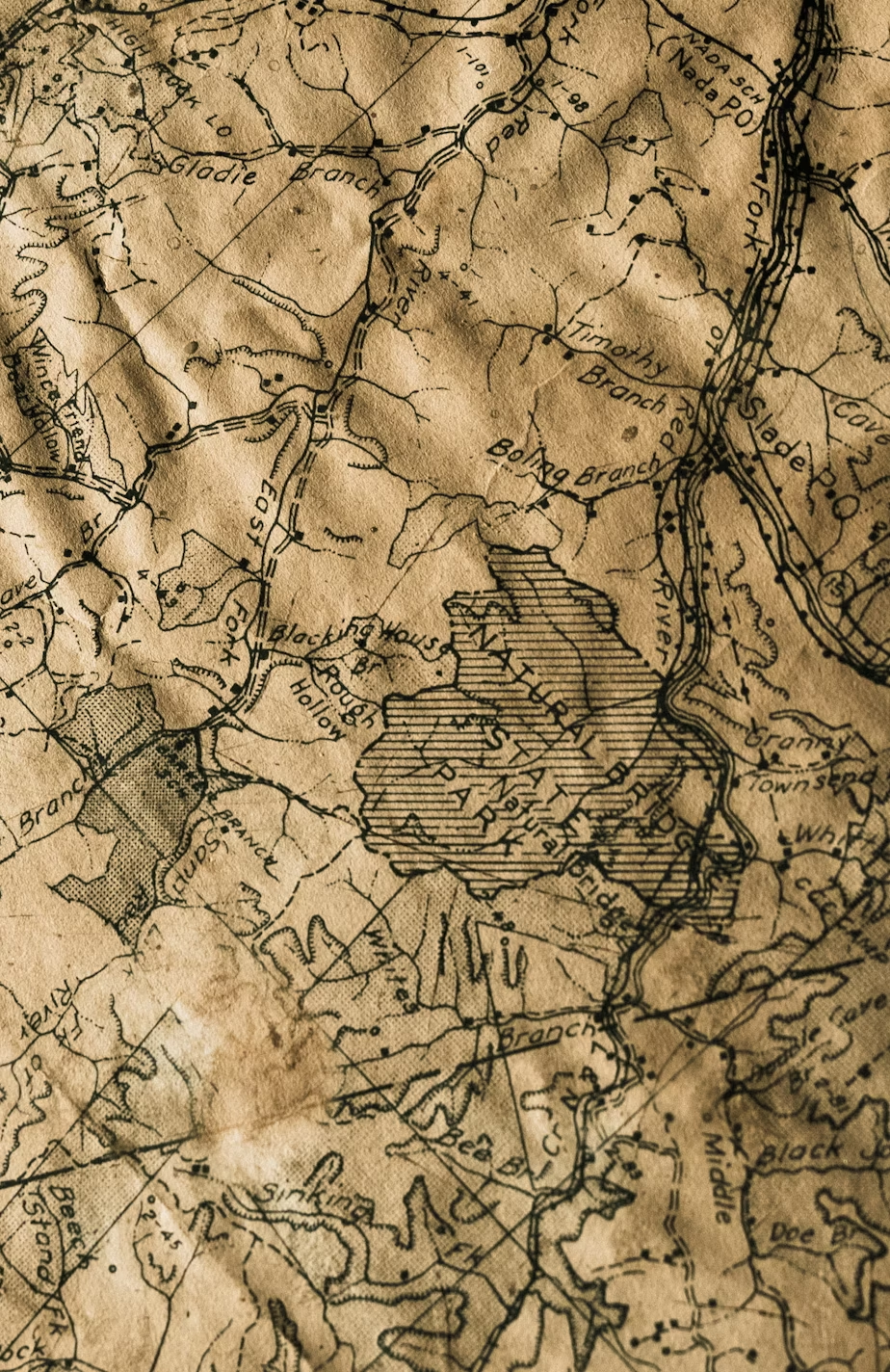
Like many of his poems, “Map” reveals Sorescu’s depth of thought and highly associative mind, and above all his ability to convey the most complex emotions and contemplations into a multi-layered poetry that remains accessible to all. The challenge in the translation here comes from the ability to convey an intimate, almost didactic exploration of the body, revealing the speaker’s vulnerability as he opens himself up for in(tro)spection. The body becomes a cartographic landscape, with known and uncharted areas, while the self is a terrain molded by time, animated by the soul, and inevitably oriented toward death. The poem blends stark physicality with cosmic metaphysics, suggesting that human identity, just like the Earth’s geography, contains vastness, complexity, and the unknowable. It is consciousness which imbues the world with dynamism. Without internal life, and perhaps without poetry, existence becomes static, ornamental.
Map
I’m going to show you
the three bodies of water
that can be seen
on my bones and tissue:
the water is drawn in blue.
Then the two eyes,
my sea stars.
The most arid part,
the forehead,
continues to form daily
by wrinkling
the earth crust.
This island of fire is the heart,
inhabited if I’m not mistaken.
If I see a road
I think that’s where
my feet should be,
otherwise it would be senseless.
If I see the ocean
I think that’s where
my soul should be,
otherwise the sheet of its marble
would make no waves.
There are of course other blank slates
on my body such as the thoughts
and events ahead.
Along with the senses,
the seven continents describe
two movements every day:
a rotating motion around the sun
and a revolving motion
around death…
This is the map of my land
which will stay unfolded for a while
right here in front of you.
Hartă
Mai întâi să vă arăt cu bățul
Cele trei părți de apă
Care se văd foarte bine
În oasele și țesuturile mele:
Apa e desenată cu albastru.
Apoi cei doi ochi,
Stelele mele de mare.
Partea cea mai uscată,
Fruntea,
Continuă să se formeze zilnic
Prin încrețirea
Scoarței pământului.
Insula aceasta de foc e inima,
Locuită dacă nu mă înșel.
Dacă văd un drum
Mă gândesc că acolo trebuie să-mi fie
Picioarele mele,
Altfel drumul n-ar avea nici un rost.
Dacă văd marea
Mă gândesc că acolo trebuie să-mi fie
Sufletul, altfel marmora ei
N-ar face valuri.
Mai există desigur
Și alte pete albe
Pe trupul meu,
Cum ar fi gândurile și întâmplările mele
De mâine.
Cu simțurile,
Cele cinci continente
Descriu zilnic două mișcări:
O mișcare de rotație în jurul soarelui
Și una de revoluție
În jurul morții…
Cam aceasta este harta pământului meu
Care va mai sta o vreme desfășurată
În fața voastră.
Marin Sorescu was a Romanian poet, playwright, and novelist nominated for the Nobel Prize for Literature in 1992 and 1996. He published over twenty books of poetry alongside plays, essays, and novels, and his popularity was such that he held numerous readings in football stadiums. He served as the Minister of Culture after the Romanian Revolution, unaffiliated to any political party.
Daniel Carden Nemo is a writer, poet, translator, and the founder and editor of Amsterdam Review. His work has been long-listed for the Best Literary Translations and has appeared or is forthcoming in Atlanta Review, RHINO, Magma Poetry, Full Stop, Sontag Mag, Exchanges, and elsewhere. He is a finalist for The Atlanta Review International Poetry Contest 2025.