By ALICE MATTISON and JANE KENYON
Edited by CHAD WRIGLESWORTH
Introduction by Alice Mattison
Jane Kenyon grew up across the road from a farm in Ann Arbor, Michigan. After she studied poetry with Donald Hall at the university there, they became friends and then married. He was from Connecticut, but had spent childhood summers on his grandparents’ farm in central New Hampshire. In 1975, Jane and Don went to live in that New Hampshire farmhouse.
After seeing a poem by Jane Kenyon, I ordered her first book, From Room to Room, published in 1978 by Alice James Books. At that time the press was in Cambridge, Massachusetts, publishing only New England poets, preferably women. It was a cooperative: the poets ran the publishing house with just one paid employee. Poets figured out policy, worked in the office, saw their books through the process of publication, and chose the next books to be printed.
I lived in New Haven, Connecticut, writing poems—sometimes stories—teaching part-time, looking after three small children. My husband, Edward, was a legal aid lawyer. When my own book of poems was chosen by Alice James in 1979, it was a particular thrill to meet Jane Kenyon. Putting in time at the office, we became friends.
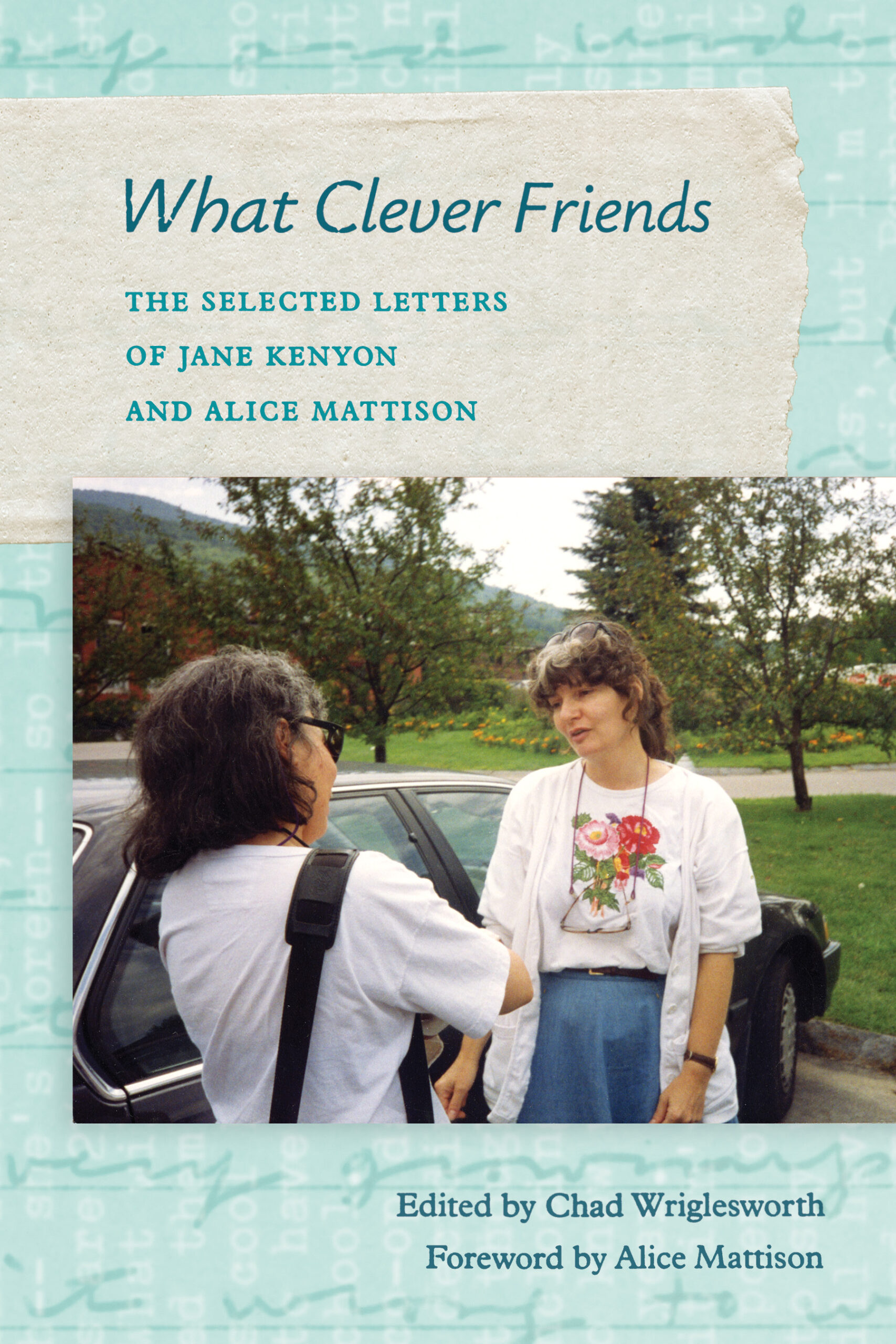
We wanted to see each other, but most poets were active in the cooperative for just two years, and Jane was coming to the end of her stint. We did meet now and then. Edward and I spent some summer vacations with our kids at a rental in southern New Hampshire. Each year, we drove up to the farm one afternoon. Don’s mother still lived in Hamden, Connecticut, a few miles from me. When they visited her, Jane came to my house, or I went there. Later, I sometimes took trains and buses to spend a couple of days with Jane. We talked on the phone. In large part, however, our friendship played out in letters, which Chad Wriglesworth has now gathered into What Clever Friends.
We also had a writing workshop. Jane proposed that we meet with her friend Joyce Peseroff, another Alice James poet, who lived in a Boston suburb. We got together about three times a year in one of our houses, most often Joyce’s. At first we all brought poems; after I began writing fiction exclusively, I brought stories, even a novel. We’d mail one another copies of new work, then spend a long afternoon together, reading what we’d written out loud, discussing what it needed. As we talked, I scribbled all over my own work or theirs, for which I also felt responsible. If my poems or stories were my literary babies, Jane’s and Joyce’s were my nieces and nephews, and I experienced an almost proprietary satisfaction when some editor was astute enough to publish their work.
We’d break for coffee and cake—I baked the same cake each time, with chocolate chips—then have dinner in a restaurant. The visitors stayed overnight in a spare room, and we worked some more in the morning before separating. Home again, Jane and I wrote letters congratulating ourselves on what we had accomplished.
Now it seems fitting that our friendship required all that travel, back and forth by car, bus, or train; city to suburb to country—and also that the difficulties of travel made us communicate by letter most of the time. We liked writing down what we had to say. But we also liked traveling, sampling each other’s lives. Jane visited the great cities of Europe and Asia but lived in the country, often writing about the fields and woods around her. A couple of times she wrote, with some dismay, about her mother-in-law’s suburban street where, in those days before most people had air conditioning, windows were open in summer and you could hear the people next door.
Jane’s road was quiet except for bird songs and cars speeding by. Evenings, a friend beeped hello, driving past the farmhouse on her way home from work; Jane looked at the clock and nodded. We crossed her road to cut asparagus for dinner, or, when I visited later in spring, rhubarb for strawberry rhubarb pie. I, on the other hand, had grown up in a loud Jewish family in Brooklyn, and assumed cities are best. My two-block New Haven street has a popular bar and restaurant at one end and a high school at the other. My house was full of children and writers. I ran writing workshops at home, mostly in the attic, but when a wheelchair user joined, in the kitchen. Jane and I relished each other’s houses and lives, and sometimes misunderstood them. We wrote about the lives we each had chosen, maybe more alertly and deliberately because our first readers were each other: people with different assumptions and preferences. Sometimes there was friction, but we got through it and learned from it. Finally, the differences made us more emphatically ourselves.
5.28.85 [May 28, 1985]
Dear Alice—
Have I missed the second story in The New Yorker? I look eagerly every time.
I’ve been overly busy and underly inspired…
Still no word from Knopf. Still no book of [Akhmatova] translations. If being an adult means that one can postpone gratification, I must be very grown-up by now. Is it wrong to want fame and fortune? Probably. Better just want to be good. But let’s get paid, too.
I am so bored… I went to Ann Arbor, helped my mother put on a yard sale, came home and wrote a poem called “Yard Sale.”1
Boredom!…
Last time I knew, Joyce’s parents were coming to visit her during the time we were going to meet. And Lucy is going to be here from June 7th → 17th. So what’s to become of our schedule I don’t know.
I need to get together. I’m feeling discouraged and dry.
You must be through at Albertus. I feel a certain glee about it, vengeful person that I am…
The washer is broken, the Saab is overheating, there’s a problem somewhere in the drainage field. The world is too much with us.2 It glugs.
A high school in Peterborough, N.H., wrote to me, asking me to participate next spring in their Young Authors Program. The letter begins, “Dear Mrs. Hall…” Shall I kill them or just say I’m busy?
It’s hormones, Alice. I’m ready to burst.
Are you well? Working? Reasonably content?
I miss you—
Love, J.
P.S. We have procured a kitten named Ada. She’s a little dickens. Gus is forlorn. I try to make it up to him by kissing his nose…
Saturday, June 1 [June 1, 1985]
Dear Jane,
Here is the first benefit of my being done with Albertus: it’s early Saturday afternoon and I’m writing to you instead of feeling so flat out exhausted that I can barely speak, as I did, week after week, for so long. I was sad when it ended but now I feel nothing but relief, and relief to be done with the workshops for the time being, too. [. . .]
I can’t believe you still haven’t heard from Knopf. These people are astonishing. Have you phoned? Maybe they could at least tell you when you’re going to hear so you wouldn’t be suffering over it daily. You have many burdens to bear. The funniest is the high school in Peterborough inviting Mrs. Hall. Send Lucy. Seriously, it’s hard to be married to someone famous. They may truly want you for yourself alone, but of course, it’s impossible not to be suspicious. I think you’d better make it policy, however, to believe that you are invariably wanted for yourself alone.
I think you should also, while I’m giving you advice, take pleasure in all the poems you have in magazines and not feel as if success is connected to any sort of schedule with the book. It will, after all, come out, and in our lifetimes. Meanwhile, your success in magazine publication has been pretty stupendous, after all.
I’m happy you got a kitten, but I’m upset that you’re bored with your writing. I’ve decided to stop refusing to listen to you on this one. That is, my first impulse is to say, oh, stop moaning: you never write trivial poems and I’m sure “Yard Sale” is not just about old furniture but about significant human stuff, as are all your poems, no matter how trivial their starting-off points. But you have been saying this for a while and so maybe I should pay attention. What happened to the English gardener?3 That sounded like a good new project: surely what all this has to do with at bottom is the dull calm before a new direction takes shape in the mind—but the trouble with that interpretation is that it goes back to the book—well, if this book were only out of the way…
Consider fiction, not prose necessarily, but poems about make-believe people or events. You write very honest poems about serious problems in your own life, like “Sun and Moon,” but you wouldn’t allow yourself to write that openly about situations that involved Don or your mother or other people. I don’t think you would, at least. Maybe the poem you wanted to write was not “Yard Sale” but “Conversation with My Mother”—now I know that one can intuit the conversation from the poems you do write, but I wonder whether inventing wouldn’t give you a little more freedom to explore not just the feeling, but the movement and variation in feeling during an event. I feel like what I’m saying is none of my business. But having apologized (I’m sorry!), let me say that I wonder whether you are not giving yourself enough freedom in your poems to write in detail about the big issues. That.
At least, for me, inventing things helps, though I also write about real things and am often sorry later…
My story [“The Middle Ages”] comes out this week (June 10); this time they sent me the page proof which makes me feel much better about it though I haven’t had the nerve to study it yet. I’ve been nervous about this one: the author’s proof had a million queries (ha, ha: they call them queries and are terribly polite about doing what I want but of course they (the queries, not the people; the people make me feel great) make me feel stupid and criticized, at least these did, which were mostly Mr. Shawn’s4 obscure difficulties and I didn’t understand any of them though I knew he was probably right about them). [. . .]
It’s interesting and wonderful and not like anything else in my life before. I’m happily writing first drafts of new stories but can’t imagine having the courage to send them to RA now that I know how many people read everything and how frank they’ll be about what’s wrong with them—but of course I’ll have to. It is very good having people read what I write with such attention, though sometimes I feel like somebody in a totalitarian country getting shot for writing: it hurts but at least somebody paid attention.
A— is bugging me to make him lunch. Sorry about all the advice. Ignore what’s presumptuous, please.
Much love, Alice.
6.10.85 [June 10, 1985]
Dear Alice—
Just a quick note because there isn’t time for anything else.
Lucy is here. We went down to Hamden on Friday and brought her back. We are ensconced in family life… the kids up here all weekend… next weekend Andrew5 and his girlfriend and his mother—at the cottage—as well. Do I need to say “I’m not working”?
I’ve been gradually reducing my Adapin, and that caught up with me last week—panic attacks, crying jags, etc… My doctor got me back on the straight and narrow path.
The most fun I’ve had in weeks is when I sat down to read “The Middle Ages.” I feel like the kid at the end. The walls keep collapsing.
The printer has offered me a new cover for the Akhmatova. I don’t really like it—it is both a cliché and nonsensical as an ideogram—but Perkins6 says it is handsome and striking, and I don’t have the strength for another round.
This letter sounds more hysterical than I feel, Alice.
Your letter and your story I have clung to as to an overturned canoe. Far from presumptuous—your letter—a balm, and a reminder that sane weeks of work are possible. Not for now, but sometime.
I hope your eye app’t goes well. I’ll be thinking of you.
I will call you when I can see my way clear, and we’ll set a new time to get together.
Til then, much love, J.
P.S. Yes, I want the freedom of “fiction”—ironically, one can be even more personal when speaking in someone else’s voice.
7.7.85 [July 7, 1985]
Dear Alice—
A quick note to thank you for your good letter. My brother, sister-in-law, and niece, a television crew, and Jerry and Philippa are here. I’m just getting by.
I’m glad the doctor found nothing new. But I believe your experience—that the eye is worse.
I’ve been in a bad depression again…trips to the doctor, double the medication. A very hard time for me, complicated by travel and guests.
When we have our workshop—the 23rd & 24th? (or 25th?)—I will, I hope, reestablish my identity. But for now I have forgotten who I am.
Alice—the first reading agreement [with The New Yorker] is a dream come true. Brava.
No news from Knopf. The Ms. is at Princeton and at Wesleyan. “Thus the days pass in their steady pace…”7
I am tired to my bone marrow but I look forward so much to our working together.
Much love, J.
P.S. Glad to hear that E. is doing something possibly easier…
July 10 [July 10, 1985]
Dear Jane,
Your note just came. You sound low, poor dear. And no wonder. You’re not meant for weeks and weeks of house guests. A television crew? I’m sure it was good to see Bree8 (I always think it’s “Brie,” but I bet it isn’t), anyway. But oh dear, I am sorry to learn about this depression. I am very eager to see you. I can’t believe Knopf still is sitting on the book (I know I say this in every letter, in the same words) but I’m very glad you’ve sent it to Princeton and Wesleyan. Maybe everyone at Knopf has died, or something.
My stories came flying back from The New Yorker in the same mail as your even-more-welcome-in-that-case note. At least the mail came hours early today, for some reason, since I was awfully tense about waiting to hear about them. I see clearly that I really don’t know what’s good and what isn’t. At least now I know that if the news is bad Roger Angell doesn’t call one up to say so; I was afraid he might, which seemed like more than I could bear.
This has not been a great week: I got the letter from the eye doctor, written after he looked at the photographs, and of course he did note the same change I already knew about. It was strange because as I wrote to you I knew it was worse—the lesion in the right eye is slightly bigger, just as I thought—but as long as he disagreed I was perfectly happy to take his authority’s word for it. I was stunned when the letter came and then a day later asked myself why, for I’d known the situation.
Still, B— is playing baseball. Yesterday he stole third. I’m reading a little Ovid for the first time since last summer and am not having any particular trouble with the Latin (when my eyes first went bad, foreign words seemed especially difficult, I suppose because one has to see them so much more precisely to know what they say, or at least I do). I’m working on a story I like—although it may please them in New York even less—but really, all we can do is keep working, isn’t that right? In a sense it isn’t our business what happens to the stuff.
Keep going, dear girl. I miss you. Let’s be sure to get together, too, when Edward and the kids and I are in Rindge (8/10–8/24). Edward, by the way, has started his new job where he has two windows, which makes him very happy even though his “office” is really the end of the corridor, partitioned off, the place is dirty, and the work is a little boring so far. He thinks he’ll find something interesting soon, though. Our 18th anniversary is Friday and he and I are going to Yale in Norfolk for Friday and Sat. night—overnight just Friday—my parents will keep the monkeys. Heaven.
Be better.
Much love, Alice
7.15.85 [July 15, 1985]
Dear Alice—
I am sorry to hear about your eye. Still, there is a certain weird satisfaction in having one’s suspicions borne out by science. I found one of the most troubling things about being ill is that one comes to doubt one’s perception of reality. It’s insidious. I hate to think the eye is worse. Save it for your real work only—writing, reading.
I love to think of B— stealing third.
Having tasted success, one wants more of it. And I know the turbulence of being rejected after the elation of being accepted at 25 W. 43rd, or whatever it is… Listen to what he [Roger] tells you and then please yourself, Alice. It is the only way.
I got through Church Fair in one piece. I think. I am better in general, but I have very bad days, and parts of days, still. I realize that my health is far more precarious than I had thought. This is sobering—really very frightening.
I wish you and Joyce could come up and stay a night in the little house while you are at Rindge.9 I’ll call you about it. I have doctor’s appointments on the 23rd and 25th of July—I had to take them when I could get them—and so our tentative plans for then may have to give way. I’ll call you.
18 years. That’s impressive. Doubtless you can hardly believe it yourself.
I’m counting on you and Joyce to give me back the feeling of freedom and power that I sometimes have when I am working. I have lost them utterly.
Save your eyes for Ovid—
Much love, J.
Tuesday July 23 [July 23, 1985]
Dear Jane,
I wrote the enclosed letter and then was afraid to mail it.10 It does look pretty fierce, as I look it over. Please don’t be angry. But I think I should mail it. I still think I may not understand you, and therefore the whole thing may be nonsense, but if I do understand you I think you are judging too fast.
I’m really tempted to tear up the letter. I guess I’m afraid you’ll be angry with me for going too far, one of these days. Well, forgive me.
I haven’t had my reading glasses for 12 days. I thought I could make do with the old old ones, that is, the optometrist took away the ones I’ve been using but I do have the ones I used before I got these, in November. But they are not helpful and I’m living on aspirin, it seems. And not being able to work makes me feel terrible. I am a pitiable wretch. Other than that I’m all right. But sometimes there is no other, it rises up, eyes, and surrounds me, becomes the emblem of being. [. . .]
Here are a bunch of stories. Read them with the following in mind. “A Rose” is one of the ones Roger just rejected. I’m not going to work on it for a long time, I don’t think, and so I don’t want to talk about it much or in detail (I guess I’m a little sore about it) but I do want you and Joyce to see it. Just to know whether your reactions are anything like his. “Sunday Lunch” is the revision of “Salad” [. . .] I would again like to know what you think, if you have time. But let these two go if you don’t have the time to read all of them. The other two are the ones I want to work on, “New Haven” and “In the Evening.” [. . .] Anyway, thank you very much for reading these, and if you don’t feel up to it yet, wait.
It was good to talk, although I’m worried and troubled about you. Be well.
Love, Alice
Thursday, July 18 [July 18, 1985]
Dear Jane,
I’ve been thinking and thinking about you. I think I am going to give you a good talking to, though you haven’t given me much to go on and so I may be quite wide of the mark. I hope you will do the same for me when it is appropriate.
Of course the depression is frightening and upsetting, and it doesn’t make it any easier that nobody is absolutely sure what eases it or worsens it, and how your physiology interacts with the seasons or with the day-to-day changes in your ordinary life or with your deeper psychology or with your work. I can’t at the moment think of a worse problem one might need to cope with, and so please don’t think that I am trying to minimize it.
However, even though I suppose it is conceivable that the depression is actually tied to work in some way, it seems to me terribly important that in your day-to-day life you keep the one separate from the other. I know I’m not being clear. What I mean is that writing is a vocation you have, whether you want it or not and whether you are depressed or not, that there is a certain basic respect you owe to your gift that has nothing to do with depression. That is, a person suffering from a sore throat may stay home from the party but may not reply rudely to the invitation. And even if he suspects that the sore throat was brought on by too many parties in the first place, or worsened by them, he still may not be rude.
That is to say, I think you may be going through a period when it is impossible for you to write well, or even conceivably to write at all, but I don’t think that excuses you from sitting and waiting for writing every day, even if none comes, or, if you can, from doing basic writing exercises. Maybe that is what you are doing, and what you mean by saying you may have writer’s block is that you don’t like what you are producing. But don’t you see that that is none of your business? It may be that you are writing well and, being in depression, can’t tell. It may be that people in depression cannot write well, just as people with sore throats cannot go to the party, but I don’t see that that gives you the right to close up shop, as long as you can sit still. It may also be that your subconscious mind is working on something deep enough that to reach it you must write a long, long string of boring and worthless stuff. I know this has happened to me, often, and that if I judge what I am doing and refuse to follow the muse on this idiotic path, I do not arrive at the happy location of the next good idea. I think you are failing to separate the requirement that you write, which is real and not avoidable, from the requirement that you please yourself with your writing, which is not a real requirement, at least not in the short run.
It seems to me that all this has been building since you first said you were bored with what you were writing. Well, for heaven’s sake, Jane, maybe the requirement of your particular gift, this year, is that you be bored for a while. Worse things have happened. I think you should write some boring poems and see where they take you. I think you’re judging too soon. I don’t think you’re seeing what’s there.
For me it would probably be necessary just to sit still at my desk and wait. Sometimes I’d have to just write, journal stuff, just fill pages. Maybe you should set yourself a number of pages to fill and insist that you make no requirements about them, that they be allowed to contain nonsense syllables if that is where your mind takes you. You just have to trust it.
Maybe you should be sketching. I’ve shaken students out of paralysis with “Down the Road” from “American Triptych”11—I remember when you read it here at the Whitney Barn you said that you’d gone out sketching. I’ve given many students the exercise of sketching something and I’ve done it a lot myself. Maybe you need to make ten sketches, however pointless.
In other words I think you need to be writing and to be accepting what you are writing and you don’t need for it to be any good—that will take care of itself.
Well, there you have it. Forgive me if it’s way off base.
I’m disappointed about next week but looking forward to August 14 and 15. I hope you do turn up before then, too, when you go to visit Mrs. Hall. If you come on July 31 or August 1 you can see my babies in Toad of Toad Hall. All of them. Gone all day until 3. The solitude is luscious.
You are right that I mustn’t be thrown by rejection from the big guys in New York. Roger Angell called me the day after I got his letter to tell me the same thing. This is certainly the damnedest experience I have ever had, but I am a lot more comfortable with it now that I’ve had the chance to show them how dumb I am in various ways and they haven’t changed their minds about me. I no longer look quite as stricken when I get off the phone with him.
I will be sending you a pile of stories in various stages of incompletion.
Read them with all the ferocity you can muster. I need to know!
Much love, dear girl, Alice
7.26.85 [July 26, 1985]
Very dear Alice,
Your stories and letters arrived in today’s mail, along w/ The New Yorker with your story [“They All Went Up to Amsterdam”] leading off—again! I know I’ve said it before, but I’ll say it again—what clever friends I have.
I know you are right about the boredom… without the boredom we don’t get the ecstatic part. But the boredom is so deadening. I really have stopped writing altogether. Perhaps sketching would be a way back in. I can’t even read with attention right now. There’s just nothing between the ears.
I know you are right, and I bless you for saying that I must practice my scales like the next person. One gets greedy and arrogant after a little success. When I think of a poem like “To Earthward,” or “Crusoe in England”12 I think that unless I can write like that I don’t care to write at all. But that’s stupid, I know. I’m just going through a petulant phase. I should follow my own advice to you, which was to stay home and wait, so that when the muse comes someone is there to answer the door.
One wants to go straight to the carrot cake without the leafy green vegetables…
I don’t like to hear that your eyes are aching so much that you have to take aspirin. And why did the optometrist take away your reading glasses? By now, Friday, you should have the new ones.
Now my latest medical bulletin, and the latest screw-up of our workshop plans. On Aug. 14th I have to have this little thing taken out of my neck and biopsied…It is apparently in an area where growths are very often malignant.13 My own doctor (Dr. Clark) gave me many good reasons to think that it is benign, real reasons, but the specialist wants it out of there all the same. So we will do that. (Lowell’s “slit your own throat…”14 comes to mind.) I’ll only be in one or two nights—two, I guess, counting the night before surgery. And there isn’t a big incision, and there won’t be much pain. Still, I dread it, of course. I was going to have to wait until September for the surgery but I didn’t like that, so another surgeon [Dr. Johnson] is going to do it—not Dr. Openweider, who is an arrogant son of a bitch anyway.
So I don’t know when we can get together. I will at least come down to see you in Rindge, or you come up to me—between the 10th & the 24th. If nothing else we can socialize in August and get down to brass tacks in early September.
I’ll read the stories, with delight, in the spirit you suggest—that is, “A Rose” and “Sunday Lunch” fairly quickly, and the others with more care. I love the title “In the Evening.”
You know, I’m much improved in the depression department…I should have said that first. Much better after six weeks on a high dose of Sinequan. And I’m so glad this news about my neck didn’t develop until I was better. I can cope much better with it now than I could have even two weeks ago. The sobering thing about this last depression is that it took six weeks to get out of it. I usually get much more dramatic results from an increase in the medication. So this was an atypical recovery and frightening for that reason. Like it or not I can’t do without a high dose of this stuff. Of course I don’t like that…
I haven’t written such a long letter—maybe—ever! I take your words to heart. I’m a writer, so I’ll write!
July 31/Aug. 1 we’ll be in Boston, picking up Aileen Ireland (but would I love to see “Toad of Toad Hall”!), our English friend who will stay here the first week in August. She is Geoffrey Hill’s “erstwhile paramour.”15 Also a friend, whose son committed suicide this past spring. So we want to give her a good visit and help if we can.
It will be a good distraction for me—keep me from planning my funeral, so to speak.
Oh Alice, it’s so good to have bright friends with whom I can be myself!
Love, J.
Tuesday, July 30 [July 30, 1985]
Dear Jane,
When your letter came I got very scared, but the more I think about it the more rational I feel, although I am sure that what you’re about to go through will be unpleasant in many ways and I sorely wish you didn’t have that to deal with on top of everything else. You are a very brave lady, you know. Your letter was pretty astonishing, in fact. [. . .]
I’m happy that the depression is lifting. It’s like weather, isn’t it—you always sound as if you are peeking through the curtain at it to see if it’s blowing less fiercely. And thank you for putting up with my letter. I was very nervous about writing it and mailing it, let me tell you! I wouldn’t have blamed you if it had made you angry and I opened your envelope rehearsing my apology. [. . .]
I hope you have a good week with Geoffrey Hill’s erstwhile paramour. She sounds like she’s been through a lot. I’m still reading Geoffrey Hill, by the way. I take him out on the swing and chip away at him every so often, and every other time one more poem falls into my lap. When it happens it’s exciting. But one has to be in good shape for him, like mountain climbing.
I’ve recently read two poems by Amy Clampitt that I loved, one of them being in your Grand Street.16 What a snazzy magazine that is. You should be very proud. (But aren’t, probably, because you’re so obstinately humble. Well, you should be.)
I’m glad you’re going to write no matter what. I will see you soon—we’ll talk before I go to Rindge and we can figure out a time when you can come there or we can drive up and see you. Whichever.
Footnotes
1. “Yard Sale,” published in The Boat of Quiet Hours.
2. An allusion to William Wordsworth’s sonnet “The World Is Too Much with Us.”
3. Kenyon was planning a long poem about the English gardener Gertrude Jekyll, a horticulturist, garden designer, and prolific writer. Jekyll created more than four hundred gardens in Europe, the United Kingdom, and the United States.
4. William Shawn, editor at The New Yorker from 1952 to 1987.
5. Andrew Hall, Donald Hall’s son from a previous marriage to Kirby Thompson.
6. Perkins, a pet name that Kenyon gave to Donald Hall. For the backstory to this name see Hall, The Best Day the Worst Day: Life with Jane Kenyon, 223; Donald Hall and Dave Barney, “Happy Men in Desert Places: An Interview with Donald Hall,” Southern Humanities Review 22.3 (1998): 229.
7. Kenyon may be alluding to lines from Shakespeare’s Macbeth: “Tomorrow, and tomorrow, and tomorrow, / Creeps in this petty pace from day to day…”
8. Kenyon’s niece; the daughter of Reuel Jr. and Dawn Kenyon.
9. Kenyon and Hall owned a cottage adjacent to their Eagle Pond farmhouse.
10. In addition to this note, Mattison enclosed the letter to Kenyon, dated July 18, 1985.
11. Jane Kenyon, “American Triptych,” a sequence of three poems first published in The Iowa Review 9.3 (Summer 1978), then in From Room to Room.
12. In reference to Robert Frost’s “Earthward” and Elizabeth Bishop’s “Crusoe in England.”
13. Surgery and analysis revealed that Kenyon had salivary cancer. Her tumor was removed. Hall provides an account of this time of health challenges in The Best Day the Worst Day: Life with Jane Kenyon, 142–44. Kenyon’s daily planners, archived at University of New Hampshire, indicate that she had at least twenty appointments with Dr. Clark between May 1985 and December 1986 (see Greene, Jane Kenyon:The Making of a Poet, 76).
14. An allusion to Robert Lowell’s “After the Surprising Conversions,” in Life Studies (New York: Farrar, Straus and Cudahy, 1959).
15. “erstwhile paramour,” former lover.
16. Amy Clampitt, “Babel Aboard the Hellas International Express,” Grand Street 4.4 (Summer 1985); Kenyon’s “Campers Leaving: Summer 1981,” was published in the same issue.
Excerpt from pages 85-96 of What Clever Friends: The Selected Letters of Jane Kenyon and Alice Mattison, edited by Chad Wriglesworth (University of Michigan Press, 2026). DOI: https://doi.org/10.3998/mpub.