By JAMES K. BOYCE
With photos by TIANNE STROMBECK
Sitting on a boulder one morning on a little island in northwestern Ontario, I watched a loon fishing about fifty yards offshore. The air and water were dead calm, the lake surface mirroring the clouds above and the trees along the shoreline.
The loon dove without a splash, and I tried to guess where it would reappear, counting the seconds. It left behind a ripple marking where it had disappeared. From a distance, the circle flattened into a line that widened slowly at both ends, the seam where the bird had departed the world above to enter the one below. Then I noticed something else: a new ripple that began just as the loon was about to resurface, created by upwelling as the bird opened a new seam to re-enter my field of vision.
Something about the sight of the loon slipping back and forth across the skin between the water and the sky transfixed me. I sat there watching for many minutes, until my companion called out that it was time to launch our canoe and go fishing ourselves.
The Native peoples of North America’s vast boreal forest tuned into the otherworldly qualities of the loon, too. Among the Wabanaki tribes from Newfoundland to Maine, a loon served as the faithful messenger of the creator. In ancient gravesites in Alaska, loon skeletons with eyes carved of walrus ivory in the sockets have been found alongside human remains, perhaps reflecting a belief that loons accompanied the dead to the afterlife.
In a tale recounted by Native storytellers across the Arctic and subarctic, a blind hunter follows the call of a loon to the shore of a lake. Seeing that the man is blind, the loon comes close and tells him to wrap his arms around its neck. Then the loon carries him into the lake and dives underwater three times. After the first dive, the man can see a glimmer of light. After the second, he can make out the shoreline. And after the third, his sight is fully restored. The loon opens the man’s eyes.
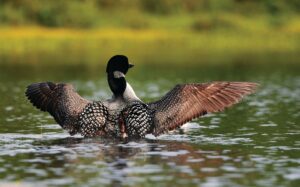
Rather different notions of the relationship between people and loons came to the Americas with the European settlers. Many of the newcomers regarded the loon, with its strange cries, as demonic rather than shamanic. Painter and naturalist John James Audubon was more appreciative, calling the bird “one of the wondrous creations of unlimited Power and unerring Wisdom.” But this did not deter him from killing them when he had the chance. In his Ornithological Biography, Audubon related a method for shooting loons: the gunner hides on the shore and lures the loon to come closer by imitating its calls and waving a cap or handkerchief, “until the Loon, having approached within twenty or even ten paces, dives, and on emerging raises itself up to shake its wings, when off goes the shot, and the deluded bird floats dead on the water.”
In the nineteenth century, sportsmen awaited the loons as they migrated in spring from the Atlantic coast to breed on New England’s inland lakes. They positioned themselves in boats on the strait between Cape Cod and the mainland, killing fifty or sixty loons on a “good morning” just for the fun of it. Anglers shot loons, too, believing them to be competitors for fish, even though the loons were usually outnumbered by other fishermen—and, of course, had been there first. The practice remained common until it was banned by the Migratory Bird Treaty Act of 1918. Writing shortly after the act’s passage, ornithologist Arthur Cleveland Bent lamented that, across New England, “the insatiable desire to kill has forever extirpated an exceedingly interesting bird.” Happily, loon populations have slowly rebounded since that time, as people not only ceased their persecution, but also more recently actively assisted in their recovery.
Call of the Wild
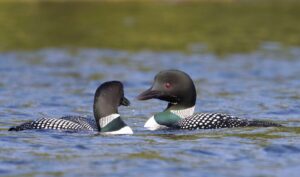
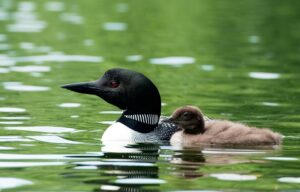
The human fascination with loons spans cultures and generations. For many who live in the north woods or spend their summers there, it has become a love affair. In 2025, the common loon was named “Bird of the Year” by the American Birding Association.1 Part of the loon’s attraction comes from its appearance: the striking black and white plumage, with blood-red eyes set in a jet-black head. Even more of its appeal, I suspect, is the similarity of loon behavior in the breeding season to a human family: a pair that often returns to the same lake year after year (it was long thought—incorrectly, as it turns out—that loons mate for life), with the male and female taking turns incubating their eggs, and then both caring for the chicks, letting them ride on their backs for safety and warmth until they are old enough to fend for themselves.
“Their whole family life is right out there where everybody can watch them,” explains Doug Tozer, a waterbirds expert at Birds Canada. Tozer grew up watching loons in Ontario’s Algonquin Provincial Park, where his father worked as park naturalist; as a kid he recalls being annoyed when his family went on holiday to Disney World, because it meant he missed spring nest-finding with his dad. “All the other birds are hiding their babies in dense bush, and there are the loons—you can watch them off the end of the dock.” Lake country residents come to know and love the birds as individuals, not just anonymous members of their species, and wait each spring for “their loons” to return.
The loon’s most extraordinary feature is its call—or, rather, its four distinct calls, each of which carries a meaning of its own. The wail, the loon’s signature call, announces its presence to other loons. Author Joan Dunning describes it as “a sensation up the spine, a chill to the skin, a creator of that little gap in the mind through which one sees eternity.” The yodel, loud enough to be heard miles away, is used by males to signal their claim on a breeding territory and their willingness to defend it. The tremolo, which people sometimes mistake for laughter, warns of danger. And soft hoots maintain contact with mates and chicks.
So eerie and primeval are the cries of the loon that they are used in film soundtracks to evoke a sensation of untamed nature, even in the most improbable of settings. The call of the loon can be heard in a Vietnamese jungle in Oliver Stone’s Platoon, in a Kenyan savanna in Out of Africa, in wizard land in Harry Potter and the Prisoner of Azkaban, and in outer space in Avengers: Infinity War.
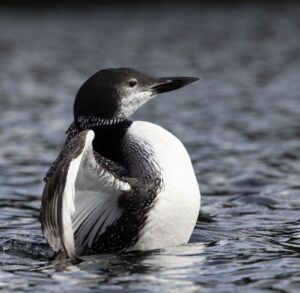
Here on planet Earth, the loon’s natural medium is the water: northern lakes in summer, seacoasts in the winter. The bird is built for catching fish. In Europe and Asia, the name for loons is “divers.” Unlike other birds, whose hollow bones make it easier to fly, loons have solid bones that let them sink beneath the water’s surface like submarines. Their stiff feathers lock together like a wetsuit, compressing to squeeze out air when they dive. They can remain below for as long as four minutes, reaching depths up to two hundred feet and withstanding a water pressure of one thousand pounds per square inch. Tucking in their slender wings to minimize resistance underwater, they use their webbed feet, positioned near the rear of the torso, as propellers. They can swim fast enough not only to catch fish but also to outrun a small motorboat. In response to danger, they dive, rather than taking flight like most birds.
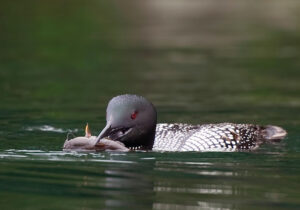
These remarkable abilities come with a downside: On dry land, the loon is ungainly to the point of near helplessness. “It is impossible in terms of physics for a fulcrum to be placed where the loon’s legs are and the body to be held up off the ground—unless the tail feathers are made of lead,” write Kate Crowley and Mike Link in their book, Love of Loons. The bird has difficulty walking more than a foot or two, so it nests by the water’s edge.
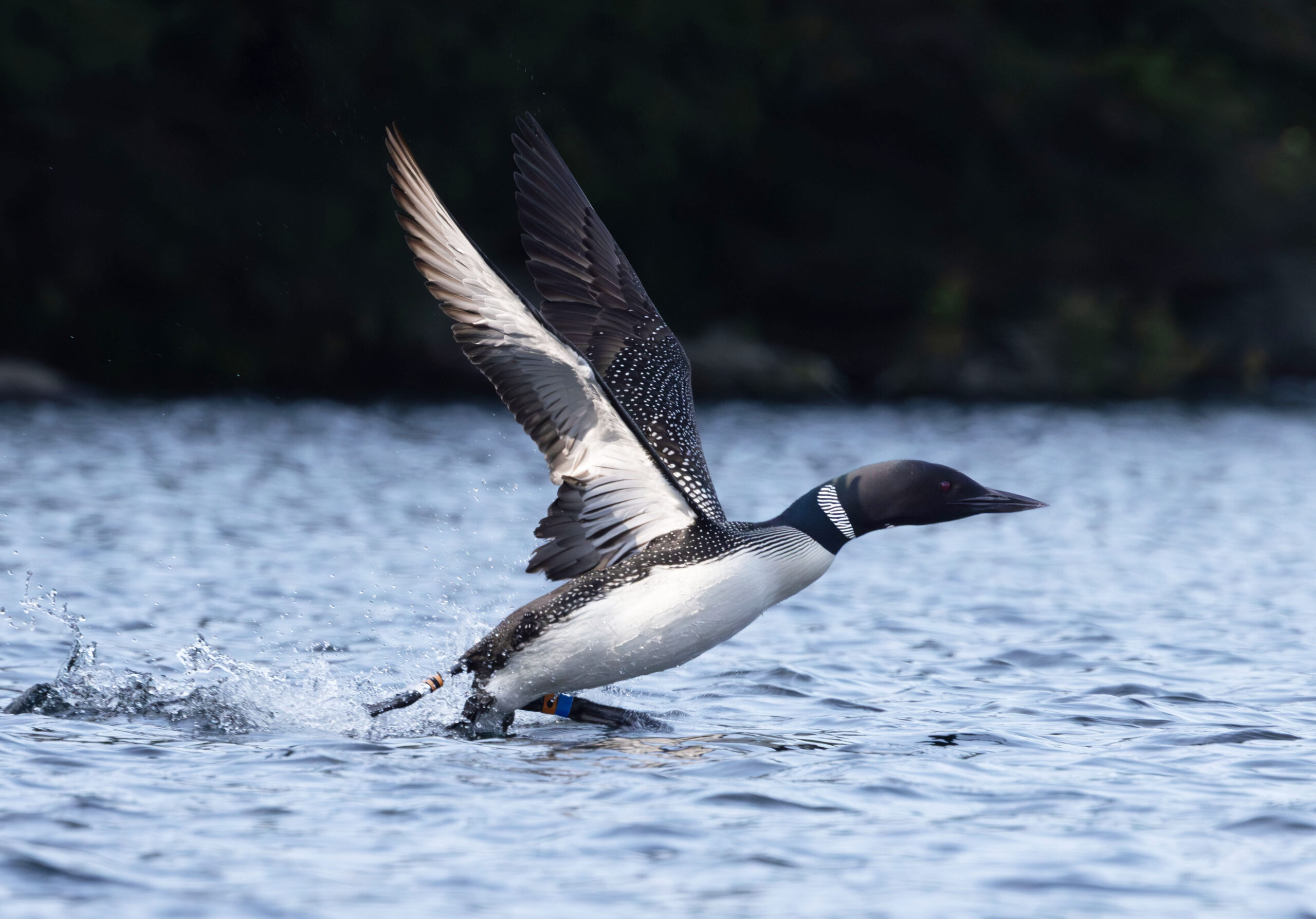
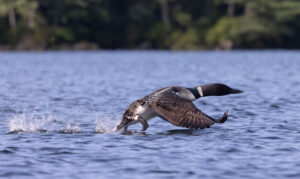
Once airborne, loons can fly at sixty miles per hour or more, but only by beating their wings constantly. Lifting off is a daunting challenge, due to the bird’s exceptionally high “loading value,” the ratio of its weight to the surface area of its wings. To take off, it runs across the surface of the water, splashing and flapping crazily, for one hundred to four hundred yards, depending on the wind speed and its body weight. Like airplanes, loons maximize lift by taking off into a headwind whenever they can. Some other waterbirds—such as Canada geese and grebes—also run for a few yards before taking off, but none require so long a runway. Loons alight only on the water, preferably with enough room to take off again. If bad weather during migration forces a loon to land on a small pond, or on a lake where ice is closing the open water, it dies unless saved by trained rescuers who relocate it to a bigger body of water.
Departing before the northern lakes ice over, loons overwinter off the seacoast. They cannot remain there to breed, however, since the tides would flood their nests (or, if built above the high tide mark, strand them far from the water at low tide). Evolution’s solution was migration, enabling the loon to escape ice in the winter and tides in the summer. Upon reaching maturity, loons establish breeding territories on northern lakes, typically within thirty miles of where they hatched. They return year after year to the same territory until they die—from natural or unnatural causes—or are dislodged by a rival.
Today deaths from unnatural causes are on the rise. The threats to loons are no longer from weekend sportsmen or jealous anglers, as in the nineteenth century, but from a suite of new hazards, including oil spills, lead fishing tackle, and climate change.
Deepwater Horizon
On April 20, 2010, the Deepwater Horizon oil rig exploded off the Louisiana coast, killing eleven workers and triggering the biggest spill in the history of offshore drilling. By the time the well was capped, nearly three months later, three million barrels had gushed into the Gulf of Mexico—more than ten times as much as in the 1989 Exxon Valdez disaster in Alaska—creating a slick that extended from Texas to Florida, with toxic plumes beneath the surface that curled around the tip of Florida toward Miami.
The spill killed vast amounts of marine life, from plankton and corals to fish, dolphins, sea turtles, and seabirds. The loons had departed for points north before the explosion, but they, too, became casualties when they returned in November. Jim Paruk, who led an assessment of the spill’s impact on migratory birds for the U.S. Fish and Wildlife Service, put the mortality rate among the affected loons at eleven percent, adding that this could be an underestimate.
The dead included loons that bred in Minnesota, the “Land of 10,000 Lakes.” A visitor driving the back roads in the forested northern half of the state easily sees how it got the nickname. There seems to be a new lake at every turn, many of them rimmed by cottages where people from the Twin Cities and farther south come to escape the summer heat. About twelve thousand loons breed there every summer, more than in all the other lower forty-eight states combined. In autumn, when the summer visitors go back to work and school, Minnesota’s loons head to the Gulf of Mexico. After the Deepwater Horizon disaster, blood samples taken from returning loons in Minnesota revealed traces of oil and chemical dispersants.
In 2014, the oil company BP, the owner of the Deepwater Horizon rig, was convicted in federal court of gross negligence and willful misconduct. (A decade earlier, in an ill-starred effort to rebrand itself as environmentally friendly, the firm had dropped the name British Petroleum, adopted a sunburst logo, and changed its marketing tag to “Beyond Petroleum.”) The EPA settlement included a record $5.5 billion fine for violating the Clean Water Act, plus an $8.8 billion fund for environmental restoration. Most of the latter was earmarked for the Gulf Coast states, but some was made available to redress impacts elsewhere. The biggest grant outside the Gulf Coast was $7.5 million to the state of Minnesota for loon restoration. The money began to flow in 2021.
In addition to funding land acquisitions to protect habitat on deep, cold lakes in northern Minnesota where loons congregate after breeding and feed on cisco, an oil-rich fish, to fatten up before the fall migration, the state’s loon restoration project includes support for phasing out the use of lead fishing tackle and for deploying rafts as “artificial nesting platforms” in partnership with local lake associations.
Getting the Lead Out
Lead’s dangers to human health have long been known. In a letter written in 1786, Benjamin Franklin described the debilitating symptoms of lead poisoning among printers and painters who worked with lead, and “the Dry Bellyach, with a Loss of Use of their Limb” among people who consumed rum contaminated by lead in the distilling process. At the time, lead’s toxic effects had been known for at least sixty years, and Franklin lamented “how long a useful Truth may be known, and exist, before it is generally receiv’d and practis’d on.”
It was not until the 1970s that the U.S. government, through the newly created Environmental Protection Agency, acted to remove lead from paint, gasoline, and water pipes. Today many states have also banned its use in wheel weights for balancing tires. Yet the impacts of lead are still with us. In 2015, a public health emergency was declared in Flint, Michigan, when hazardous levels of lead were found in the tap water of residents. Overseas, exposure to lead—a major source of which is automobile batteries sent abroad for recycling—continues to kill millions of adults and damage the developing brains of children, causing losses that a recent World Bank study calculated are equivalent in monetary terms to an astonishing seven percent of world economic output. Despite its dangers to people and wildlife, here in North America lead is still widely used in fishing tackle and hunting ammunition.
Researchers from Minnesota’s Department of Natural Resources (DNR) estimated in a 2004 study that more than 100,000 items of fishing tackle, altogether containing about a ton of lead, were lost in a single year on five of the state’s inland lakes that are popular for walleye fishing. When a line breaks, leaving tackle attached to the fish, its swimming is impaired, making it easy prey for loons to swallow hook, line, and sinker. Loons also scoop up lost sinkers and jigs on lake bottoms, mistaking them for the pebbles that they ingest to grind food in their gizzards.
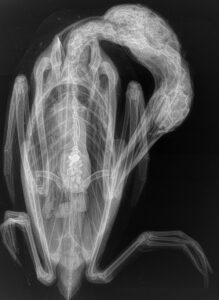
Courtesy of Mark Pokras, Tufts University Cummings School of Veterinary Medicine.
In the bodies of people and loons alike, lead poisoning leads to failures of multiple body systems, including nerve transmission, heartbeat regulation, and breathing. In human victims, it used to be called “painter’s colic,” because one of its symptoms is excruciating contractions of the intestines—Franklin’s “Dry Bellyach.” Poisoned loons often swim into shallow water and beach themselves to die. “You’ll see them sitting there, hunched over, their eyes half closed, gasping for breath,” Mark Pokras, who studies lead poisoning at Tufts University’s Cummings School of Veterinary Medicine, told me. “They are just sort of circling the drain.” Within two to four weeks of swallowing the lead tackle, the bird is dead.
Pokras has identified lead poisoning as the most common cause of mortality in breeding loons in New England. In 2000, New Hampshire became the first state in the nation to enact a partial ban on lead fishing tackle, specifically targeting the sizes and weights that impact loons. Maine, New York, and a handful of others have followed suit. But efforts to ban lead tackle have failed in the Minnesota legislature. Instead, the Minnesota Pollution Control Agency has launched a “Get the Lead Out” campaign with educational outreach and free lead tackle exchanges.
A promising substitute for lead is tungsten, which is even heavier, allowing jigs and sinkers to be smaller and more responsive to the touch of the hand that holds the rod, but also more expensive. Tungsten is gaining popularity at the high end of the market. “If you look at the competitive anglers on the Saturday morning TV shows,” Pokras says, “that whole crowd is switching over to tungsten.” He reckons this is a hopeful sign.
Life Rafts
At the DNR’s regional headquarters in Brainerd, Minnesota, I met Rob Rabasco, the field coordinator of the loon restoration program. We boated out to look for loons and their chicks on a nearby chain of lakes. Summer cottages dotted the shoreline. Many of the summer people bring dogs, whose presence unnerves the loons. They also bring food, some of which winds up in the garbage, attracting raccoons that then menace loon nests. The cottagers zoom around the lakes in motorboats, posing a special danger to chicks: Adult loons can dive to get out of the way, but the chicks can’t. “In Minnesota, we love our lakes,” Rabasco remarked ruefully. “We love them to death.”
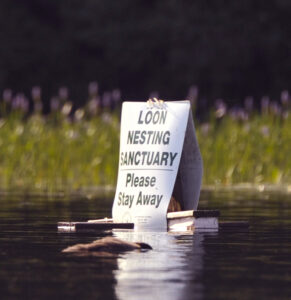
We passed nesting rafts set out by residents, some of them built from materials provided by the DNR project. “As an agency, we can only do so much,” he explained. “We have 11,400 lakes, maybe twelve thousand loons, and only a handful of staff. So we really need the public. We need the power of the people.” We motored slowly by a red and white buoy with a picture of a loon. A yellow sign on shore said, Caution! Loon Chicks Ahead. Go Slow! These mark a no-wake zone designated by the local lake association to protect nests from being swamped and chicks from being struck.
The first recorded instance of loons nesting on a raft was in the Chippewa National Forest in northern Minnesota in 1968. Evidently it was the loon’s idea. A Forest Service biologist had cut chunks of free-floating bog sedge from the lakeside and anchored them offshore to create nesting sites for ring-necked ducks, a game bird prized by hunters. A number of these floating islands were occupied instead by loons. This outcome was unexpected enough that the biologist wrote it up for a national ornithological bulletin, commenting that rafts could be a way to assist loons, “should this ever become a matter of concern.”
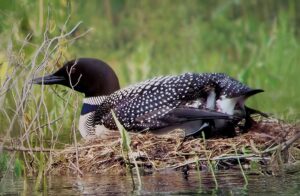
Rafts soon caught on among the public as a way to encourage loons to nest near their cottages, much as people put out birdhouses. They caught on among conservation professionals, too, as a way to shield nesting loons and their eggs from raccoons, foxes, and other terrestrial predators, and to keep the nests from being swamped on reservoirs and lakes subject to large water-level fluctuations.
As we headed back to our landing, we spotted three youngsters, a boy and two girls, launching a Jet Ski from a dock. Rabasco hailed them, and the boy, who looked younger than the legal driving age of sixteen, hastily jumped from the front to the rear of the machine. The new driver looked a little older, but maybe not sixteen herself. Rabasco asked them not to disturb a pair of loons we had just passed. They headed off in the other direction, and soon were speeding around in circles in the middle of the lake, where earlier we had spotted another pair with a chick.
For wildlife professionals, the price of public engagement is, well, public engagement. Some loon lovers reckon that the ideal spot for a raft is in front of their cabin. But this can lure loons to nest in a location where there are not enough fish, or there is too much boat traffic, or other disturbances like barking dogs that flush them from the nest, exposing the eggs to cold and the sun.
A badly placed raft also can exacerbate disputes among loons by luring them to try to nest too close to another pair. Loons are fiercely territorial in the breeding season, though happy to be in the company of other loons the rest of the year. Breeding territories vary in size, depending on the supply of fish, but forty acres or more is normal. Intrusions by other loons provoke aggressive displays, and battles between males (although rarely, if ever, females) can end in death, often from a puncture by the rival’s dagger-like beak.
In New Hampshire and Vermont, where rafts have played a key role in the restoration of loon populations since the 1980s, conservation organizations have addressed these risks by developing strict guidelines and doing most of the work themselves, without relying much on the public. Harry Vogel, a senior biologist with New Hampshire’s Loon Preservation Committee, tells me that they put out rafts only where loons otherwise would have “close to zero reproductive success” due to shoreline development or water-level fluctuations or getting “nailed by raccoons.” But he cautions that rafts are not a conservation panacea. “Rafts are a Band-Aid—they don’t help the fish, or the moose that needs natural shoreline to come down and get a drink of water, or any of the other species.” Moreover, putting in the rafts after the spring ice-out, and pulling them out in the fall before the ice returns, is a lot of work. “Over time,” he says, “I really think that one measure of our success would be to reduce our reliance on rafts.”
In addition to these practical issues, there is a philosophical question: “How much do we want to depend on an artificial platform to sustain a wild species?” asks Vogel’s colleague John Cooley. “Is there as much satisfaction in watching the loons when you know that they’ve been propped up with this intervention?”
“I think we’re obsessed with platforms because they’re easy,” says Walter Piper, a biologist who studies loon behavior and tracks their populations in Wisconsin. “It’s a beautiful way that humans can help the loons, but we need to understand that there are better ways.” Combating lead poisoning is at the top of his list. “It’s not as conspicuous. You can’t take a picture and say, ‘Look—there’s a loon sitting on it.’ But if we could end the use of lead fishing tackle, that would do a lot more than throwing in a few hundred platforms.”
But, for conservation agencies, public appeal is part of the job. This may help to explain why rafts have featured prominently in loon recovery efforts funded by oil spill settlements. When a New England-wide consortium for loon conservation received settlement money from a 2002 spill in Buzzards Bay, off the coast of Massachusetts, one of its members recalls that at first the settlement fund’s administrators “just wanted rafts, rafts, rafts.” In the end, the consortium persuaded them to put some of the money into other programs, too, such as reducing lead exposure. This raises the intriguing possibility that rafts may serve not only as platforms for nesting loons, but also for a broader range of efforts to protect them.
The Changing Climate
Hot weather is hard on loons. Their dense feathers allow them to maintain a 104-degree body temperature in frigid ocean water in the winter, but unlike mammals that shed fur in the summer, loons wear their winter coat year-round. As climate change leads to more frequent hot spells in the breeding season, nesting loons dip more often into the lake to cool off, exposing their eggs to predators and the heat.
Heavier rainstorms, another correlate of climate change, increase the chances of nest flooding. Their runoff reduces water clarity, making it harder for loons to see and catch fish. Warmer weather also boosts the population of blackflies, the bloodsucking pests of early summer for which the northern forest is notorious. The bugs attack the exposed flesh on the loon’s nostrils and eyelids, sometimes covering the entire face. “In a sort of reverse Lake Woebegone scenario,” Piper remarks, “worse-than-average black-fly years are the new normal.” Loons plagued by blackflies sometimes abandon their nests altogether.
Based on the model it uses to forecast the impacts of climate change on birds, the National Audubon Society predicts that by 2080 the loon will lose more than half of its current summer range, warning that “it is all but certain that Minnesota will lose its iconic loons by the end of the century.”
Not all experts are convinced that the prognosis is quite so dire. “Loons are resilient,” observes Lucas Savoy of the Biodiversity Research Institute in Maine. “They used to breed as far south as New Jersey and Pennsylvania. They left those areas because of development, not warmer temperatures. That is the thing that can really kill a loon lake.”
As spring ice retreats, the Audubon model predicts that the breeding range of loons will expand in the north, though not enough to offset losses in the south. But Doug Tozer of Birds Canada likewise observes that what happens at the southern edge of their range is not just a matter of weather. In Ontario, loons expanded their breeding range farther south from the early 1980s to the early 2000s, recolonizing territories where they had been extirpated a century before. But Tozer worries that the latest data will show them retreating, as the effects of climate change again tilt the balance against them. “It’s a dance,” he explains. “The push south was winning up to the early 2000s, but now the push north is winning.”
Why Loons?
In choosing where to focus their energies, conservationists like to emphasize species whose survival is most at risk. There is no shortage of candidates. The Red List of the Switzerland-based International Union for the Conservation of Nature now includes more than 157,000 threatened species, of which 44,000 meet the most stringent criterion of being globally threatened with extinction. The common loon is not among them.
Another focus for conservation is keystone species that underpin entire ecosystems. In the oceans, for example, coral reefs occupy only 0.1 percent of the seafloor but provide habitat for one quarter or more of all marine species. In the boreal forest, the best-known keystone species is the beaver, which plays the role of an “ecosystem engineer” by creating and expanding wetlands. Loons do not qualify for conservation priority by this criterion either; their lake and coastal habitats would likely survive fine without them.
The Endangered Species Act, the linchpin of conservation regulations in the U.S., takes what might be called an equal-opportunity view: that all species, no matter how humble, should be safeguarded. However appealing in principle, this has proven difficult, if not impossible, to implement in practice. In the hard-nosed world of competing claims for limited government dollars, economic payoffs play an outsized role. Of the $1.2 billion the U.S. government spends annually to protect endangered and threatened species, nearly half goes to just two commercially valuable fish—salmon and steelhead trout. In the political cost-benefit calculus, loons don’t register either.
In the end, one cannot escape the feeling that much of the effort put into loon conservation is motivated above all by the simple fact that people love them. Even if loon populations are in decent shape globally, this does not cut much ice with people in Wisconsin or New Hampshire who worry about whether “their” loons will return in the spring. “In some places, loons are in trouble,” observes Piper. “And for most people, what matters other than the local? Sure, there are plenty of loons in northern Canada. But if you think of the number of humans impacted, most of the people are down here in the States.”
At the end of the day, perhaps it is not so much that loons need us. It is that we need them. Is this a defensible rationale for spending time and money on them? Conservation organizations often focus on “charismatic species”—those with wide popular appeal—many of which are large mammals. When a team of French researchers carried out a survey to identify the world’s twenty most charismatic species, tigers ranked number one. No birds made their list, but if the survey had been done in Minnesota, loons probably would have been at or near the top.
In 2013, Sir David Attenborough, whose face and voice are familiar to millions of viewers of nature documentaries, created a stir when he remarked that the world “wouldn’t change hugely” if panda bears became extinct. However charismatic, pandas are not of great ecological or economic consequence. Maybe not, but I wouldn’t want to be the one to break the news of their demise to my grandkids.
Targeting conservation dollars to charismatic species may help to protect the ecosystems where they live—say, bamboo forests in the case of pandas—and this can benefit less glamorous species, too. In this way, as Attenborough conceded, our preoccupation with charismatic species can be a “useful mistake.” Nevertheless, scientists worry that “the best way of raising conservation funds excludes the best way of spending it.”
But the premise underlying this fear may be faulty. The amount of money available for conservation is not fixed. It depends on public interest, which can wax or wane over time. Even if charismatic species claim a disproportionate slice of conservation resources, they may help to expand the pie.
The same controversy applies to birds in general. They are a charismatic class of organisms, and attract disproportionate attention compared to, say, insects and amphibians. Yet bird conservation helps innumerable plants and animals that share the same habitats. And for many people, birds open the door to a wider love of nature.
So, personally, I think it’s okay to love loons. In fact, more than okay. Once we expand our notion of ecosystems to include people, human consciousness becomes an important part of the big picture, too, shaping what we do and how we impact other species. Loons are gateway animals. If they help us tune into nature and the other living things with which we share the thin skin of our planet, between the rock below and the atmosphere above, they may be a keystone species after all.
Footnote
[1] There are five loon species worldwide. In this piece, “loon” refers to the common loon, the most populous and familiar species. The other four—the red-throated loon, the Arctic loon, the Pacific loon, and the yellow-billed loon—breed farther north in the lakes and wetlands of the tundra and taiga.
James K. Boyce is an author, naturalist, and environmental scholar. “For the Love of Loons” is excerpted from his forthcoming book on human interactions with birds. His essay “Return of the Puffin” appeared in Issue 28 of The Common.
Tianne Strombeck creates portraits of nature to promote conservation and wildlife education. She works to understand her subjects and capture their essence. Her work has appeared in numerous books, including Sy Montgomery’s Condor Comeback, which focuses on the condor restoral effort in California. More of her photos and books can be seen at Tianimal.com.