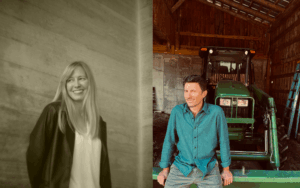
Jenna Grace Sciuto (left) and Nathaniel Ian Miller (right)
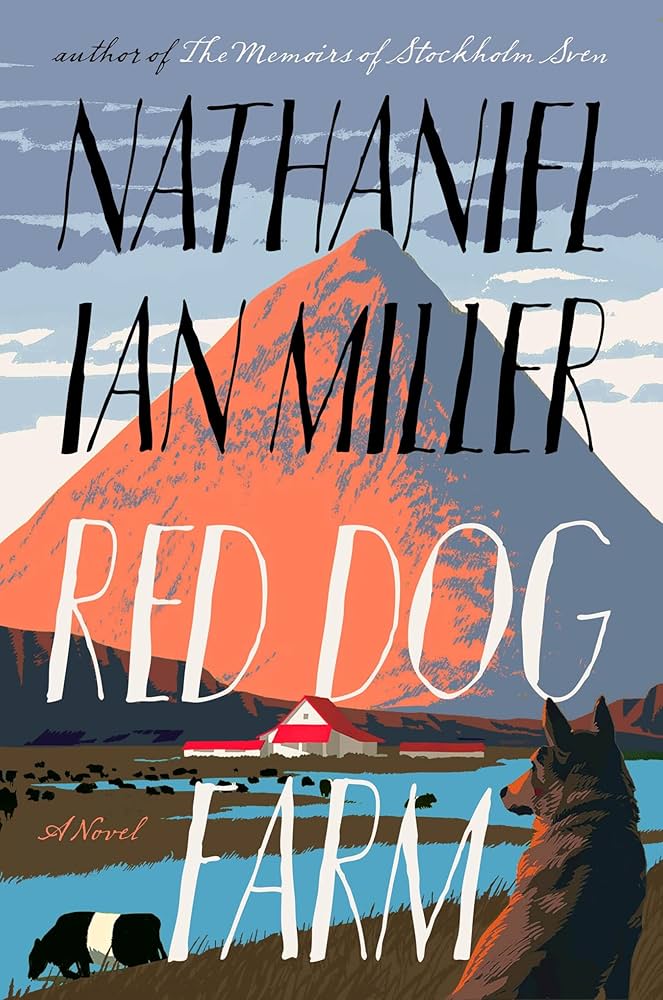
NATHANIEL IAN MILLER has always been intrigued by northern spaces, a link that connects his acclaimed first novel, The Memoirs of Stockholm Sven, to his latest work, Red Dog Farm. Red Dog Farm is a wonderfully engaging coming-of-age tale about a young Icelander named Orri and his relationships with family, friends, and the farm where he was raised. Miller’s ability to write characters—whether human or animal—that are, in his words, “emphatically (and believably) themselves,” is a unique strength. JENNA GRACE SCIUTO discussed the book with Miller, touching on what writing about northern spaces enables in his novels, his influences (Icelandic and more broadly), and the versions of himself that have gone into this story.
Jenna Grace Sciuto (JGS): Both of your recent books, Red Dog Farm and The Memoirs of Stockholm Sven, span different northern locales—Red Dog Farm is set against the backdrop of an Icelandic cattle farm, and Stockholm Sven centers on Sven’s adventures in Svalbard, in and around the Arctic Circle. Is it fair to say you have an interest in northern spaces? Or what draws you to these settings?
Nathaniel Ian Miller (NIM): I’ve had a long-standing obsession with ice-bound stories ever since my mother gave me a copy of Alfred Lansing’s Endurance. I think I was about 12 years old. The subsequent amassing of books—mostly about the bad old days of polar exploration—eventually got so out of hand that it had to be curtailed for the sake of shelf space.
But more generally, the kinds of tales I like to tell—or seem to wind up telling, whether I want to or not—are those of isolation, alienation, disaffection, solitude, and loneliness (and how, sometimes, a person can claw their way out with the help of unlikely human or animal connections). Northern spaces, with their harsh austerity, seem to lend themselves to such themes. Not a “blank canvas,” as they used to say, but one with enough emptiness to draw the viewer’s eye toward a single, tiny character.
JGS: That’s fascinating. So, Red Dog Farm introduced me to farm literature as a genre, and being less than knowledgeable about that, I’m not sure if this is a facet of the genre or just this book, but I love that it encourages the reader to slow down. If you are racing to get somewhere, you miss out on a lot on the way. How important is the story’s setting, in your mind? And why did you decide to set the farm in Iceland during the 2010s?
NIM: That’s funny. If farm literature is a genre, it’s one I’ve strenuously avoided reading! I raised beef cattle here on our farm in Vermont for about 11 years. Before that, I worked as a ranch hand and even, briefly, as a flack for the bison industry, which was weird. Friends would often say, “You should write about farming,” but writers detest being told what to write, and I never wanted to anyway. It’s all too close when you’re engaged with it.
Setting this fictional farm in Iceland, a place that beguiles me and that I gave very short shrift to in The Memoirs of Stockholm Sven, was a way for me to finally grapple with my own hard-won, often brutal experiences on the farm, but gain a little perspective by putting them at arm’s length: essentially projecting them onto someone else’s landscape. This was possible because Iceland’s agricultural conditions are surprisingly similar to those of northern New England. Long, wet, unforgiving winter; short growing season, etc.
JGS: For me as a reader, the setting of the Icelandic countryside, with interludes in the cities, seems baked into the novel as a whole. I enjoyed the range of references from Icelandic Nobel laureate writer Halldór Laxness and the Lóa or golden plover signaling the start of spring, to the history of the 1973 volcanic eruption in the Westman Islands. As someone who loves to research Icelandic literature, culture, and history, I have to ask, is there anything you’d like to share about the research entailed in this project? Or anything else to add about your experiences or relationship with Iceland?
The research and the book’s existence were only made possible with the constant help and generosity of two Icelandic actors: Ólafur Darri Ólafsson and Guðmundur Ingi Þorvaldsson. Ólafur Darri Ólafsson performed, at my fondest request, the audiobooks of Stockholm Sven and Red Dog Farm, and put me in touch with everyone I needed to talk to, including the former mayor of Vestmannaeyjar. And Guðmundur Ingi Þorvaldsson grew up on a farm in Borgarfjörður, where the book takes place, and he not only drove me around and told me a hundred amazing stories, but also took me to meet his lovely parents, who are still farming there. I couldn’t have asked for better guides or friends.
JGS: One theme that links your book with Icelandic literature more broadly is the humbling power oflandscape, weather, and other natural forces, connecting to Halldor Laxness’s classic Independent People, but also many other novels from Fríða Sigurðardóttir’s Night Watch to Ragnar Jónasson’s Snowblind. And this aspect is brought out even more fully via a flashback towards the end of your novel (no spoilers!). This connection makes me wonder if there are any specific Icelandic writers that you would cite as influences for this book, or also writers outside of Iceland that serve as inspirations?
NIM: Yes! I think anyone who has read the brilliant Jón Kalman Stefánsson will see, immediately, the debt that my novel owes him. His trilogy about “the boy,” as translated by Philip Roughton, was seminal for me. I really wanted to quote him in an epigraph (or two, or three) for Red Dog Farm, but couldn’t navigate the byzantine rights process. More recently, I’ve found myself walking in his footsteps through France, where I keep visiting bookshops that he’s been to only a few months or a year before. I hope to meet him someday and tell him how much I admire his work.
Beyond Icelandic literature, I’ve consumed a great deal of “nature writing” over the years, for better or worse. My favorites, who write/wrote about landscape and weather in ways that continue to inspire: Gretel Ehrlich, Franklin Russell, Donald Culross Peattie, J.A. Baker, Loren Eiseley, J.R.R. Tolkien…
I want the reader to feel that I love each character, even the bad or obnoxious ones, because that makes them real.
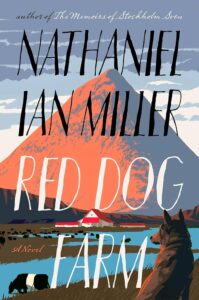
JGS: That’s great. The novel draws on so many intricate intersections of identity, and this is something I appreciate about your writing generally. Characters are naturally themselves. So, if a character is queer, such as Rúna in this novel, it’s not made into their one defining feature but just another aspect of their identity in a realistic and seamless way. I found the character of Orri fascinating in part due to his development over the course of the story. Can you speak a little to the inspiration for this character and how he came to be? How about another favorite, the titular red dog Rykug?
NIM: Thanks for your kind words. They say, and maybe it’s meant to be reductive, that writers are either character-first or plot-first, and the rest is secondary. If that’s true—and I don’t think it will be a surprise to anyone who has read my novels, which are very light on plot—then I’m definitely the former. And sometimes everything else has to slow down or get out of the way while the characters adapt or evolve (or devolve) on the page. If I don’t give them room to do so, all the air goes out of it.
I want the reader to feel that I love each character, even the bad or obnoxious ones, because that makes them real. Some writers seem to hate their characters and clearly enjoy scorching them under a magnifying glass. As a reader, you can sense that, and it puts an alienating distance between you and the story.
Making characters emphatically (and believably) themselves, rather than contrivances, or collections of quirks, or pawns to move around, is always my goal. The same is true for animals. Too often, animals are just two-dimensional devices, used to further the plot or another character’s emotional journey. I want mine to be real individuals, with agency and idiosyncrasies.
Rykug, therefore, is based on my dog, Bonaparte, who is amply idiosyncratic. I guess I mined a great deal from my own life for this book, because if Pabbi is close—uncomfortably close—in many ways to me, at the tail end of my own farming “career,” Orri is like the young, more idealistic person I once was.
JGS: Finally, I love this quote on the opening page of the prologue: “It’s an Icelandic paradox: The very stubborn nature of the place is change itself. Not always adaptation but alteration. It’s written into our rocks and our bones.” This helps frame the novel as a meditation on the expanding nature of “Icelandic identity.” Stereotypes might paint Icelanders as a monolith of blond-haired and blue-eyed folks, but in reality, even the Vikings were a multiethnic and multicultural band. I appreciate the engagement with Orri’s Lithuanian Jewish history, particularly through the experiences of his mother, as well as the story of Mihan, his girlfriend who immigrated from the Philippines, weaving many compelling threads together in this lush novel. Any thoughts to share on the novel’s engagement with notions of “Icelandic identity”? Was it intentional, the way the novel might write back to or disrupt assumptions and monolithic stereotypes about what it means to be Icelandic? I’d love to hear any musings in response to these thoughts!
NIM: Definitely intentional. I’m the furthest thing from an expert on demographic and cultural changes in Iceland, and wouldn’t wish anyone to think I was attempting to tell that story, but I did want my book to reflect the shifting landscape there, as Iceland has finally opened itself up to some (not much) immigration in the last twenty years or so. Telling a more modern story, then, enabled me to move beyond certain dated ideas about homogenous “Icelandic identity”—the “monolith,”— as you put it so well. And that suits me. I’m always looking to tweak a formula, as I’m allergic to it and will run in the other direction if I smell it drifting in on the wind.
Nathaniel Ian Miller is the author of Red Dog Farm and The Memoirs of Stockholm Sven, which was longlisted for the Center for Fiction First Novel Prize and translated into five languages. A former journalist for newspapers in New Mexico, Colorado, Wisconsin, and Montana, he lives with his family in Vermont.
Jenna Grace Sciuto is a professor of Global Anglophone Literature at the Massachusetts College of Liberal Arts. Her second book, Intersecting Worlds: Colonial Liminality in US Southern and Icelandic Literatures, was published in January 2025 by the University Press of Mississippi. She conducted this interview from Skriðuklaustur, writer Gunnar Gunnarsson’s homestead, in Eastern Iceland.