By QIAN ZHONGSHU
Review by BEN TAMBURRI
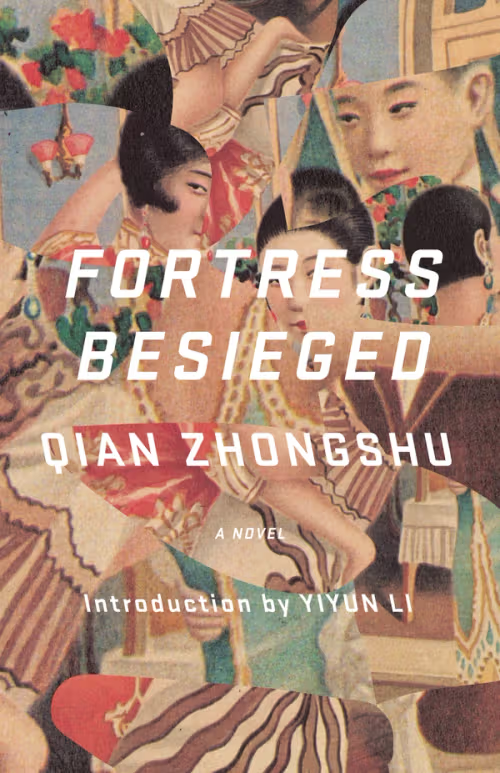
Qian Zhongshu’s Fortress Besieged takes its namesake and epigraph from a French proverb: “Marriage is like a fortress besieged: those who are outside want to get in, and those who are inside want to get out.” The proverb foretells much about this acerbic novel, as its protagonist, Fang Hung-Chien, stumbles into and out of the lives of various women in Shanghai after returning from his years studying abroad in Europe.
The novel, originally published in 1947 and reissued this August by New Directions, opens in the summer heat, aboard a transnational steamer en route from Paris to Shanghai. The heat, Qian’s omniscient narrator explains, will later be read as a portent of the oncoming Sino-Japanese War (1937-45), a conflict that encroaches into the lives of the characters as an inconvenience rather than a threat as they navigate disastrous love affairs, strict familial pressures, deceitful rivalries, and the schemes of gossipy academics.
Our twenty-seven-year-old hero, Hung-Chien, aimless and unemployed, finds himself compelled by social niceties, often at the expense of his own desires. A victim of “softheartedness,” he cannot help returning the flirtations of the admiring Miss Su, despite hoping her affections for him will die. Whether it be an endowment to fund an education he won’t finish, a teaching position he lacks the qualifications for, or a marriage caused by taunting rumors, he reaches for whatever life offers him, only to find “having it isn’t as good as not having it.”
The prose of Fortress Besieged is ripe with adages, references to poetry, and playful, complex similes that bring humor and insight to the subtleties of human nature. The characters are vulnerable and imperfect. Scenes escalate quickly and often to heights of picaresque embarrassment, as propriety entangles with real feelings and misunderstandings ensue. However, the high acclaim heaped on the novel in the introductory matter, in which it is called “one of the greatest twentieth-century Chinese novels” and compared to War and Peace, Don Quixote, and Madame Bovary, gave me the feeling that I read a very different book than the one that is so heavily lauded. There is a richness to Qian’s writing, as translated in the English, but often the sentences creak under the strain of translation. The result is a silhouette of a great novel, but one that lacks the color and contours the original might possess. The wryness and pathos of Qian’s prose come through in lines like “Not being made of raincoat material, his heart was soaked by her tears” but not without acquiring a certain clunkiness.
The novel’s greatness comes from the strength with which Qian renders the forces that motivate, destroy, enrapture, and embarrass his characters. Heartbreak forces Hung-Chien to retreat to a teaching post at a university in the country, turning what was a romance into a campus novel. When his contract at the university isn’t renewed, he must pivot again, away from the campus, and so must the novel, to track his crumbling marriage. The novel’s constant recreation of itself reflects Hung-Chien’s erratic experiences, as he resigns himself to the haphazard tugs of fate, love, and social pressures that pull him into the scattered unpredictability of modern life. The precise, discomforting legibility with which Qian writes Hung-Chien’s misguided affairs, the jealousy of romantic rivals, the tragic denouement of his marriage, the piddle of academic politics, and the overwhelming influence of family is part of what makes this a classic.
Many of the novel’s themes and its lasting relevancy come together in the form of a clock Hung-Chien inherits toward the end of the book. An old family heirloom, it only ticks fifty-three seconds for each minute, making it useless for telling the time. But Qian’s narrator considers, as the clock rings six strokes at eleven, how little his characters’ good intentions five hours earlier impacted the events that came to pass. What Qian, via translators Jeanne Kelly and Nathan K. Mao, present us with now is a similar keepsake: one that is imperfect but rings the past into the present with a message about the deep irony of our condition and the forces that afflict us.
Ben Tamburri is a senior at Amherst College and the fourth annual David Applefield ’78 Fellow at The Common.