By ELVIS BEGO
Brunch nearly over, talk getting punctuated by lulls, her mother, trim and elegant in her pastel widowhood, letting father go so easily, it seems to Josephine, now asks her if she is thinking about a child.
“No,” comes the answer, but too quick, too reflexive. It’s too late to take it back, but she makes the attempt anyway, and says, “Well, it occurs to me now and then, but Ismar, you know….” She doesn’t finish the sentence, and her mother knows to look away to give her time to change the subject, which she doesn’t. Instead she says, “I will, of course, have to think about it, if it is ever to happen.”
“You still have time. But, yes, our lives are not like theirs,” her mother says and snatches a swift bite of cake, swoops in on it raptorlike and wipes her mouth in what looks like a single gesture. “Now, I understand perfectly if you decide to not have any, and you should feel free to make that decision for yourself, because, God knows, there is more to life than having children, for women too, but all I can tell you, dearest, is that you have been the greatest joy and satisfaction of my life. But that is neither here nor there. You may be an entirely different person. Needless to say.”
Her mother had her late. Late for the times, of course, for a first child. She was thirty-three, and here Josephine was now, thirty-three years later, thirty-three herself, and childless, her mother almost sixty-seven and without a toddler to throw her demanding love upon, and yet the panic has not set in for Josephine, not quite, not yet, even though she would have to admit that there is something that begins to stir, perhaps because she can see that Ismar does not seem to stir at all, not even with all the little hints that begin to come up in conversation, little jokes, probings that used to be innocent but she knows are becoming less and less so, and intend to scan his professed resolve to not have any. Even so, she’s not actually sure what she herself thinks on the subject. She had thought when she was very young that she would have had a couple by now, but that had been entirely pushed from her mind during the architecture studies and all the grind afterward.
“And it is also perfectly fine, too,” her mother says—and here she pauses to find the delicate phrase—“to be alone, or even to reconsider one’s life with a man whose own happiness may be at odds with our own. Now, as you know, I think Ismar is a wonderful man, and I don’t want you to think otherwise, but only—”
“He is,” Josephine says, and her mother nods a kind of smiling retreat. “Tell you the truth, I don’t even know if I’ll want any,” she adds. “Honestly.”
“Then you probably shouldn’t.”
“But you would like me to?”
“Well, I wouldn’t mind.”
“I would want more than one, if I ever do.”
“Yes?”
“Being an only child, you know.”
Her mother makes a strange, unaccustomed grimace, trying to suppress emotion, it looks like, which is alarming because so rare. “I don’t see you enough,” she says, reaching forward, and rather abruptly, it all coming with a desperate note, her eyes gleaming, having welled up, and Josephine, moved, lays her hand on her mother’s, and something fine, wordless, passes between them.
Later, in the car, not far from the cemetery, her mother says, “Listen, darling, today I want to show you something rather large and particular, something I have wanted to tell you for the longest time, and haven’t been able to, for one reason or another, but I think it is time for you to know, and it’s better that it comes from me while I am here to tell you.”
“Please tell me you’re not sick, Mom. You’re not sick, are you?”
Her mother laughs. “Nothing like that, darling, I assure you.”
“Tell the truth. I can take it.”
“I am telling it.”
“What is it?”
“Let’s see your father first. Believe me: it’s not so bad, or not anymore.”
They park outside the cemetery. Her mother takes the flowers from the back seat and scans the petals and the ferns and pinches off whatever is judged unworthy. They walk slowly up the avenue and turn off through the thicker, shadier canopies toward her father’s grave, and the light is golden and falls at a slant, and it is as beautiful as a day ever is, and they look up at the poplars and the pines, and their pulsing rustle sends them back to certain arid slopes in southern France they used to go to when Josephine was a child, lolling on her father’s shoulders, and even that displaced smell from twenty-five years ago comes in with memory of love.
Her father’s simple slab with the name and years never quite seems real. She has to stare at the terminal year, last year, and lingers there to convince herself that he is gone, his term complete, that he lies exactly here, a man like that, picture of health at sixty-seven, with his tennis and his conscious diet, his merino sweaters, struck down in the street by his exploded heart, strange faces the last things he would’ve seen, dark against the noon sky, and the phone call, oh God, she sees it all, and everything late, too late, so soon, her mother in the hospital a ghost, eyes dry, remote.
Her mother lays the flowers neatly next to others and is left with a smaller bouquet in her hands, and she whispers sweet nothings, and it sounds as though she speaks to a child rather than her lover. Josephine finds again that she cannot come fully into the presence of the moment, into the significance of this place, when her mother is here, as though she has to keep it together for her, and only feels what she feels when she comes alone.
“Dearest,” her mother says, reporting, “if you only knew how we miss you. If you only knew.”
“What’s that?” Josephine says.
“What?”
“Why don’t you put those down, the flowers?”
“That’s what I want to talk to you about.”
They stride backward, solemn. Her mother then walks ahead some thirty or forty yards away into a darkened grove where the few graves seem screened off in shame by cypresses and shrubs. She stops before a little rough piece of granite set against a hedge and tells Josephine to take a look.
The stone bears the inscription: Eva 1971–1977.
“Who’s this?”
“This,” her mother says, “is my daughter.”
“What?”
“My child.”
“Your child?”
“Yes.”
Josephine looks at her, waiting for more.
“Before your father,” her mother says, “I was married.”
“You are joking.”
“You think I’d be joking about this?”
“You are joking.”
“I am not.”
“Oh my God, Mom.” She trembles, cries.
“I can’t believe I’m finally telling you. I had her young. I was a child myself, eighteen,” her mother says. “She died, my little darling, and her father. It was such a terrible shock. I’d been so happy. She was such an easy child. And she was starting school; we were buying books. One morning you are a mother, and then that same day you are not. I only wanted one, and she was like a dream, and she was taken away, just like that. And her little body cold, you wouldn’t think there had been a crash at all, you’d think she’d fallen asleep, but she was so cold. And for years I didn’t think I could ever again get into something like that—emotionally, I mean. But then I met your father, and he was such a sweet man, and he wanted a child, of course, and for a while I thought I would have to leave him, and then, of course, I couldn’t, I loved him, and in a way I felt I owed him, and when you came I loved you so, and was so fearful, and I know I sometimes let your father even give you love that was mine, and he was wise like that, and it took a while, but this is why, I think, and you will know what I mean, but here it is. I had to tell you now, while I can.”
“This is awful,” Josephine says, unable to lift her voice above the most common intonation.
“It doesn’t have to be. For us, I mean. Don’t feel sorry. I have lived with this all this time. You know, strange to say, but if it didn’t happen, you wouldn’t be here.”
“How could you not tell me? It’s my sister. It’s my sister,” she repeats, trying to come to terms with what the sentence really means.
“Well, I felt I couldn’t.”
“But why?”
“Will you please—”
Josephine lets out a clipped, exasperated sound.
“You don’t tell me everything,” her mother says, coolly, as if to say, Leave well enough alone.
She thinks of the trip to Naxos, at twenty-two, with Marcus, tall, mindless Marcus—where is he now?—the endless blue sea, his pale languid eyes, whitewashed houses, island breeze, light and shadow, the smell of that soap, their clammy bodies in that room, brown earth, the horror of that morning when they were making love and he came and they saw the broken condom, the terrified search in the heat for a pharmacy, the lady behind the counter, Marcus loafing outside sulkily, the woman berating her, but full of a kind of motherly love, then finally giving her the magic pill, and the relief, the sighs, and, no, she never told her mother about it, maybe, it occurs to her now, because this other woman had felt more like a mother than her own ever quite did.
That night she cannot sleep. She sits up in bed in the dark, and Ismar stirs, asks if she’s okay.
“I don’t know if I can forgive her,” she says.
“For not telling you?”
“For having that child.”
“What?”
“I’m serious.”
“Come on now.”
“She said I wasn’t supposed to exist.”
“She didn’t say that.”
“That’s exactly what she said.”
“She lost her child. You’ve always told me how secure, how loved you’ve been.”
“Yes, but was it mine, that love?”
“Come on.”
“I’m serious.”
“Don’t you feel sorry for her?”
“You don’t understand.”
“Well, I’m trying.”
“I feel I am slipping from myself.”
“So, you’re angry your mother had a life before you?”
“No, I feel that my life has been a lie.”
“You’re being dramatic.”
“The love she has for me was another’s.”
“You sound like a jealous boyfriend.”
She puts the light on. “Wow,” she says.
“You really want to do this now?” he says, squinting, propped on one elbow.
“In the car, I asked her if she meant what she said about me being the joy of her life, and she just—”
“Just what?”
“She hesitated.”
“Your mother loves you.”
“You know what she said? She said she only wanted one child.”
“And she has only one. You.”
“I don’t expect you to understand. I don’t know that I do myself. But I feel loosed, unmoored. I thought I was an only child, and, yes, it made me sad sometimes, but now I don’t know anything.”
“Oh, come on.”
“Just go back to sleep.”
She flicks the light off and hears him turn away to settle into dream again. She girds herself in her huge cardigan, slips her feet into plush slippers, moves into the living room, and ruminates in the dark. Sirens come and go; some drunk man howls at phantoms down in the street. She then steps on the lamp switch and pulls one of the photo albums from the shelf and looks through pictures of her mother, and it was true, it occurs to her, there’s only two or three shots from her twenties, and she only now realizes someone has been cut from one of them, evidence destroyed, and Josephine tries to look into her mother’s eyes to see what she will find there, but there is nothing new to see. Then she comes to her own early pictures, all those giddy bursts in front of the camera, the three of them in easy comfort, the ballerina years, the staged happiness, as it seems to her now, and she squints, tries to erase herself, to see what it looks like, her mother without her, and it is terribly easy to do, and then she tries to imagine Eva in there alongside her, or in her place, and it is terribly hard to do. She then pries one of her favorite pictures out of its plastic, a picture taken on the little beach in front of the hotel in Villefranche in 1992, Ismar’s worst summer and one of her best, age six, and with a little scissor she carefully cuts herself out and slides the mutilated picture back in its pocket. When she sees the slick, perfect tulips in their green vase, both vase and flowers a birthday gift from her mother, she takes the flowers and walks out into night and walks about two hundred yards down the green median of the boulevard before she halts and, in a motion unplanned, unknown to her, she swings and strikes the flowers ferociously against a concrete edge, once, twice, three times, and at this third blow a young girl passing under a light on the sidewalk across the street is startled, a brief exchange of glances, and now the flowers are a ragged bunch, decapitated, dead.
Walking on in the dark, in her pocket she finds something stiff, a small envelope, and in it a tiny passport photo of a child—her mother must have slipped it in there—and she stares at the lost child, and all day next day any moment she tries to apprehend every living atom of that sweet child.
“I’m so sorry,” she tells her.
That second night she dreams she is in a rowboat, floating down a deep, narrow river, and there is awareness of some whirlpool ahead, and another skiff on her left, and a woman in it, and she cannot see her face, but she knows it is her sister, grown up, but younger than her, and she tells her to come closer, that there is something downriver, that she should come into her boat, and they struggle in the dark for a long time, unable to align the sides of the boats, but then they do, and Eva comes over into hers and sits between her legs, and they warm themselves like this, and they row together, and she wakes before they have to face the hole in the river.
All that morning the dream is with her, a tiny flame in her chest. Light spills in through the windows. The day is perfect, which, she says at breakfast, promises good things. She tells him the dream. She says she wants to show him the grave. She feels better, steeled, as if whatever had held her these last days has loosed its grip.
They wander among the trim parklands of the dead. She brings a bouquet of things she loves: wild, fragile cornflower; sea lavender; harebells; cow parsley.
When they come to the grave, she tells him, barely audibly, “This is my sister.” She takes the flowers out of their paper and strews them around the stone.
She cries.
He cries.
He wraps her in himself.
They stand there for a long time.
They sway.
“We should have a child,” she says.
This is how it begins.
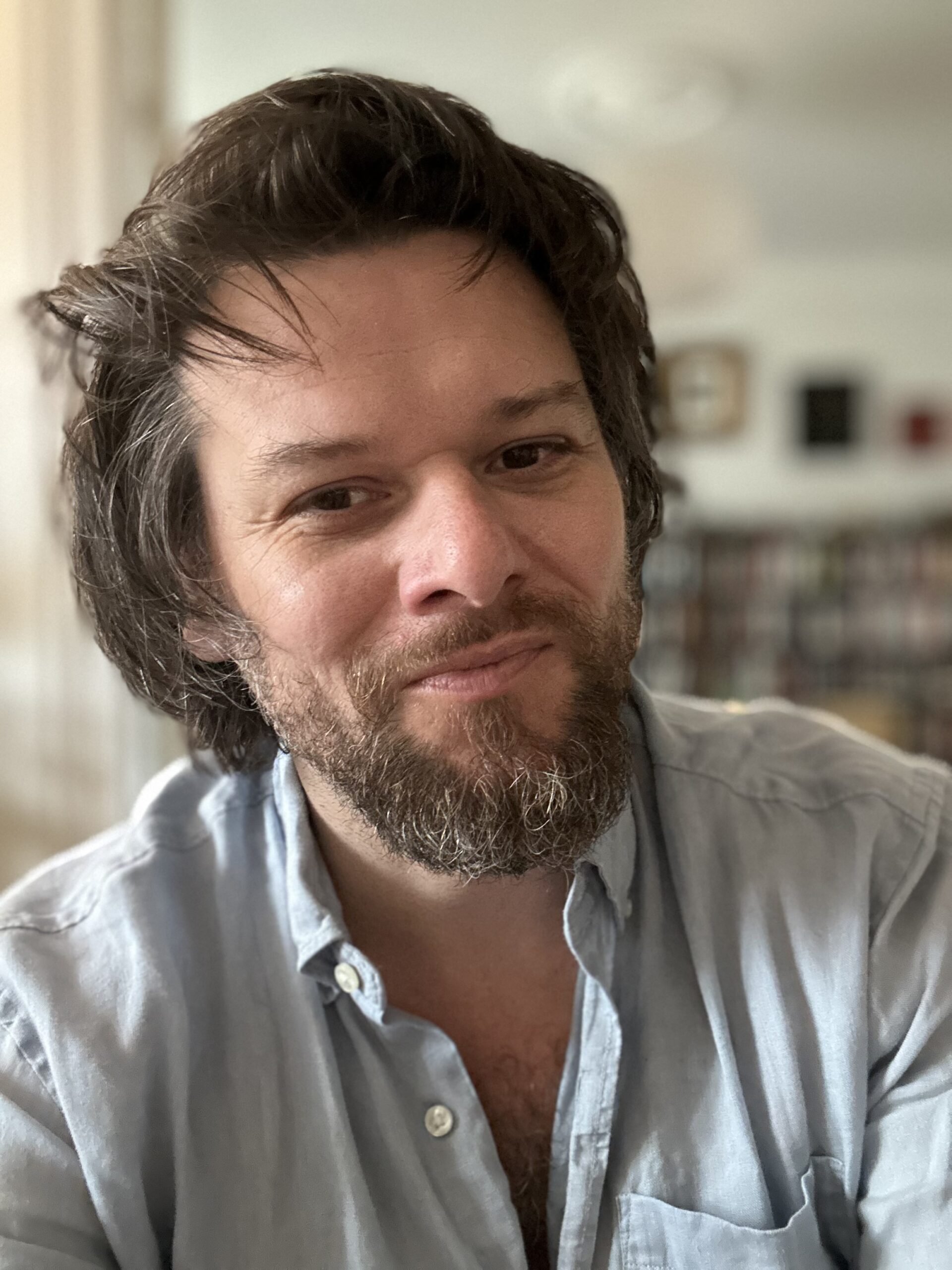
Elvis Bego was born in Bosnia, fled the war there at age twelve, and now lives in Copenhagen. His writing has appeared in AGNI, The Best American Essays, The Kenyon Review, New England Review, The Threepenny Review, Tin House, and elsewhere