Cigan Valentine

Conjuring Home: Talia Lakshmi Kolluri interviews Samina Najmi

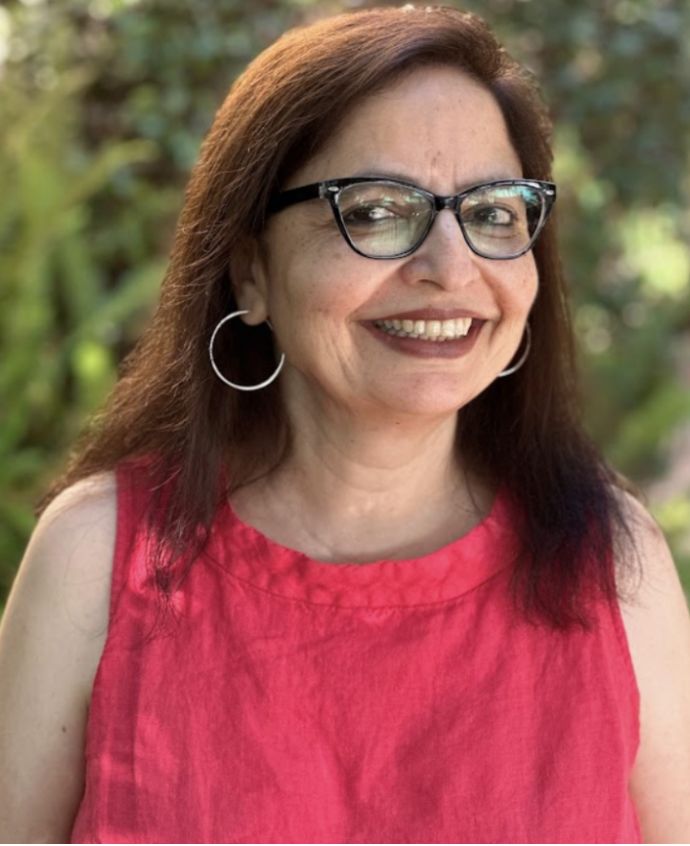
Talia Lakshmi Kolluri (left) and Samina Najmi (right)

Talia Lakshmi Kolluri (left) and Samina Najmi (right)

SAMINA NAJMI and TALIA LAKSHMI KOLLURI first met in 2022 after Najmi read Kolluri’s short story collection What We Fed to the Manticore and conducted her own interview for The Normal School. In that conversation, they found that not only are they practically neighbors, but they share a tremendous amount of common ground. Thus, a friendship was born. This conversation unfolded over email during Najmi’s book tour for her electric memoir-in-essays, Sing Me a Circle: Love, Loss, and a Home in Time, which spans her childhood in Pakistan and England, her first foray into the US in Boston, her family and professorial life, and Fresno, the place she now calls home. In this conversation, Kolluri and Najmi explore memory, return, the meaning of home, and the way we tell our stories.


Conjuring Home: Talia Lakshmi Kolluri interviews Samina Najmi
Read more...

How to Cry in Public Places

By EMILIA DŁUŻEWSKA

Translated from the Polish by KLAUDIA CIERLUK

Translator’s Note

I first encountered Emilia Dłużewska’s How to Cry in Public Places (Jak płakać w miejscach publicznych) three years ago, when it was shortlisted for the Joseph Conrad award—the most important Polish prize for a debut work. I was immediately captivated by its strong and unique voice: if you’re looking for a somber work about depression, this is not what you’ll find here. Instead, Dłużewska navigates her experiences with mental illness, the structural inequalities that fuel it, and the grey reality of post-Soviet Poland with unusual grace and humor, smoothly moving between disparate tones and registers. Playful vignettes, to-do lists, and shrewd word plays are just a few of the elements that comprise this genre-defying work. Set in contemporary Warsaw, with the lingering shadows of the Soviet era still shaping everyday life, How to Cry in Public Places nevertheless attests to the universality of the experience of depression, exploring how private suffering is deeply connected to the social and political contexts that surround it. The book’s intelligent deconstruction of mental illness affixes it to the vibrant vein of modern, English-language classics that approach similar issues through an equally dark and funny perspective, such as Ottessa Moshfegh’s My Year of Rest and Relaxation and Juliet Escoria’s Juliet the Maniac—the key reason in my belief that Dłużewska’s prose will appeal to readers on the other side of the ocean as well. 

How to Cry in Public Places
Read more...

Before Times

By JENNIFER CHRISTGAU AQUINO

Seattle, Washington

We walk sixteen thousand steps in shopping bags and Patagonia rain jackets through the never-rain, using Google maps to navigate your hometown. I talk incessantly about my lost life while you take us down wrong turns, saying, You will get there. At a paper maps store, we pull out drawers of flattened Earth. Of streets in Seville and Oslo, as if life can be laid out and easily navigated. More than once I say, Wouldn’t it be nice to travel there.

Before Times
Read more...

Nocturne for Dark Things

I do my finest listening in the dark.
My best friend has always been ink
and she lets me talk so much at night.

One of the marvels of my life—
an alphabet. A whole green and mossy
world can be made and remade

from just twenty-six dark curlicues.
Here’s more dark: sometimes birds sleep
tucked under a giraffe’s dusky armpit

Nocturne for Dark Things
Read more...

[Freedom Song]

By FATIMAH ASGHAR 

what does it mean, to be free? i sip coke at my phuppos, azaadi
on the walls of the university, free kashmir sprawled, azaadi

on my body. when i walk the streets of lahore men stare.
can i write the poem that makes me free, that brings azaadi

to my lips? i say i want to drink from its waters, but i know
what it means to be human & dumb, to pray & when azaadi

comes to shun, to judge & say not like this. control, a bitch
deeply un-free, that sticks me in my own mind, azaadi

[Freedom Song]
Read more...

The Back Meets the Nose

By EMILY NEMENS

She was running along the Manhattan side of the East River—this was in the bucolic “before” times, prior to when the city tore up the East Village’s riverside park, chucking its eighty-year-old trees and modernist amphitheater and ebullient perennial flower beds in the name of future flood mitigation—when she felt a curtain being snapped up the back of her left calf, krrrrrik! More lightning than pain. At first. Then, it became very painful. A hot pain that ran an invisible line down the meat of her calf, like those sexy stockings with seams, but the seams had turned carnivorous and were nibbling at her flesh with tiny razor teeth. Running farther, even slow-jogging the 1.3 miles home, was out of the question (her mental math: more pain multiplied by less time in transit, or less pain times more minutes; the latter had the lower sum), so she slowly limped back from the river, putting as little weight on her left foot as possible. She wondered what she would do.

The Back Meets the Nose
Read more...

My Cousin Thinks I Gave Her Nazr

By EZZA AMHED

Because I didn’t say Mashallah when she swapped her nose stud for a hoop and two days later I’m met by the bursting bulb of blood and pus which seals the fibrous innards of her nose cartilage on the outside sits the bulb pulsing expanding as if it’s breathing looks like a red evil eye ornament white pupil right at the center she has a nose growing out of her nose

My Cousin Thinks I Gave Her Nazr
Read more...

The Strays

By RUSSELL BRAKEFIELD

Reggie pulled his truck up the driveway and past the old goat pasture, a field of knee-high brome that now fed only a rusted tractor, not a buck or a nanny in sight. The only good thing about his wife’s death all those years ago—he could finally let go of the shaggy herd she had loved so much, fill the freezer, and focus on the more agreeable ruminants.

Reggie killed the ignition next to the house. One coal-colored cloud floated like a top hat above his yellow lopsided rancher. Past that, the afternoon sun painted the foothills a fiery mauve. In the distance a trio of bluffs gave way to an abstract canvas, just cattle and rust-red desert smudging south to New Mexico and on into the Navajo Nation.

The Strays
Read more...