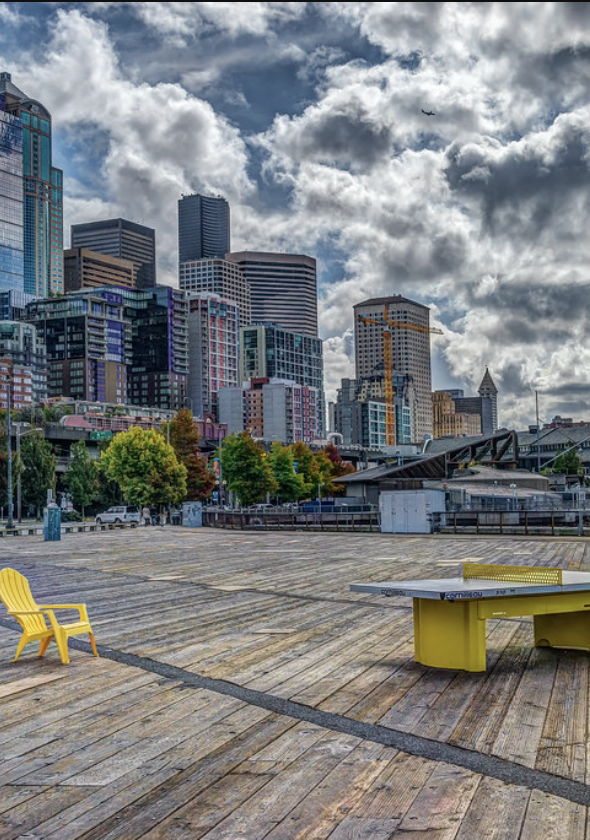
Seattle, Washington
We walk sixteen thousand steps in shopping bags and Patagonia rain jackets through the never-rain, using Google maps to navigate your hometown. I talk incessantly about my lost life while you take us down wrong turns, saying, You will get there. At a paper maps store, we pull out drawers of flattened Earth. Of streets in Seville and Oslo, as if life can be laid out and easily navigated. More than once I say, Wouldn’t it be nice to travel there.
In a bicycle repair shop cafe they serve espresso and beer. The tangerine light is scented in college with a touch of alcohol. We buy everything. Next door, the convention center is flooded with Comic-Con. There are giant swords and torn tights and bustiers; spiked helmets and smiles. The world appears full of conflict.
We fall for an architecture bookstore hidden in an alley. The shopkeeper is smart in electric blue hexagon glasses. He wrote the Bible on washing dishes. There are so many steps to correctly clean a plate, he tells us. We walk away sudsy in a life so focused there is nothing else to worry about but dishes. However briefly.
In another store, they organize everything by color. Brown has chocolate bars and llama socks and wooden olive spoons with holes for sifting oil. I’d like to sort my life in this way. Caregiving, red. Work, blue. Raising children, purple. Love, clear. And there would be nothing ombreing into anything. All tidy. Then my phone lights up. The table pales.
Your big Ziploc baggie of cancer pills gets stuck on your purse zipper. We nearly lose it; how simple things can cost you your life.
On our way downtown, a car goes off an overpass. One man is ejected and sprawled. The yellow tarp over his body is unforgiving. His plaid sleeve puddles from underneath. At night, the absence of his hand floats like eye drops on my lashes.
I wonder how we can keep going.
On our last day through a sculpture park we rise above the sound. We cross the face of a towering orange structure I think is an homage to Erector Sets. When we are beyond, we see it’s a giant chair, empty and overlooking the minty mountains. From a distance, the range appears dressed in cheesecloth and bleeding heart flowers.
How beautiful it all was.
Jennifer Christgau Aquino is an award-winning Bay Area journalist, essayist, poet and fiction writer. Her literary work recently appeared in University of Iowa’s Examined Life, Wild Roof Journal, Third Wednesday, and Cagibi. She holds a master’s degree in creative writing and an undergraduate degree in journalism, both from San Francisco State. She’s a 2024 Gullkistan resident and a 2022 Craigardan resident. She currently is an adjunct professor of media studies at College of San Mateo and the president of the The Writers Grotto.