The first time I saw Lake I was sitting on the bench between sets, waiting for the burn in my chest to subside. She walked past me to the big cage and slung her duffel to the floor. I watched with idle interest as she wrapped her wrists with soft black straps and wrangled her hair into a high loop. Her rose-colored Alphaletes came up well above her hips, and she wore a long-sleeved crop top that announced in block letters
NO TIME FOR RATS.
NO TIME FOR SNAKES.
Jacking her left leg way out in a low stretch, she pressed her chest nearly to the floor, then traded over to the right. In one fluid motion she rose, stepped onto a low rung of the cage, and grabbed the overhead bar. With the control of an acrobat, she brought her legs together and lifted them straight out, toes pointed, then with no visible effort pointed them back through the gap between her arms. How can I describe it? She threaded her body through itself and hung it down, her shoulders fully rotated, her feet pointed to the floor—sort of strung there like a kill.
When she’d repeated this movement seven times, she dropped down and pulled off her shirt, revealing a cross-backed Reebok sports bra the same color as her leggings. As she passed me on her way to the desk, I saw it—a quote rendered in antique script along her right oblique: I hope you have had a pleasant darkness.
I lay back on the bench and grabbed the bar. Beyond my balled fists, the vermiculate patterns in the drop ceiling swirled. I knew those words. In high school I had carved them into the lacquer of my bass guitar.
Janey and I were living in a rented house on Marshall Avenue, across the street from a semi-defunct school where now and then a man was shot and the neighborhood efforts at starting a community garden never quite took hold. I remember driving past the newly raised beds jungled with tall, spiny weeds, their blazing crowns and clusters of purple nightshade declaring that I was almost home.
I’d carried a little extra flesh around my middle since childhood, and I knew the foundation had been laid on which my body could build a house of fat. So when the coupon arrived in the mail, I brought it in and signed on for $9 a month.
A trainer named Quentin sat me down by the cooler and opened his binder. He was shorter than me by about six inches, but his charisma made him seem taller. The end of his sheaf of locs was bleached blond. V-shaped, wasp-waisted, he looked like one of the trophies lining the shelves in the trainers’ office. He had the kind of smile that made you want to say yes to him.
“Let’s talk about why you’re here,” Quentin said. “What are your fitness goals?”
This caught me off guard. I hadn’t known you needed goals.
“Put it another way: You’re looking back next August. What do you want to see?”
What did I want to see? I wanted pecs that weren’t round and conical like a pubescent girl’s. I wanted the front of my shirt not to bulge when the wind blew against me but to fall in a clean line from my chest. I wanted a body that was powerful and effective, like the prayers of the saints.
“More muscle mass, leaner physique,” Quentin wrote in his binder. “We can get you there.”
I listened as he pitched the training packages and told him, apologetically, that I couldn’t afford them. I was working as an assistant fundraiser at a regional food bank. Janey and I were saving up for a trip to England.
“No problem, my man.” He turned to the back of the binder. “We’ll get you set up with one of our self-directed modules.”
“So you’re a gym rat now,” Janey remarked over her shoulder when I came back.
I stared at the back of her head. She’d set up her computer in the dining room because the basement was unfinished and I didn’t want it in our bedroom.
You’re a smoker now, I could have returned. You spend all your time playing League of Legends. Is it true, from the desolation I feel when I have to pass you on my way to the shower, that you’re sleeping with one of my friends?
Each time I saw Lake at the gym, my throat would catch like it does when you feel you should speak to someone. A month passed, and I had yet to find a day of the week she wasn’t there. But I gathered as I overheard her talking to Jill, the lady trainer, that she spent her weekends on a boat in Grand Haven. I contemplated the existence of a wealthy boyfriend.
It was difficult to tell who among the trainers and bodybuilders was paired off because an easy physical intimacy predominated among them. The hand was laid on the hip, the stretch assisted with comradely affection. They had this device. It looked like a slope-headed installation drill, but in place of a bit was a blunt, silicone-covered knuckle. Quentin would come up behind Moon or Roberto, Adrienne or Dave while they were between sets, press the knuckle into their trap, and let the heavy mechanism dig away. Lake stood there with her head down while he did this, her flag of pale hair flashing, an expression of deep resignation, even sorrow, on her face. I thought of a horse standing still to be roughly brushed. I wanted to be touched like that, or to touch someone else that way. Perhaps this is the reason, late at night when Janey was asleep, I began watching chiropractic adjustment videos on my phone.
The place wasn’t large but it was never all visible at once. Like a Japanese garden, pillars and quirks of perspective always hid some part of it from view. You shifted into the free-weight area and lost the leg machines. You leaned against the check-in desk and couldn’t see the floorwork room. As a consequence, you could never quite tell who was in the gym, if someone you knew, say an old coworker or someone you’d gone to high school with and last seen at your own wedding, might come around a corner and startle you with a handshake out of that dead world. The gym was a clean place for me. I went there to be clean.
I felt Lake understood this. Like me, that sense of being clean, of sweating until every impurity had been purged, that was the real reason she spent so much time there. Not the Powerhouse Classic in Ypsi or the NPC Western Michigan Championships with all their categories—fitness, physique, bikini, wellness. All that was just a pretense, a way of justifying the time spent.
They went to competitions together, Lake and the others. Sometimes they stayed for the weekend, Ann Arbor or Pontiac or Kalamazoo. Afterwards, they’d cut loose a little with the other competitors, these people who were ordinarily so abstemious. I wondered what it would be like to see them all in some hotel suite in their white cotton robes, the oil and spray tan of the stage washed away, Adrienne in Dave’s lap, Lake and Jill lying on their backs passing a joint over their heads, Quentin and Erik enthroned in leather chairs, ice clinking in their tumblers of Hennessy, smoke from their Cohibas circling the can lights. Or maybe after they showered they hit the downtown scene, mingling with all the mere mortals and making them wonder which Fast and Furious sequel was shooting nearby.
“Bikini dreams and a wellness ass,” Lake said to Jill after the qualifier for the Wings of Strength Yamamoto Nutrition Cup. Apparently she hadn’t made the cut.
Jill looked at her squarely. “Girl, I’d kill somebody to have what your momma gave you.”
I existed in a twilight realm that autumn, driving to work, going to the gym in partial darkness, the tang of apples ripening on the ridge, the smell of leaf fires washing in after me as I stepped through the door. What a feeling to find it nearly empty! One elderly Korean woman marching on an elliptical, one attendant worker pushing the swivel mop over the vinyl, and Lake alone, as if it had been prepared for us. Before leaving the car, I worked the band off my finger and dropped it into the cup holder where it lay shineless on the crust of old cola, crumbs, and hair.
It was not until I was pulling my Carhartt out of the locker one night that she spoke to me. Squatting over her duffel, she began to unwrap her wrists. I’d done a long leg routine that night, pushing myself further by several sets than I’d gone before, and I was feeling narcotized and floaty, which may be why, when she glanced up at me, I didn’t look away.
“Don’t ever start using these,” she said, peeling the Velcro off and rubbing her freed wrist. “You wear them long enough, your body starts to depend on them and it’s a bitch to stop.”
“Were you hurt?”
She didn’t seem to register the question. “Half of this shit,” she said, describing a circle with her finger that seemed to include not just the machines but all of it, the drinks, the supplements, the programs, “it’s just so someone can make money. You don’t really need it.”
She rose and put out her hand. “Call me Lake.”
Her palm was warm. There were calluses at the bases of her fingers.
In the dim and dusty region of my brain that governs flirtation, some synapse—the last aging soldier at the gun emplacement—must have begun spastically firing, because I responded, “Is that a Christian name?”
She frowned, then laughed. “Might be a pagan one.” She released my hand and pulled a sweatshirt out of her duffel and tugged it on. For a moment, she seemed on the verge of saying something else. Then headlights flared through the black windows and she turned her head. Her ride, it seemed, was here.
I felt a sudden panic as she made for the door and the waiting car. I hadn’t introduced myself. Through the window, the dashboard reds and blues of the cab were visible. In the darkness, it appeared to have no driver.
“I’m Will,” I called after her.
“I’ll see you around, Will,” she said over her shoulder.
In the spring of that year, my college crew had started getting together once a week to play board games. Feeling she’d become somewhat estranged from her own friends, I’d invited Janey along. There always seemed on those nights to be a mutual disdain between her and Joe. They were both highly competitive. Even when they ended up on the same side, they nagged each other in a way I found wearying. Understanding arrived in me the day I came out to join her on the porch and found her smoking his brand of menthols.
We had never been particularly close, Joe Corning and I. I even pitied him in a minor way in college. He was tall, broad-chested, fatless. Imagine the actor Michael Shannon as a young man, his goatish face, his affect at once seedy and mildly autistic. He seemed directionless, wasting his intelligence on a major he didn’t care about, hacking PlayStations for clients who found him on Craigslist. A visit to the house he and Simon rented together after graduation revealed an unlighted living room glutted with shelled consoles and computer towers posted up on chairs and card tables, hundreds of minuscule screws and washers, picks and tweezers, small plastic fans and motherboards, a stack of pizza boxes leaning in one corner. This was the room, I later learned, where Janey had first taken off her clothes for him.
I need not enumerate the projects that kept her late at the agency; the weekends with her mother; the night she announced she would drive up to Lookout Park to watch the thunderstorm and my request to join her was lightly, then firmly, rebuffed; the deranged episode in which I, walking alone along the train tracks in the depths of an insomniac night, laid out the evidence, summoning God, our friends, and the ghost of her dead father to testify. The thousand small rendings of a shared life.
When I confronted Janey about it in the upstairs hallway between our bedroom and the head of the stairs, she slid down the wall, clutching her stomach as if I’d slugged her.
“How could you ever think that of me?”
So I decided to stop. Thinking about it. The coupon arrived. I brought it in. And there was Lake, and Lake seemed to be waiting, in whatever mysterious way, for me.
I hope you have had a pleasant darkness. As Quentin massaged her with the gun, the words of her tattoo were again visible along her side. They came from a book by George MacDonald, the Scottish fantasist. Lilith, a long, howling late-Victorian dream of a novel I’d first read at sixteen, when death and hell were very much on my mind.
I determined to ask her about it.
Quentin and the others had gone to Pontiac for the cup. She stood there crossing the cables by herself. I passed between the rows of treadmills, descended the ramp, and dropped my bag in front of her.
“There’s something I’ve been meaning to ask you,” I began. I expected her to make some quip, something deflating like, No, I’m not single. Yes, I have plans. But she simply waited for what I would say. “Your tattoo.”
“Which one?” She looked down her forearm where a prism, a crescent moon, and several black hands were constellated.
I touched my ribs.
“My script?”
“It’s from Lilith,” I said.
“Holy shit!” She was beaming now. “You’re like the first person I’ve ever met, at least here for sure, who knows what it is.”
I could not believe my luck. Steadying myself, I asked her when she got it.
“Six years ago,” she said. “After their show at the DeltaPlex.”
“The DeltaPlex,” I repeated, unsure, suddenly, what we were talking about.
“They were opening for Baphomet. They should’ve been headlining, they were totally sick. It’s so weird you brought it up. I’m listening to that album right now.”
Something akin to despair climbed the lattice of my guts as she went to her duffel and pulled her phone out of the side pocket. She brought it back and came so close to me that her shoulder pressed my arm. On the screen a naked woman with wild, pre-Raphaelite hair was nursing a skeletal bat-creature amid desert crags, the words Progeny of Lilith written in blood-red hell-script across it. Lake found the song she wanted and held one of the padded earphones up to my head. Its rim was slick with sweat. I listened. A tumult of drums was drowned by a wave of detuned guitar. A female singer screamed as if she were being boiled alive.
In the morning we set out
And made for the forest!
I rode Lona’s horse and carried her body
To give it a couch in the chambers of the dead!
We stood like that for half a minute as the lyrics notched past on the screen. I felt my body dissolving away.
“Better than Carcass, right?” she said, looking up at me.
Her sweat was clean and strong, like cracked branches or burnt grass. With a slight dip of my head, I could have kissed her eyes.
“Totally,” I said. “They’d eat those fuckers alive.”
On my drive to work I listened to the album, seeking any glimmer of the cold, bereaving joy that had first quickened in me when I first read Lilith as a teenager. The faerie strangeness of it, the ecstatic theology, the conviction that death was just a sleep to pass through and no one and nothing was ultimately lost. I couldn’t find any trace of it in the music.
A feeling of fraudulence crept into my interactions with Lake.
“What’d you think of Corpseflower?” she’d ask me. “If you were into them, check out Hard To Be A God. I think their bass player is a legit cannibal.”
I started listening to her music at the gym out of a fear that, should she come up to the treadmill while I wasn’t looking and pick my phone off the stand she’d find me listening to Joan Baez or The Be Good Tanyas and I would be unmasked as a dweeb. But slowly, without perceiving the change, I started to enjoy it: the utter extremity of it, its total disregard for me, my comfort. That sense of pushing against the limit, the very gates of death.
At my three-month check-in, Quentin led me to the bioelectrical impedance machine and had me grip the electrodes. “Seventeen percent—not too shabby, my friend.”
I asked him what he thought of my progress.
“Well, there’s definitely less of you.”
I wanted to go further. “What would you do with someone like me?”
He stared at my clavicles; I brought my shoulders back. “I’d start by getting a workup on your natural T, find out what we’re working with. My hunch: You run a little low.”
“We talking gear?” I asked.
“Well,” he said, “there’s all kinds of ways.” Probably there was a protocol about discussing steroids with clients. Working his gum thoughtfully, he surveyed the populous cardio room, the far cables. It was bright outside, and the light on days like this was even brighter in the gym, amplified by the mirrored walls.
“When did you start training?” I asked.
He grinned. “When you were just a tickle in your daddy’s pickle.”
I was absolutely confident he was my own age if not a couple years younger.
He turned now to watch the free-weight room, like a lifeguard. “There’s a lot of benefits to training hard.” Moon and Roberto were on the decline bench, Roberto under the bar, Moon shadowing it with his hands. Beyond them, Lake carried a set of dumbbells back to the rack. Quentin tracked her as she selected a new pair and carried them out of view. “Lot of benefits.”
“Corporate don’t like me to say this,” he went on, “but the most important part we can’t give you.” His gaze moved downward over my chest, my abs as if he could see through my clothes. “There’s a fire. It’s like a life force. The muscles are just a side effect. The fire is what it’s all about. When you meet somebody who’s touched it, you can feel the heat off them, just like you can feel the heat off somebody’s skin who’s been in the sun all day.”
“That’s what I want,” I said. “How do you get that?”
He looked me in the face again. He wasn’t grinning now. “That right there, brother, is something nobody can tell you. Get there, and I can show you fifteen ways to hit the rear delt. I’ll train muscles behind your balls you didn’t know you had. But I can’t carry you to the fire. You gotta get there on your own.”
Not long after the cup, Lake began to miss training days. Then for about six months she didn’t come in at all.
“Don’t know, man,” Quentin said when I asked him, as if I were a troublesome customer pestering him about an item they no longer stocked. “Haven’t seen her.”
In May, Janey and I flew to England, where we’d spent a semester in college, before we were married. From York we took the train to Edinburgh, Glasgow, the port of Mallaig. In a pub on the Isle of Skye that served infected local beer we played pool with a pair of young fishermen. Janey flirted with the handsomer of them, and when they stepped outside to smoke, I remained inside with the one with the drooping eye.
“How is it living here?” I shouted at him as he swayed at the end of the booth. The Red Hot Chili Peppers were being played at incredible volume. “It’s so beautiful!”
“It’s pure shite,” he said.
Our last four days we spent in Grasmere, in the Lake District. The worst part of it, what really gutted me those days eating gingerbread, visiting Dove Cottage, seeing De Quincey’s opium scales, is that I still loved her and, in her way, I believe she still loved me. What can I say to do justice to her walking back toward me waist-deep in ferns, the sunlight and daffodils worshiping her? We’d been children when we met.
From her laptop in our room she joined a League match with Joe. In the bar downstairs I put back three Dalwhinnies, not caring that she would see the charge, and went out into the gathering dusk and made for Helm Crag.
Halfway up I lost the path. There under the trees, it was already dark as night. I stumbled and sat down on the roots of a huge rowan tree. I rose after some minutes and turned back. The slope eased and brought me suddenly out of the tangle of the wood to the edge of a pasture I did not remember passing on my way up. It was lighter there. A smoke of sunlight still haunted the grass.
From out of the ditch something long-bodied, low, and dark, wearing a death’s-head for a face, was climbing into the pasture. A second followed it, smaller. Black ocular holes peered from its skull. There were more. They stood there blindly scenting the air.
Yes. Here. At last.
The first and largest bent its head to the ground, and I heard the tearing of grass. It was as if a spell had been broken. The weird horror loosened its grip. I saw that they were sheep. Standing, chewing ordinarily, turning their faces toward the last glow that fringed the hills. Herdwicks, I later learned. A Viking breed, gray-wooled and white-faced. For a moment, I thought they were wraiths.
When Lake came back to the gym at the end of July, her body had softened. Her abs were no longer visible, hidden under new, alluvial drifts of flesh. Her arms were rounder, even mottled slightly, like soft cheese. If she stood, back straight, head down, doing a barbell row, a little pouch of flesh pushed out under her chin. Something in her body, maybe chemically, had changed. I had known friends of ours from high school who had become almost unrecognizable after pregnancy. Even the architecture of their faces rearranged as if by violent attack.
I noticed too a change in the old camaraderie. There was a gingerliness in it now, the way Jill and Erik approached her, as if she had to be handled carefully. And from Quentin, undeniably, a whiff of disdain.
I was working out five, six days a week by then, sometimes twice a day, in the morning before work and again after, subsisting largely on the glycogen-creatine-whey-protein shakes I batched at home. I’d startle myself sometimes, stepping out of the shower and seeing my gluteus medius fluting my hipbone, my obliques rilled along the side of my body. I began to fantasize as I had when I was young about fistfights, accidents where I had to lift cars off young mothers. Late at night when no one else was in the gym I’d throw shadow punches at the mirror, ducking, swiveling. I’d imagine it was Joe Corning I was beating. Beating his goatish face as Janey looked on, until he could no longer beg me to stop.
I was midway through a set of preacher curls when she arrived. It was late, after 11:00. Maybe I’ve colored it in over the years, but she looked harried to me. Her face was flushed, her throat too, as she passed through the cardio room and down the ramp.
Pity stirred inside me. I knew I’d gone beyond her somehow. More than in my fitness only. I racked my dumbbells and passed the desk, venturing into the long aisle between the treadmills. She stood there beneath the cable tree, tightening her wraps. What could I say to her? Maybe only that I admired her and in my distant, uncomprehending way cared that she was in pain.
I got as far as the ramp and balked. I stepped onto one of the treadmills, turned it on. As she pulled and pressed the cables below me I tramped out my eight-minute miles, staring at my own reflection in the black window, trying to work out what to say.
The pressure changed. Quentin stood just inside the door, scuffing the soles of his shoes on the mat. The trainers never came in this late.
He hipped past me down the ramp. Going around the cable tree, he straddled the lat bench in front of her, grabbing the bar on his way down and sitting with his trunk-like arms extended, chewing his gum. He seemed immensely gratified.
Lake was doing chest flies, her hips back, her back straight, pressing the handles together in a tight, scooping motion, the loop at the top of her head quivering with the effort. Quentin grinned at her, toying with the plates, teasing them up and down. She kept her earphones on and stared straight ahead. I cut the power to my treadmill and walked it to a stop.
Quentin dropped the plates with a clap. Quick as a toad he hopped up and went around behind her. In the middle of her rep, when her chest was fully engaged, he pulled the earphones off her head and settled them around her neck.
She chunked the cables back, left, then right, and went to stand over her duffel. There was a narrowness in the way she held her shoulders, a guarding. Unwrapping her wrists, she said something I couldn’t catch.
“Totally—ha!—totally,” Quentin barked. “Life’s a bitch, isn’t it? Thing is, though, I know my commitments.”
She must have replied, because he leaned in. “What was that?” He wasn’t quite shouting. “Come again?”
Lake slipped her wraps into the duffel and shouldered it, going back toward the leg presses. He followed her. Their reflections in the window were dim and distant, spreading out and warping in the headlights that swam out there on Leonard Street. A sickness coiled in my stomach. Earlier that week I’d lain awake in bed listening to Janey talking to Joe on her headset, her voice filtering up through the vent in the floor. I’d heard the baiting in her voice, the come-on, do-me cadences of a seduction she’d never used on me because I’d never been unavailable, never out of reach. Faced with her absolute denial of what I could plainly see happening in front of me, I was utterly stymied.
I stepped off the treadmill and descended the ramp. At the back wall, beyond the machines, Quentin and Lake stood close together. Something was off. He was behind her. Her face, I saw, was pressed to the drywall. His right hand was on her shoulder blade, holding her there; the other gripped her wrist. I had seen him work the muscles of her back many times with the massage gun, seen him use his weight to help her stretch. That’s not what this was.
He pushed his pointer finger into the meat of her left glute. It sank into the soft flesh as easily as raw dough. She squirmed as he dug into the nerve, but his grip on her wrist was implacable. “That’s fat,” he said calmly, almost hermeneutically. He pushed his finger now into the folded flesh of her back, just below the hem of her bra. “That’s fat.” He pointed at the dimple in the corner of her mouth, poked it once, twice, a third time. “Hello there, fatface.”
I wanted to do something to stop this humiliation, but my legs, as in dreams when you’re trying to flee across a broad highway, seemed mired in a heavy substance. The corners of her mouth were turned down. There was a deadness in her eyes. They were a fish’s eyes, deep-sea eyes. Yet for a moment they quickened and fixed on me.
Observing this shift in her attention, Quentin turned. He looked me up and down as if noticing me for the first time, champing his gum with big, molar champs. “William Solomon Eisen,” he said, surprising me with my full name. “Burning the midnight oil, bud?”
“What’s going on?” My voice was full—I could hear it.
He released Lake’s wrist. For an instant, I thought I’d won. Head wagging, arms loose, he came and put his hand on my shoulder, close to my neck, the way you’d clasp the shoulder of a confidante. Something in me was allayed by his touch. I could smell the wax in his hair. Something else too, in his cologne, a sharpness of bergamot or castoreum. “Little trainer-client intervention,” he said, as if he could afford to go that far with me, let me ask a question he would deign to answer. So great was his authority.
“Tell me what’s going on.”
That’s not what I’d wanted to say. What did I want to say? Fill your hands, you son of a bitch. I needn’t have said anything, only stepped around him, gone over to her.
“Remember what I was telling you about the fire?” Quentin said. “Well, she’s doing her best to lose it. You, on the other hand…”
He gave my trap a firm squeeze. Under his grip, I knew its scrawniness. His hand moved out to my delt, then down to my triceps, appraising them.
I remembered Janey’s voice. I remembered my paralysis. My head sang. My vision became constricted, burnt around the edges, Quentin’s grin looming huge and moonlike. Over his shoulder, Lake still stood where he had put her. Watching me. What was I holding myself in reserve for? What was all my running and lifting and stretching, my wage-earning and dieting, my abstinence from alcohol and tobacco, from bath salts and heroin, meant to get me, finally, if not the capacity, in the crucial moment, to act? Maybe if I’d looked at her— Maybe if I’d simply stepped back from him and put my attention on her that would have been enough.
“I’ve been thinking about our conversation,” Quentin said. “I think I did you wrong there, like, led you on. Let me save you a lot of heartbreak: You don’t have it, and you’re never gonna have it, and that’s okay. You’re a good-looking dude. Who says you gotta be jacked? Relax. The world needs every kind, and you’re one.”
“Thanks,” I said. Why? My voice had lost its fullness, sounded boyish and thin.
He pulled back from me and smiled, and his look was frank, secular and already half distracted, as if I were a problem dealt with and soon to be forgotten. “Do something for me, champ?”
“Sure.”
“Give us a little space.”
“You got it,” I said.
He patted my stomach, there on that remnant paunch I hadn’t been able to carve from myself. The feeling of his touch lingered as he cracked his gum and turned away.
Lake was not looking at me anymore. She was looking down. I couldn’t see her eyes, only her cheek, blotchy and swollen.
VENI
VIDI
VVHISKEY
her long-sleeved T-shirt read, its hem tucked into the waistband of her leggings, tight and black and filled up with her imperfect hips.
It’s strange how little I ultimately remember of that year. I remember Janey cursing me on the stairs of our rented home as I left with a bag of clothes and the books I could fit under my arm. I remember a bottle of Ballantine’s on the nightstand in my childhood room when my father came in to speak to me, how he didn’t mention it, how he appeared to me then, sitting on the edge of the bed, like the old man he is becoming now.
I lived with my parents for a month until I found a place of my own in Grand Rapids. A studio apartment on Lafayette in what had once been a house of manorial grandeur but in later years was divided into sixteen units, showers installed in coat closets and the rest. A police cruiser hit me one night while I was crossing Union sober as a minister, breaking my pelvis and a rib that punctured my lung. I was in the hospital a month. When I got out I quit the food bank and lived off the damages until, in the fall of the year, I met Amelia and decided, well, it was time to come back to the land of the living.
Rain had fallen the morning we drove to the showing in Spring Lake. It was May again. The long, dire spring of false starts and freezes was over. The rain had washed all the dirt and oil down the storm drains of the world, and things were new and green again.
“It looks even better than it did online,” Amelia said as we pulled up. “Look at that garden.”
“Crocuses.” I pointed.
“There’s wisteria around the door.” She turned back to me. “These are good people.”
“Let’s play it cool, though, with the realtor.”
The credit union had preapproved us for a $200,000 fixed-rate. She put her elbow on the armrest and leaned toward me with her chin in her palm. “We’re actually doing this.”
We got out, and I opened the rear passenger door to retrieve the journal I used to take notes on the houses we toured—stains on the ceilings, cracked foundations, evidence of mold, that kind of thing. When I straightened, I saw that a woman had come out of the house and was standing on the porch under the wisteria. She wore a cream-colored skirt and a long-sleeved blouse of aquamarine.
Amelia was already halfway up the drive, introducing herself. I hadn’t moved.
Her hair was different. It was dark now, a buckwheat color. Her hips had continued to fill out. Still, despite the new flesh, her bearing was exactly the same. If twenty years had passed I would have known her.
She’d shaken Amelia’s hand, was waiting for me with her black leather realtor’s folder held in the crook of her arm. Amelia half-turned and gestured toward me. “—and my partner, William.”
Lake held out her hand. “Hannah Talvitie, Summit Realty.”
I repeated the name she’d given and accepted her hand. If there was an acknowledgment of our connection, it was so subtle I’m sure Amelia could not have noticed.
She had the facts down as she led us through the house: the year it was built, the age of its roof, how much we could expect the heat pump to save us on gas during the winter. She parceled out these bits of information from living room to kitchen and into the bedroom so as not to let the conversation falter. Amelia asked if the current owners had kids.
“Two,” Lake said as she brought us down into the basement.
Two, Amelia mouthed at me.
The basement was unfinished, all bare concrete with an area rug laid down in the center the color of dried blood. A little wet, the smell, but not as grim as most Michigan basements, which tend to feel dankly haunted. For one, the ceiling was high enough for me to stand upright. Against the left-hand wall was a workbench with a toolbox, a vise grip, a Dremel. On the bench, a carving of a hand reached out of a block of pale wood.
“There’s enough room for your weights down here, Will,” Amelia said.
“Does it ever flood this close to the Grand?” I asked quickly. The river was about eight hundred feet off, back through the woods behind the house.
Lake opened her folder and held a sheet of paper out to me. As she did our eyes met again, briefly. I was sure she recognized me. I took the paper. It was an insurance report going back to the mid-eighties. “You’ll see the last time was in 2013, when we had the disaster declaration.”
Amelia had gone to the window at the far end of the room. She lifted onto her toes, her hands on the sill. The window only came a head’s height above the level of the grass. “That was such a crazy year.”
In fact, it was. It was the year of my divorce, the year of the gym. It was the year the river rose and kept on rising and flooded the streets of Grand Rapids and washed away all those river houses north of the city.
Lake’s tattoos as she stood beside me, looking at Amelia, were covered by her blouse. I could picture them: the phases of the moon down the outside of her left forearm; the rose on her right shoulder; Victrix in German blackletter on her right triceps; the line from the book I’d thought meant something to both of us.
After what happened with Quentin, I’d stopped going to Fitness 19. It wasn’t clean for me anymore. I took up running, for a while. My runs grew to five miles, eight, twelve—my endurance like a band I could stretch out and out. I ran the stairs at Belknap Lookout five, six, seven times until my legs shook coming down and I had to steady myself on the rail. Then one evening, late, I reached the top and saw Janey there, in Joe’s car, and that place, too, could no longer be mine.
I packed my duffel bag and moved out the next day.
“Don’t go,” she cried. “Don’t go.”
Within a year she was remarried. Not to Joe. To someone else whose name I’d never even heard.
What was it that grieved me, finally? That I’d failed to act and so prevent catastrophe? If so, where was the catastrophe? No one had died. Life had gone on, for all of us. No, I think it was the realization that for all the difference I had made to Lake, to Janey, to the history of Fitness 19, it was if I’d never been there at all. I’d passed through it all, a ghost in my own life.
“The river was so high,” Amelia said. “I went downtown when it happened. All those offices down by the Fulton Street Bridge got flooded. Remember that? The water was up to the second floor.”
Janey’s agency had been in that building. I remembered going there with her when the flood was peaking. Unlocking the door with her key card, we’d entered the aquarium twilight of the ground-floor lobby, towels bundled against the seams of the glass, all that water rushing past in perfect silence.
Amelia stood on her toes, looking out the basement window but seeing back, I suppose, into her own past, before we’d met. If I had chosen, then, I could have stirred my arm, even just an inch or two, and taken Lake’s hand. I felt certain she knew me. She had to. I remember you, I wanted to say. Do you remember me?
Amelia turned and looked back at us. “Did you ever see that picture of the fish in the window?”
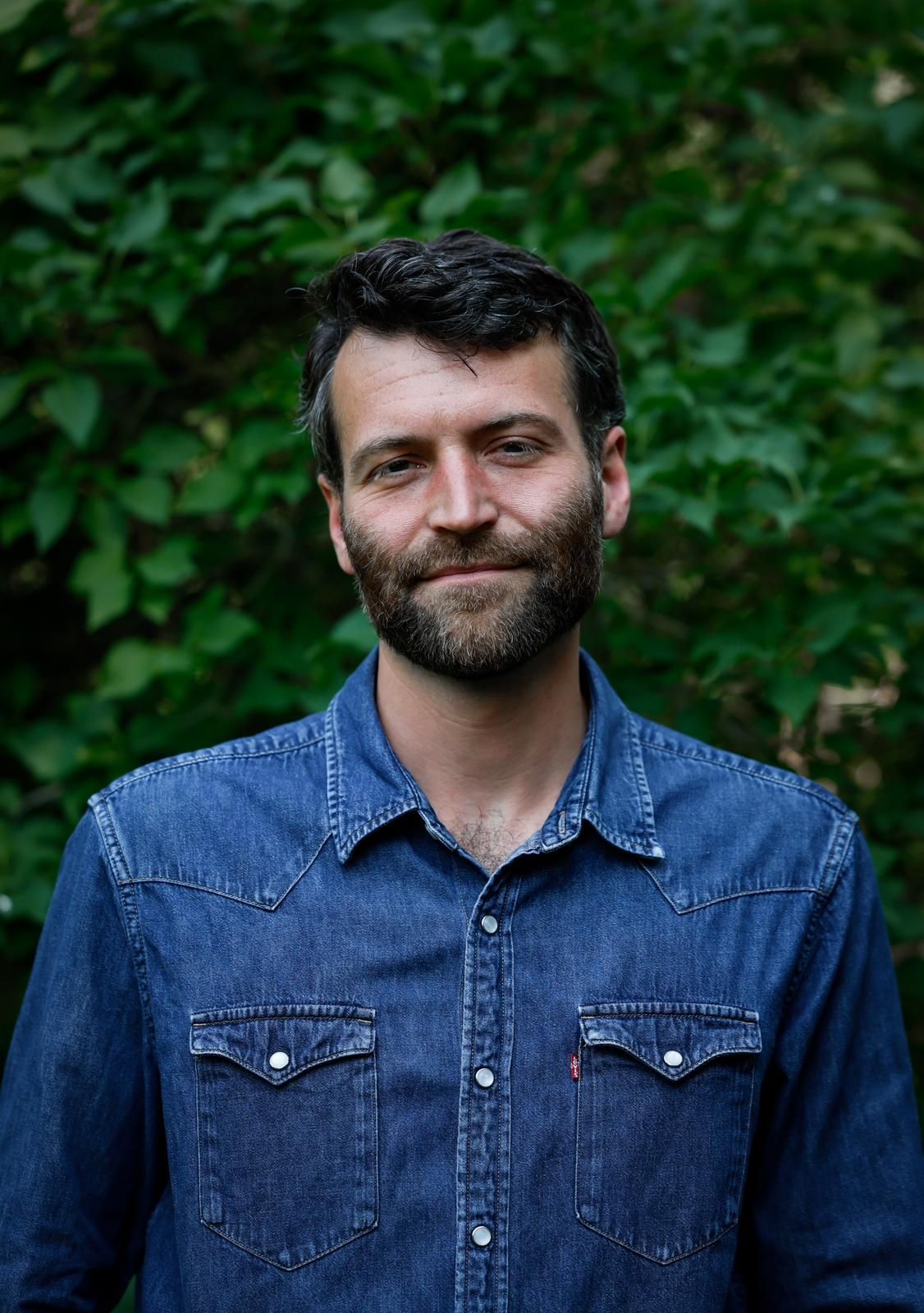
Andrew Steiner was born in Grand Rapids, Michigan. His work has been featured in Narrative, Grain, EPOCH, and other publications. He received an MFA from the Iowa Writers’ Workshop in 2022 and lives in Germany with his wife.