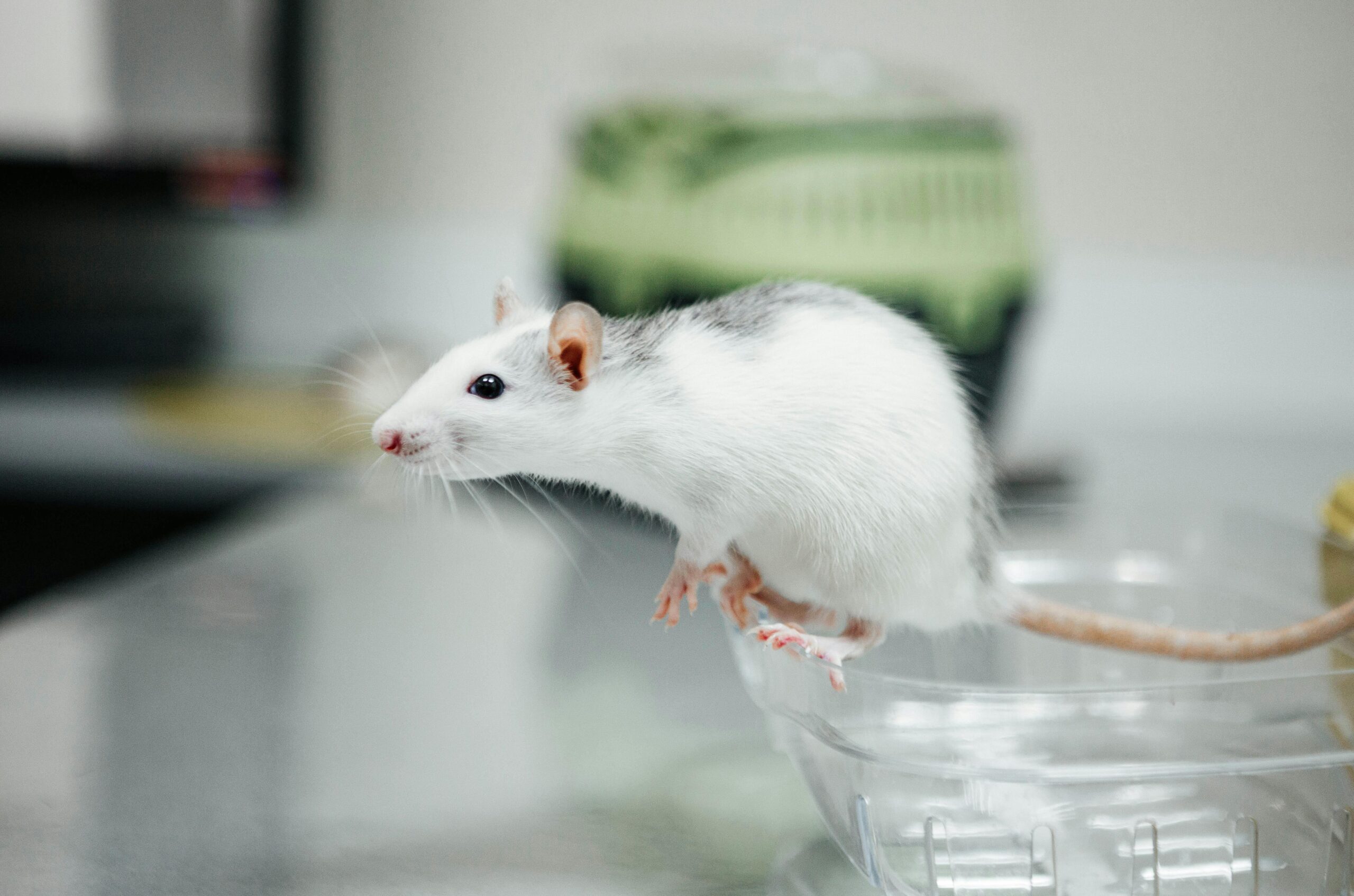
When Nayana came out of the garbing room, Noah forgot all about the pinworms. He forgot about the perianal tape test he’d just done on the sentinel mouse in Room 8, and he forgot about the disinfecting he’d have to do for the rest of the week. He forgot about the yellow paper gown, elastic hair bonnet, and rubber gloves he was wearing. He knew only the ray of Nayana’s smile, her scent of lemon and ginger.
“There’s a pinworm issue in Room 8,” he said, floating down the hall behind her. “But don’t worry—your mouseys are fine.”
“Okay, good, because today’s a big reward day. There’s some nice sugar water in store for Number 452, if he’s a good mousey.” She opened the door to Room 7. “But I couldn’t sleep last night. I’m worried we’re starting the test too early.”
The ChR2 needed three weeks of expression time before the lab began stimulation, Nayana said, but it had only been fifteen days. She shook her head, and Noah nodded. He’d gotten better at pretending to understand. He crammed neuroscience books in his free time, in the hope of someday speaking confidently about action potentials, neural pathways of motivation behaviors, the role of neuropeptides in the central amygdala. He’d always loved science, biology in particular, but had never followed through academically. He’d abandoned the chance to go to college, like a fool. Now, he was so far behind Nayana he’d never catch up. He just said, “Have you mentioned anything to Sanjay about it?”
Nayana rolled her eyes. “No, I’d never. My job is running the tests, not critiquing them.”
She turned toward the cages. Her lab kept a colony of C57 Black 6 mice, the most common variant, interbred but otherwise genetically typical, not transgenic in any way. Sanjay Choudhuri had been developing this colony for years. After the first twenty or so incestuous generations, the deleterious mutations had finally been purged through population bottlenecks and the strain had been made hardy.
“Well, I hope it goes okay,” Noah said, standing in the doorway in his hair bonnet. “I’ll let you get started.”
He continued his rounds, already counting down until lunch. In the washroom, he greeted Hector and George over the clunk of the autoclave machine, but he didn’t linger. The room was windowless and humid and made him claustrophobic. Back when he’d worked in the washroom himself, he’d had several full-blown panic attacks. He was much better now that his duties included movement and air, traveling from one animal room to the next, surveying the sentinels for lethargy or agitation. There were over five hundred rodents under his watch, each cage labeled with tag number, strain, sex, and date of birth. There were recombinant inbred mice, albino mice, nude mice without T cells, ataxic mice with knockout alleles, mice homozygous for autism-like phenotypes, seizure-prone and seizure-resistant mice, wild-derived mice from Japan and Peru. There was also a room of bonded prairie voles, a rat room, and a room of canaries being studied for adult neurogenesis. From outside the blunt concrete building, a passerby would never guess at the small mutant city contained within, the aroma of corn cob bedding and wood shavings, the vapors and susurrations, the hum and rub of life.
At noon, Nayana found Noah in the rat room and pulled him out into a gorgeous autumn day. They’d fallen into the idyllic habit of having lunch together on a bench by the water. Noah thought of it as their bench, where they’d sat that legendary evening in August after the campus barbecue—when Noah had first seen her after their eternity apart, when she’d caught his eye in the crowd on the lawn in her white sundress, laughing, with a plastic cup of prosecco. She’d run to greet him—actually run over the grass. Time had restarted for him then, and he realized he’d been holding his breath for eight years.
She’d immediately led him by the hand toward the group of new PhDs. “This is Noah Warren,” she announced. “He was my first friend in this country.” The surrounding faces looked at Noah with bemused interest. “He works here now, at the animal facility. Can you believe that? It’s so crazy that life has put us together again. It’s like kismet.” Nayana flashed the exact smile Noah had remembered and dreamed of every night since he was thirteen. “When I came here as an exchange student, I barely spoke English. But Noah helped me. We were both the biggest science nerds. And his family was so kind, they treated me as their own child. His mother encouraged me to pursue a real education. His father’s a famous neurosurgeon, which is why I became interested in the brain. They sent books to me in Bangladesh and helped me apply to college in India. They changed my life.”
The group’s requisite sounds of delight spiked and faded out, and the discussion eventually fell back to neurotropic viruses. Noah listened, stunned by Nayana’s easy eloquence and English vocabulary, textured only lightly by her melodious accent. He lingered at the edge of the cluster for a few moments more, then drifted off to refill his cup. He refilled it several times—he stood with several different clumps of security and IT people—before the mosquitoes came out and the bartender closed shop. Only then did Nayana return to Noah’s side. Only when the sun was setting did they amble to the water together, Noah buzzing with prosecco and unreality. He was, incredibly, inhabiting the moment he’d conjured when his mother had called him in Colorado and told him about Nayana’s expected return that fall, about her acceptance at the Nearwater Institute. He’d gotten off the phone and immediately bought a plane ticket back East. He’d scanned the listings at the Institute and applied for a lowly husbandry tech job, the only position that didn’t require a bachelor’s degree. And then, on the night of the welcome barbecue, Noah and Nayana had sat together for the first time on the bench, green-painted iron with forked feet planted in the earth, as the pink clouds canopied the water like chiffon skirts. The houses on the finger of land across the Sound twinkled, as they must have twinkled every night for whomever bothered to look, reminding Noah of The Great Gatsby’s beckoning green light—the difference being that he already had what he wanted right beside him.
Now, they sat together on that green bench and ate lunch, as if it were the most ordinary thing to do, here on the same continent, in the same country, beneath the same circle of sky. The noon light caused a painful throb in Noah’s head. He was living back at home now, just a few miles away from the Institute, masochistically dwelling in his parents’ Stygian basement with its gym equipment, so sensitive to external stimulation that he sometimes spent entire weekends in bed.
“I guess I didn’t understand how expensive everything would be,” Nayana was saying. “My stipend goes so quickly, just from rent and food, it’s crazy. I know how lucky I am to be here, but it’s going to take so long to earn a real salary. It makes me feel like a selfish American, pursuing my silly dream. I should have just done what the smart Bengali girls do, marry a man with money, so my mother and sisters wouldn’t have to worry.”
“Oh, but you’re much too smart for that. And they must be so proud of you.”
“Yes, of course they are! They would never complain about money, even though things have been getting worse there. They brag to everybody about their daughter, the scientist. It’s true: I can hardly believe I’m here at the Institute, that Sanjay hired me out of all the PhDs he interviewed. It’s like winning the lottery.”
“No, it’s not. You were the best candidate.”
“Maybe. Or maybe he just hired me because I’m Bengali. I can’t help wondering if I’m truly good enough,” Nayana said, taking small bites of her sandwich. “Sanjay’s so driven, and he can be very critical sometimes. It’s hard to feel adequate. But I do think I’m adding value. For instance, I’m redesigning the next phase of the study we’re doing. Sanjay was proposing giving foot shocks to the models, which he thinks is the fastest way to collect data. Not a very nice thing to do. But he’s in a rush—I get it. Other labs are circling around the same results. So, I told him I think the study would be better if we simply strengthened the force of the air puffs. We can increase avoidance behavior in a linear way without causing actual pain to the models. He actually listened, and he’s letting me revise the test to be more humane and efficient. He’s tough, but he’s giving me a chance. He still calls me Kali, though, from the time I knocked over the pipette tray.”
“The goddess of destruction?”
Nayana shrugged. “Well, you know, Kali’s complicated. She’s ugly and awful but also the most powerful force in the pantheon, so maybe it’s kind of a compliment? And it’s way better than what he calls some of the other people. Like, Soo-Win he calls Jabba the Hutt. And Tessa he calls Turtle, because he thinks she’s slow-witted.”
“No one here is slow-witted.”
“He just has a strange sense of humor. How would you say, ‘offbeat’?” She shrugged and moved a piece of hair away from her mouth. “Anyway, I’m excited about the congruent study we’re developing, about motivation conditioning and its social ramifications. Have you heard of the Winner Effect? It’s the theory that, if an animal prevails in an aggressive encounter, it’s more likely to prevail again. Confidence begets more confidence. We want to understand that neural mechanism and compare it to basic reward motivation and need-seeking behavior in the amygdala, and see whether social variables differentiate it. Also, we know that the stress of repeated social defeat impacts microglial cells and astrocytes in the hippocampus, but their role still isn’t well understood. We want to know if the interaction of microglial cells specifically with interneurons might reinforce social goal-directed behavior and whether this is modulated by oxytocin.”
Noah had the sensation of being buried, each polysyllabic word a shovel of dirt.
“I’m sorry,” Nayana said. “This is a lot. Do you understand?”
“More or less,” he said.
At moments like this, he felt he shouldn’t be sitting with Nayana, though no one on Earth valued it more. He was selfish, greedy for her time, this precious lunch hour that she could have been using to edge closer to a breakthrough. It was possible that today’s lab discoveries might someday lead to a transformative medication. Her research team was a clique of little gods, reducing the universe to particles under a microscope—then, with the force of their brain waves, magnifying them back out. Perhaps it would be better for the whole species if Noah retreated to the bowels of the animal facility and had his sandwich in the break room.
“Also,” she continued, “we want to know whether the neural circuitry of basic fear and avoidance behavior is similar to the reinforced behaviors we observe in the Loser Effect. That is, do negative outcomes concretize in the same neural pathways, leading to pathological risk avoidance and anxiety?”
“So, basically you’re trying to figure out whether it’s the same brain process that makes winning mice into champions and losing mice into pathological wimps?” Noah asked. “Signs point to yes.”
“Oh my God, ha, remember the Magic 8 Ball?”
“You thought it was possessed.”
“I was ridiculous.”
“You thought Americans were insane. And, I mean, we are. You were right.”
She sat smiling quietly, and Noah luxuriated in the knowledge that she was recalling their time together as twelve-year-olds, goofing with the 8 Ball, studying squirrels and earthworms in the backyard. Did she remember regaling Noah with stories of animals back in her village? He remembered everything she’d told him, in her halting English, about the elephants trundling down dirt roads, the tigers lurking in the forests, the macaques that swung through the windows of her house to steal food. Did she remember the innocent way they’d sat together for Nova episodes about microbes and black holes, biomes of the rainforest and tunnels of the brain? What wondrous things must have been happening in her mind as she sat beside him on the couch? Had she, even then, been formulating her purpose in the world of science? Meanwhile, Noah had taken his astonishment to bed each night, where he’d lain awake, aware of Nayana in the room above his, the light and foreign stir of her dreams. He’d slept for nearly a year in that hypnotic admixture, awaking each morning to a world that seemed slightly changed, looking carefully at Nayana to see if she felt it, too.
They finished their sandwiches without talking, and Noah dared to imagine the quiet years ahead of them, the garden they’d someday have in their own backyard, the soft stepping of pets, the contentment of sharing a home on this busy planet.
“Look,” Nayana whispered as a great blue heron swept down to the shore and landed. They watched in silence together as it tucked its wings and planted its feet in the sludge. As they packed their lunches away, the heron stood holding its pose, a thing of elegance and patience, waiting for prey to edge into its vicinity.
When Nayana returned to Bangladesh after her year with the Warrens, Noah hadn’t admitted despair. It was only an interruption in their time together, he told himself, and he proved it by emailing her constantly, despite the spotty internet service in her village. There were so many photos and videos to share, innumerable things to discuss. Even when her replies arrived less frequently, Noah hadn’t worried but simply mirrored her slackening schedule, giving her space, respecting her time, all the chores he knew she shared with her mother and sisters. She’d gone back to Bangladesh with new dreams of studying science, attending college in India, eventually returning to the US if she could, on some academic fellowship or sponsorship. Noah wasn’t smart, but he was smart enough to pull back, for fear of seeming needy. He sat passive in his American palace as their correspondence dwindled, and he eventually understood that he’d allowed it to cease altogether.
For years, he waited. At least once a day something reminded him of her—a shard of quartz in the driveway, a meteor over the house—and he debated whether to shoot off a little note, something quick and fanciful, no questions or expectations, just a silver pinprick in her day, a small reminder of his existence. Every day he thought of it, and every day he let the impulse pass. The fabric of her life had been unrolling without him for so long that he was reluctant to touch his finger to it, lest she yank it away. It was safer to stand back and be the Noah of her memory, ready when she was ready, as she surely would be someday. It was bound to happen, although he couldn’t say what made him think so. He wasn’t sure where he’d learned the term, but he felt it was written. Maybe it verged on the metaphysical to believe it, but if any two souls had been born linked, theirs had been, and she must know.
He went to Bangladesh. He’d never told anyone. He’d been aimlessly backpacking through a gap year in Asia and told himself it was only natural to pass through her village on the way to India, that it was an obvious stop-off near Dhaka. He’d pretended so well that he almost came to believe his own charade. Only when he was a day away, on a slow, hot bus from Rangoon, did he finally drop her a breezy note of coincidence and surprise. “Guess where I am!” He pressed send, sat back in his seat, watched the landscape roll past—the dense, tangled scrub, the occasional shirtless laborer—and felt an explosion of joy.
Over the following hours, he refreshed his email compulsively in pockets with cell service, sweat saturating his clothing and a feeling of dread settling in his gut. His heart raced, and the bus felt suddenly so crowded and overheated that he couldn’t breathe. What had he been thinking? Why hadn’t he written to her earlier, like any normal person would have done? No reply came, and he finally alit in her village and wandered alone for three days. He felt like a madman, an ogre in a backpack, people stepping out of his way in the narrow alleys. He imagined that every rubbled structure was Nayana’s house, every woman her mother, every girl her sister. He climbed the ladder to the roof of his homestay, hoping to gain a panoramic view, but was greeted by the snarling face of a monkey, one of the giant red-bottomed macaques that prowled the town.
On the third day, he escorted himself onto a bus to Delhi and wanted to cry. He was the most pathetic and tragic of figures, blindsided by regret. Back home, he fell into a slump. He’d somehow expected the trip to simply hand him the next chapter of his life to unwrap, a chapter that included Nayana. Half-heartedly he joined his friend Chris in Vail and sank into a stained couch from Goodwill. His gap year turned into six. He earned rent by walking dogs, house-sitting vacation homes, cleaning cages at the petting zoo. He read poetry that made no sense but that he returned to compulsively, approaching and stroking the same lines as one might stroke an aloof house cat.
Shall I part my hair behind? Do I dare to eat a peach?
Nayana didn’t retrieve him for lunch the next day. He’d spent the morning in a chemical suit and breathing apparatus, fumigating Room 8 with chlorine dioxide while Hector and George decontaminated the cages and Svetlana put ivermectin in the colony’s drinking water. The chemical suit had made Noah overheat, and the mask dug into his face so sharply that, when he took it off, the imprint created a kind of muzzle around his mouth.
As he walked to the dining hall alone, a crisp breeze chilled the sweat on his skin, and the sunlight hurt his eyes. Squinting, he made out the sunny spot of Nayana’s coat near the water. She was walking with a man not much taller than she. Noah had only seen Sanjay Choudhuri in person a few times in the dining hall. He was squat, bespectacled, and balding, not one of the tall, aristocratic-looking Indian men you sometimes saw. Noah didn’t like the smirk on his face, or the expensive coconut water on his lunch tray, or the way he sat exclusively with other tenured PIs. And, of course, he didn’t like much of what Nayana reported about him. Now, Noah watched as Nayana and Sanjay Choudhuri walked together along the water past the beloved green bench. They walked with slow, matching strides, not looking at the bench or at the water or at the place where the great blue heron had recently visited. They disappeared beyond a stand of birch trees.
“I think I saw you with Sanjay,” Noah said to Nayana at lunch the next day.
“Oh?”
“What were you guys talking about?”
“Ah, you know, just science. He was asking for updates on the study.”
Noah felt his pulse speed. “Does he seem happy with your work, or was he giving you a hard time?”
“He’s quite happy. He complimented me.”
“Oh. Okay.” Noah nodded. “That’s good. I was just making sure. I know he can be critical, and I don’t want—” he swallowed. “I just don’t want him, or anyone, to make you feel bad. Ever.”
Nayana tilted her head and looked at him sweetly. “I know,” she finally said.
Noah pulled his eyes away and tried to lighten his voice. “Where’s Sanjay from, anyway? I don’t think you ever mentioned it.”
“Kolkata. But he’s been here for decades. He has degrees from Berkeley and Johns Hopkins.”
“Does he live on campus?”
“The blue house at the end of the road.”
“What? The gigantic one on the beach?”
“He’s a tenured professor.”
“But why does he need that big house? Does he have some kind of supersized family?”
“No, it’s just him rattling around in there. He doesn’t even have a dog.” Her voice softened as she looked at the water. “It’s actually a little sad. He sometimes comes across as harsh, but when you get to know him, he’s sort of funny and awkward. And he’s so intelligent, it’s hard to keep up with his brain sometimes. I think that’s why he gets impatient with people.” A smile crept onto her face. “But I don’t mind. It challenges me.”
The sunlight seemed to dim, and Noah perceived a creeping margin of darkness in his field of vision.
“Maybe he should try getting a dog.”
Nayana laughed and turned fully toward him. “Oh my God, Noah. Are you jealous? Listen, I’m sorry about missing lunch yesterday, but you have to understand: I couldn’t say no when he asked me to talk with him. He’s my supervisor.”
Noah took a long drink from his reusable water bottle, plastered with idiotic Coexist stickers from Colorado. Nayana sipped her own drink. Coconut water, he noticed, in a tall, sleek can. He remembered the village in Bangladesh, the animal dung in the streets, the rampant monkeys. It seemed impossible that Nayana had come from that place. He looked at her refined profile, breathed in her blend of ginger and lemon, and thought of confessing his visit. Maybe he would laugh as he told her. Maybe she would laugh, too. Or she wouldn’t laugh at all. He was certain she’d received his fatal email from the bus in Myanmar. She’d have been baffled by his casual tone, insulted by his inconsideration, the audacity of his coming to her village uninvited at such short notice. She would have ignored the email, deleted it.
“Is everything okay with you?” Nayana asked, looking at him. “I’m always talking about myself. I never really ask whether you like your job. Are you happy at the animal facility?”
Noah processed this. What did she want to hear? Was she hoping he liked his job, that he would stay at the Institute, or was she suggesting he move on? Was she simply being polite? His job was hardly worth talking about. It wasn’t neuroscience, or neurosurgery. His father was the one Nayana respected, the one celebrated for his lifesaving hemispherectomies. Afterward, the patients whose brains he’d split registered perceptions differently. One eye might see a flash of light, while the other was blind to it. The halves of the brain were disconnected, in conflict, yet neither half noticed. The person felt like a whole person.
Noah closed his eyes and saw the burning red curtain of his eyelids. “Sure, I’m happy,” he said quickly, opening his eyes again. “I guess I feel like I’m doing something important, looking out for the animals and their welfare. Somebody has to.” Noah paused, seized with worry that he’d offended her. Quickly, he added, “Sometimes I think I’d like to make the jump into science. But I don’t know if I could squeeze myself into such a tight slot every day. You have serious endurance, spending hours in the lab like you do.” The sun brightened, piercing his eyes, and he worried again that she’d misinterpret his words. “I mean, I think your patience is amazing,” he rushed to say, aware of the terrible irony that, in terms of patience, he was the reigning monarch. “I don’t know. Maybe vet school might be more my speed.”
“Oh! What a great idea,” Nayana said and put a hand on his thigh. “I think you’d be a wonderful vet, Noah.”
“Then maybe I could stay here long-term,” he said, barely breathing, looking out at the water. The feeling of her hand took all his attention. The next thing he should say, the necessary thing to ask, was whether she might consider moving out of her apartment and signing a new lease with him, splitting the rent. A two-bedroom, of course—or a one-bedroom where he’d happily sleep on the couch to save money. Something with a view of the water. He’d move out of his parents’ house, and he and Nayana could live together platonically as roommates, at least at first. He’d keep the space neat, and with all his disinfecting experience from the animal facility, the apartment would be antiseptically clean.
“I wish I didn’t have to get back to the lab right now,” Nayana said, removing her hand and packing away the crust of her sandwich. “But let’s talk more about vet school next time. I can totally see that for you.” Her gaze hovered on him, as if she were assessing him in veterinary scrubs, then shifted away.
They stood from the bench. “Nayana,” Noah heard himself say, “I have a very random question.” His heart bounced unpleasantly as the words rushed out. “Did you ever get a weird email from me years ago, saying I was coming to Bangladesh?”
“What?” She raised her eyebrows at him. “When?”
“I don’t know—like six or seven years ago?”
“That you were coming to Bangladesh?”
“Yes. No. Never mind.”
Her face turned serious. “There were a couple of years I didn’t have a computer or a cell phone, Noah. I wouldn’t have gotten an email. But I hadn’t heard from you for a very long time. What are you saying? You were coming to Bangladesh?”
“No, of course not. It was just this crazy idea I had, and I wrote without thinking, but it was stupid. After you didn’t write back, I realized how incredibly stupid it was.”
They walked together to Nayana’s building. She didn’t speak. So, she had never seen the email. But she knew about it now. Noah felt the twin crush of relief and regret. The external world seemed wildly exaggerated. He heard the loud music of the brook that ran between the buildings, noticed the size and shape of goose droppings underfoot. Nayana murmured a quick goodbye and disappeared through the door of her building. Noah had never been inside. He didn’t have key card access, and she’d never invited him.
For a moment, he stood outside the building, looking at the quirky decor lined up along the lab windowsills—Star Wars figurines, funny stuffed microbes representing cancer cells, Ebola, smallpox—and hated himself. He hated himself for mentioning the email. He hated the delusion that had urged him onto the bus to Bangladesh, that had made him send such a childish, presumptuous email in the first place. He hated the bumbling way he’d wandered Nayana’s village, a spoiled, ignorant American brat who’d pissed away his privileges, and he hated the years of his life that he’d wasted in Vail, imitating a bohemian instead of building his knowledge so that, today, he might have entered this building with her.
Through the windows, Noah glimpsed the scientists leaning over microscopes. He recognized all the PIs by sight now. He’d watched their videos online, listened to their talks, read their papers. Professor Zhang, he knew, only wore black. Professor McCandless had a tic disorder. He knew what grants each of them had won for research into Alzheimer’s disease, hoarding behaviors, psychogenic itching, the anti-tumor properties of ailanthone, the epigenetics of trauma.
Noah returned to the green bench for the remaining twenty minutes of his break and pulled the books from his bag. He was determined to read three at once, about neurogenetics, brain anatomy, animal consciousness. There were so many unanswered questions about behavior and genetic coding, it was actually comical. All these scientists laboring with their pipettes year after year, publishing reams of papers—they knew almost nothing. It would take a billion knockout mice to identify the synchrony of any two genes together, never mind the orchestration of the full genome. At this rate, they’d never discover why some genes obediently sparked while others failed to switch on, like dud bulbs in a string of Christmas lights.
He stared at a map of the brain in the anatomy book, the page blazing in the sun. It was impossible to focus. Not to mention there was too much to learn, if his own muddy brain was even capable of learning, and not structurally inferior to Nayana’s splendid machinery. The illustration on the page showed the cerebral cortex, the brain’s corporate suite, coolly giving orders. Beneath that, the mysterious renegade caverns of the limbic system, passed down from our mammalian ancestors. The frontal lobe issued commands that were vetoed by occupants of this primeval animal room. The hippocampus, a curled seahorse. The beetle-sized amygdala. The snaking cingulate gyrus. All of these clutched brute memories, glued emotions to them, and refused to march toward danger.
A Canada goose paced nearby, one of the few that remained, not yet ready to retreat south. Some neurological switch would have to be flipped, Noah supposed, before the goose would take action. A combination of genetic code, individual memory, environmental input, and planetary magnetism prodded the goose with a subliminal call to flight. But in the sun, today, it seemed unlikely the bird would ever leave. It seemed impossible that snow would ever come, that the garlanded trees would be bare.
“Sanjay rejected my redesigned study,” Nayana told Noah the next day, putting on her PPE. “So, I guess we’re doing the foot shocks.”
“What? Why?”
“Sanjay said the stronger air puffs aren’t enough. He’s right. I was stupid to waste my time on all that.”
“But wait—did the Animal Care and Use Committee sign off on the foot shocks?”
Nayana walked ahead down the hall. “Yes, it’s well within the guidelines.”
The in vivo study would take several months, she said. It would include the Open Field Test, in which a freely behaving thigmotaxic mouse was left on an exposed surface without shelter and—as its anxiety peaked, as it froze and pooped in anticipation of a predator attack—multiphoton microscopy would capture the activity of its neural dendrites and microglia. The same behaving mouse would be monitored again as it endured puffs of air in its face at random intervals. The imaging system would capture neural activity as it wrestled with the puzzle of what was causing the irritant, trying to predict and prevent it from happening. Was it brought on by something the mouse itself was doing, or failing to do? Or was it simply a feature of the universe? Next, the puffs would be replaced by mild and moderate electric shocks, and the intensity and location of neuronal activity would again be analyzed. This experiment would be repeated on a series of individuals. At the end, the mice would be sacrificed.
Noah stood in the doorway of the animal room as Nayana removed today’s model from its cage. “Have you named them yet?” he asked.
“Who?”
“The mice.”
“No. I told you, we’re not supposed to.”
“Well, actually, you can. I mean, there’s new guidance that says it’s okay to name models now. Even Svetlana’s encouraging it. She says that using numbers is kind of outdated and naming the models helps researchers remember that they have feelings.”
Nayana took the Black 6 model across the hall to the procedure room. “That’s easy for you to say. You’re not the one who has to shock and sacrifice them.”
“Okay, how about this one here,” Noah pointed to the diminutive pink-nosed creature behind the acrylic. Its whiskers brushed the wall, trembling. “Number 475. Let’s call him Willie.”
“Jesus, Noah. Thanks so much for that. Now I’m going to feel terrible when I have to sacrifice Willie.”
“You’d feel terrible anyway,” he mumbled.
“I know.” Her face clouded. “And you know what? That really frustrates me. Nobody else seems to care. I could never tell Sanjay I feel attachment to the models. I’m too embarrassed. I try to compartmentalize, like a surgeon. I try to see them only as biological systems.” She looked at Noah. “But I can’t convince myself that they’re interchangeable when I know they’re not. Even genetic clones are unique. And I know that mammals feel fear and attachment. I know we use mice because they share eighty-five percent of our DNA.”
She opened Willie’s cage. The mouse scrambled out into the behavior chamber.
“And this is going to sound stupid, but spiritually I’m sometimes repelled by the work I do. Hindu ideas of reincarnation get their hooks in you early.” She laughed bitterly. “It’s very difficult to banish the belief that your grandmother might have come back as the mouse you’re about to destroy. I know it’s ridiculous. I know it’s voodoo, not science, but still.”
Noah was quiet. He remembered when Nayana first tried to explain Hinduism to him, how animals were seen as sacred carriers for the gods, and deities in their own right. Noah had especially loved Ganesha, the elephant god of learning and wisdom, who rode on a mouse that symbolized the ego, the “wavering human mind.”
“I mean, I know the euthanasia’s painless,” Nayana said, watching Willie. “And I don’t believe that death is categorically bad. It’s suffering that’s bad. And if we can avoid inflicting too much suffering while researching disease, we’re ultimately alleviating so much more suffering. Right? That’s what you believe, isn’t it?”
She waited for Noah’s reply. He considered telling her what he’d learned from his reading: that some mammals had larger limbic systems than humans did; that elephants, dogs, monkeys, and rats expressed joy and grief; that these animals played for the sake of fun and mourned each other’s deaths; that they possibly felt more emotion than humans felt. But Nayana wasn’t the one who needed to hear it. Sanjay Choudhuri was. Noah felt certain that no part of Sanjay Choudhuri had ever worried about euthanizing his grandmother in the lab. When Noah had first started at the facility, Svetlana warned him that there were certain researchers they had to watch carefully. Some were less compassionate by nature, or their compassion had been blunted over time. Maybe some were just sadists, Noah wanted to say.
“But I’m okay,” Nayana said. “It’s just a passing feeling. There are so many good things happening. Really, so many.”
Her face held a look of heartbreaking sadness as she watched Willie take a tentative step out of his shelter. Noah saw the girl in her, unchanged—curious and kind. Emotion surged inside him, and for a moment he couldn’t breathe. He wanted to tell her the truth of his love, right at that moment, but found no words he could trust. The risk of speaking, of fumbling, was too great. Instead, he risked staying silent, a swollen balloon at his throat.
He learned about the grant from the Institute’s weekly newsletter. The newsletter was something he usually skimmed or ignored, but this Friday the headline stopped him. The Christensen Foundation had just announced a major award to Dr. Sanjay Choudhuri in support of his research into the function of ventral striatal medium spiny neurons, the results of which research were positioned to launch potentially transformative neural-circuit-based therapies for a spectrum of conditions like anxiety, depression, and obsessive-compulsive disorder. Noah’s stomach clenched. Harold and Carol Christensen, the newsletter said, were longtime supporters of the Institute, already proud funders of research areas such as the neuronal and chemical underpinnings of bonding in prairie voles, and the biological basis of ego transcendence as observed in rodent models under the influence of psilocybin and other hallucinogens. This new grant would represent their largest to date. “The groundbreaking work conducted by Dr. Choudhuri and his colleagues at the Nearwater Institute holds not only major significance for the scientific community at large, but great personal meaning for myself and my family,” Mr. Christensen said. “We’re confident that Dr. Choudhuri and his team are well on their way to making phenomenal discoveries that will improve the lives of millions, and we are thrilled to be part of it.”
Noah finished reading the announcement and deleted the newsletter.
“Their daughter has bipolar disorder,” Nayana told Noah, chewing her salad at lunch. “And the wife’s into hallucinogenics, I think.”
Noah couldn’t eat his sandwich. “How do you know that?”
“Sanjay went to dinner with them and the fundraising people.”
“And then he came back and told you everything.”
“Of course. The whole lab knew about it. Obviously, I couldn’t mention it to you before it was official. But it’s a very big deal, you know.”
Noah knew. Everyone knew. The campus was still abuzz from the NIH grant that had rocket-launched Dr. Ahmed to a research patent and its subsequent sale to Big Pharma. The new drug had just hit the market, the only available treatment for a rare pediatric condition, priced at ten thousand dollars a dose. Dr. Ahmed now lived in a Federal brick mansion across the Sound.
“You have to come out to the pub tonight to celebrate.”
“No, no. I don’t think so. Won’t it just be your lab?”
“No, everyone’s bringing friends. It’s a party. Come, or else.” Nayana closed her salad container.
Noah disliked the gloomy campus pub, and he didn’t want to celebrate. But if friends were invited, if he were a friend, if he had any hope of being anything else, he had no choice.
Of course he would come, he said.
The full-length mirror in his parents’ basement had a vertical ripple down the middle that made Noah look lopsided, half his face slightly lower than the other. He had only one suitable ensemble, a blue button-down shirt with faint sweat stains and a pair of dark-washed jeans that bled. But it didn’t matter. He wasn’t the one being celebrated. The recessed ceiling lights were on dimmers, but still they caused a pulsing aura in his vision. He wished he had something—psilocybin, marijuana, heroin—to take him out of his own head, to replace its usual chemical circus with a different one. All he had was alcohol. At the risk of triggering a full-blown migraine, he drank a shot of vodka before climbing the stairs. He was barely able to yank open the basement door, which was hopelessly warped and jammed.
Nayana was already at the pub, in a red dress. She appeared somehow smaller tonight among her lab mates. Perhaps the cut of the dress narrowed her. He noticed that she wore makeup, rings around her eyes, some sticky substance on her lips. She was drinking through a straw and laughing. Circumventing her, Noah went to the bar for a vodka soda. He recognized Arnold, one of the IT guys from the barbecue, watching basketball. He took the stool beside him, if only to avoid standing in an awkward circle with Nayana and her lab mates. He’d just have one drink, to show his support, and leave.
At the edge of his vision, Nayana’s dress flashed like a bullfighter’s cape. A stocky man approached her and stood nearby. Sanjay Choudhuri. Noah saw the lab mates recede, the group disperse, as Sanjay drew closer. Noah turned away from the television screen and looked straight at Nayana, just as Sanjay’s hand touched hers. His vision seemed to tilt sideways. With a sharp inhalation, he fought the urge to slide off the bar stool and bat away the man’s hand, to knock him to the ground. Instead, he forced himself to direct his eyes back to the television screen. He stared at the jumble of figures struggling for control of a ball, and drank his vodka.
The next minute, Nayana was beside him, a hand on his shoulder. She seemed to sway slightly, and he understood that she’d already had more drinks than he.
“Noah,” she said languidly. “I’m so glad you’re here. I have to tell you a secret.”
Arnold glanced at them, raised an eyebrow, and turned back to the TV.
Nayana shifted so that she stood between Noah and Arnold. “But you have to promise not to tell anyone.”
Some kind of sparkling thread was woven through the fabric of her dress, so that it scintillated in the darkened room. Golden pendant earrings spun lightly at her neck. She stood so close that he could smell her breath, sweetly alcoholic.
“Do you promise not to tell?”
“I don’t know,” he said. “What’s the secret?”
“You have to promise, or I won’t tell you.”
“All right. I promise?”
“Noah, I’m serious. I trust you more than anyone in the whole world.” She leaned in and whispered into his ear. “The secret is that Sanjay and I are engaged.”
She pulled back and looked straight at him. Her eyes were open too wide, as if she’d been slapped.
“I know it’s a surprise. It was a surprise for me, too. We weren’t even dating, I mean, not really. But out of nowhere, just after the grant was announced, he took me out to dinner and proposed. He said I’d be a good partner. Just like that.” She laughed an unfamiliar laugh. “Is it stupid that I’m flattered? I’m not beautiful or even smart compared to the other women here. I wasn’t even sure he liked me, to be honest.”
She said that it probably seemed unromantic to Noah. Maybe, to Noah, it sounded like an arranged marriage. But it wasn’t arranged—just practical. It was different for Bengalis, she explained, who didn’t fetishize choice the way Americans did. Marriage was thought of as a desirable and noble good, uncomplicated, not the elusive exit of some bewildering love maze. Sanjay’s parents were old and had nearly given up hope for their son, so they were pleased he’d finally chosen a wife.
“We’re going to India together next week to introduce our families and ask for their blessings. Then we’ll have the wedding. My mother is thrilled, of course. She’s the only one I’ve told, besides you. I’ll have to make the arrangements for her and my sisters to travel to Kolkata. Then I have to help them find nice saris for the wedding, and I have to make sure they have jewelry and henna and everything for the celebration. They are so excited!”
She took a long breath, then lowered her voice. “But listen to me, Noah. Nobody here can know, because it could be a mess for Sanjay professionally. We’ve decided not to say anything until after the wedding. It’s just safer that way. Romantic relationships are discouraged for colleagues, especially supervisors and students, but that’s very stupid.” She made a face. “The rules are stupid American rules. It’s not even romantic. It’s marriage. And my mother is just so, so happy. A successful man like Sanjay Choudhuri? For a poor Bangladeshi girl like me? It’s a Cinderella story.”
She half closed her eyes as she said this, slightly slurring the words. Noah noticed the places where her hand had wavered in applying the black liquid eyeliner, the little bumps and jags of a girl putting on her mother’s makeup. She laughed, a stilted arpeggio, then looked somberly at Noah, holding his gaze for a long moment. He looked desperately into her eyes. They were caramel brown, nearly gold, and he drank the familiar light from them. That light was just for him. He knew it was. It was the limbic resonance they shared, which they’d shared as children, and which remained alive between them. Her gaze flicked away for a moment, and then returned, and now Noah saw the wavering of a silent question. She was asking if he loved her, if he was going to stop her. He could kiss her, he realized. He could do it right then.
“Why did you never tell me you wanted to come to Bangladesh?” she said, in a voice so low he wasn’t sure if he imagined it.
“Nayana!” a voice called from a cluster of women who were starting to dance.
Her eyes lingered for another beat as Noah began to say something. He wanted to ask her to repeat the question. His mouth opened, but nothing came out.
Nayana spun away. “Wait there—I’ll be back,” she said to him.
Arnold turned to Noah with an inquiring look that he only dimly registered. He sat mutely, watching the women dance. They wore jewel-colored dresses and danced a ring around an empty space. Nayana, with a lazy smile, swayed slightly behind the beat, as if underwater. Noah waited for her to glance toward him, and finally she did. She gestured him over. But then, all at once, the women squealed and clapped as Sanjay Choudhuri approached with a hammy dance-stride. The circle parted and he, their hero, stepped into the center.
Noah watched it all. He watched them responding to the music and to each other with instinctive, irrational movements, as in a kind of mating ritual. What cerebral region, he wondered, what neuronal spark in what primordial pit, was responsible for this behavior? And why was it absent in Noah’s own wiring? It all came down to natural selection, of course. The world was full of risk and reward, for which some animals were unsuited. Those that lacked the drive to reproduce, or the intrinsic appeal to attract a mate, were removed from the gene pool.
Noah felt a wave of dread, sitting on the bar stool. His heart thumped, as if he were alone on a vast plain, spotlit and visible from all directions. He slid off the seat and, without paying for his drink, left the building.
He called in sick to work and stayed in bed the rest of the week and weekend, in the basement of his parents’ house. He was, in fact, sicker than he’d ever been, only able to ingest crackers and water, an iron clench in his gut. Overheated beneath a pile of blankets on the futon, he slept superficially. He skimmed through nightmares, replaying Nayana’s words at the pub and Sanjay’s peacock dance. In the dreams, he joined the circle of dancers, attacked his opponent, sent the females fleeing. In the dreams, Nayana clawed and cursed him. Sanjay bit him in the face. Animals streamed into the pub and trampled everyone. Nayana rode on the back of a monkey. Noah mounted an elephant and followed her over the ocean to India, stampeding into her wedding, scattering horses and ornamented guests.
He surfaced periodically, drenched in sweat. A roar filled his head, his heart galloping, chest tightening. It was certain that he would die, that he’d join the ranks of young men who suffered fatal cardiac events without warning. He waited for whatever tunnel might appear, waited to walk toward the light and leave his useless body behind.
He descended again, his dreams losing contour and detail, devolving into vague and violent imagery, spinning like bright garments in a washing machine. He woke to sounds of footsteps on the kitchen floor over his head. After a few attempts, his mother wrested open the warped basement door. “Noah,” she called, “do you need anything? Can I bring you soup?”
“No, thank you.”
His mother didn’t respond, and after a few moments, he heard the basement door close.
Noah stared at the blank wall beside him. A scrabbling sound came from inside it. There were probably mice nesting between the studs. Now that it was getting colder, they were in every house, burrowing in warm, dark places. Above, his father’s voice vibrated the floorboards. Noah flinched at the sound, the seahorse at his brainstem curling tighter. Maybe he was emotionally disabled in some profound way by the caustic animosity he’d always held toward his father. Noah’s classmates were lawyers now, hedge funders, putting wives and kids into houses. He was stunted, still a child himself.
The pain in his chest was so sharp now that he could take only shallow breaths. His phone lay face down on the floor beside the futon. When he finally lifted it, he found a string of texts from Nayana. She hoped he was feeling better. She thanked him for not sharing her secret. She hoped to see him before she left for India on Tuesday. She was starting to worry about him.
He turned off text notifications and dropped the phone to the floor. The old book of poems, stained with coffee, lay on the table beside him. He wrested it onto the futon and let it open naturally to whatever page it pleased.
Do I dare
Disturb the universe?
In a minute there is time
For decisions and revisions which a minute will reverse.
The book weighted his chest. It was Monday. Out of his sight, on the far side of town, a postdoc was pressure-injecting a calcium indicator into the brain of a mouse. One was descending an optical fiber onto a skull. Another was analyzing the optogenetic patterns in a mother recognizing the call of her pup. An in-house presentation was beginning, about extended microglial activation in autism spectrum disorder. The dining hall workers were setting out the Romano lettuce and croutons. Hector and George were sliding dirty cages into the autoclave machine. In the room of bonded prairie voles, a pair was being separated so that the research team might examine their agitated protest behaviors, measure their reduced heart rates and the falling body temperature of despair. Later in the day, a new number would appear on that room’s mortality log. In Nayana’s room, the mice were drinking from their water tubes, their little teeth flashing. They were spinning their enrichment wheels, hearts pattering, tiny feet running and running. In the corner of one of the cages, Willie’s glossy black fur pressed against plexiglass.
The sun inched through the basement’s single half-window, a narrow rectangle just above ground. Noah squeezed his eyes against the light and finally fell asleep again, pulled underwater by the fingers of mermaids. A vision took form, a yellow shape, a crooked house on a field of blue. It was the house where he and Nayana would live, on a hill at the edge of the water. They would tend its expansive, sloping gardens. They would share its sunlit rooms with animals: a dog, a cat, and a rat adopted from the animal facility.
When he awoke, he was sweating again, and the window was darkening. The clocks had just been turned back, so that it was dusk at five o’clock. He heard the wind pick up outdoors, rattling the basement window. The weight of the poetry book pinned him in place. It felt like the heaviest thing in the world, a compendium of human gibberish.
Noah threw the book off. The volume fell to the floor, its pages splitting obscenely apart, and he stood up. Unshowered, in the flannel pants and ripped T-shirt he’d been perspiring in since Wednesday, he stood and felt the floor dip and sway. When he gained equilibrium, he went to the basement stairs and climbed them.
Do I dare disturb the universe?
At the top of the stairs, he turned the knob on the door but could not open it.
The door had been warping for years. The children had long complained about it to their mother, but never their father. It just needed to be trimmed down, their mother had said, an easy fix, but she had yet to call a handyman. It was only a seasonal glitch, anyway. In the winter, the door was fine. Since he’d been living downstairs, Noah had been in the habit of leaving it slightly ajar. Now, it was completely sealed. He pounded and shouted, but no response came. His mother must have gone out. His father was obviously still at work. Noah was alone.
Night was now falling. Svetlana, and everyone else, would have left the animal facility. Nayana wouldn’t be there. She’d already be on the way to the airport for her red-eye flight to Kolkata. She’d have packed her passport, her neck pillow, and the lightest pajamas she owned for the subcontinental heat. But Noah still had time. A narrowing sliver of time before she boarded the plane, formalized her choice, sacrificed their future.
Noah thought he felt a gust of air, a puff that chilled his face. And there against the basement door, he saw the impression from his dream again: the yellow shape against the field of blue. The house, the hill, the water. The image persisted in front of him, glowing like a hologram. It was his future. All he needed to do was walk into it. Just order himself to walk into that picture like he owned it. How had he not understood? It wouldn’t even be hard. He’d go to vet school. He’d need to earn a bachelor’s degree first, but that would be cake next to what he’d already been doing: teaching himself from books. He’d learn whatever he needed to know, then he’d go to graduate school, and then—in some number of years, not too many—he’d be a veterinarian. A brand-new Dr. Warren. He needed to tell Nayana. He had a plan. He needed to stop her before she reached the security lane. He’d buy a ticket himself and pull her off the plane if he had to. She didn’t have to chain herself to Sanjay Choudhuri to be secure, to help her family. Noah Warren was going to make as much money as, or more than, Sanjay Choudhuri. And he was going to be of real use in the world. He’d be of real use to his patients, who needed him. And to Nayana, who’d love him. Who already loved him.
There was a howling sound, a windstorm strengthening outside. Noah’s brain split. One half of Noah Warren remained immobilized, staring at the basement door, enraptured by the blue and yellow vision. The other half descended the stairs. It put on jeans and found wallet and keys. It folded the heavy futon upright and dragged it, inch by inch, across the basement floor to the wall where the window was. Spinning with vertigo, this half gripped the ten-pound hand weight from the bench press. This half carried the weight to the futon, and climbed onto the mattress. With a burst of hidden strength, it brought the weight overhead, like an axe, and swung it hard against the strip of window.
He felt the pieces of glass in his hair and swung again. He clambered to the top of the futon and used the hand weight to punch out the large remaining shards. He yanked a bedsheet from the futon and spread it over the lower part of the windowsill, where the smaller jags of glass jutted like teeth. This half of Noah, this mutinous half, gripped the drywall ledge and strained. It told his muscles to hoist his torso until his chest reached the ledge, and to scramble forward onto his stomach. The shoulders were too broad to fit through the narrow opening, so he wiggled them through one at a time, at an angle. Like this, he inched forward, headfirst, through the ruined window and into the blowing wind outside, feeling the bite of glass through the cotton sheet and shirt. He felt the skin tear on his abdomen and back. He felt the drip of blood. The thighs of his jeans and the fabric of his socks ripped as he fell forward to the ground. His body lit with pain as he rose, torn and bloodied, to his feet. The wind slapped his face. Puffs of air from an unseen source, an invisible god.
He saw the blood on his shirt, but the pain was already fading. He was filled with power and purpose. He pushed against the wind, striding over the backyard where he’d played as a boy, where he and Nayana had once buried a time capsule filled with cracked birds’ eggs, coins from their countries, and letters they’d written to their future selves. They were in the future now. They were those selves. There was still time. He could be at the airport in less than an hour. All he had to do was drive fast. He just had to be there before she reached the security lane. Even soaking wet and streaked with blood, if he said the words he needed to say, she’d fall into his arms. Like a script from another life, repeating.
Lauren Acampora is the author of four books of fiction, including the forthcoming collection The Animal Room, of which “Husbandry” is a part. Her stories have appeared in publications such as The Paris Review, New England Review, The Missouri Review, Story, One Story, and The Best American Short Stories 2025.