Which of the two writes the poem?
He who sleeps waking with the cypresses
of India or you who live enamored
of the streets of Buenos Aires


Which of the two writes the poem?
He who sleeps waking with the cypresses
of India or you who live enamored
of the streets of Buenos Aires
I’m going to build a window in the middle of the street in order to not feel lonely. I will plant a tree in the middle of the street, and it will grow to the astonishment of the passersby. I’ll raise birds that will never flit to other trees, and they will remain perched and chirping to the surrounding noise and general disinterest. I’ll grow an ocean framed within the window.

By ANGELA VERONICA WONG, AMY LAWLESS
Let’s just see if it fits, and your voice blurred, your hand brushing away mine, me laughing because seriously who says that? I flashed out of my body picturing you saying this to other girls, and laughed again.

Dear Johnny,
In your last letter, you requested
. Take my photograph down, you wrote. Disremember.
Yesterday M started talking. All at once, as if inside, she had alphabets that ached to break
out. We were and relieved. We it would never happen. Johnny, the
tomato plant takes water as if in love, and a map upside down is still a map. The arrows,
, . I’ve
. placed Europe above the . It hangs like our .
Every morning, I
. I trace where you could be: Newbury, Canterbury, ,
Maidstone, Kent. will bring you to another place: Merville, Pas de Calais, Caen,
. You are pushing through fields. In , one cloud like an apology. I
think the word verdant, and it brings me closer to . I the word tomorrow. It
a falling body. . Johnny, I am busy history.
We were climbing a hill in . The ice soaked through our mittens. I
. You . Johnny, the ocean has salt
enough without your blood. I feel your hurried fear, tendoned and tight. You make your
body small. We split at what seems . We
. Johnny, .
There are so many spaces my body needs filled. Love, your dark-haired
doll.

i
By the shadowless, lion-bluff of Pigeon
Island, you have gone swimming, a clear
afternoon, children’s faint play noise ring
in the yard

It was a boy named Pierre Powell
that was in charge of the atlas
in the cabinet. He also ended days
by shaking the iron bell from principal
William’s window, a work we grudged
him for very little

The voice came from a white utility van parked alongside the campus tennis courts. “Hey baby,” it said, in the sort of voice that comes from vans.
Right away, I knew it was the skirt. I tugged at it and looked all around—across the empty student parking lot where I sometimes rollerbladed; at the drab, squashed little dorm that had the best vending machine; at the ivy-choked library where I’d recently borrowed the first season of Twin Peaks, which had gotten me so excited I’d filled two whole sheets of college-ruled loose-leaf about the way the wobbly ceiling fan in my dad’s faculty office might at any second crash murderously to the floor. I looked everywhere but at the voice.

By SETH PERLOW
Dear future self, when you read this
will they have abolished the yellow
light, or merely changed its function?
Where I come from, we have a color
for Sort-of-stop, but no way to express
Sort-of-go.

A family friend, one of AP’s first female photojournalists, used to cover news in Florida. One day there was a kidnapping. She had a hunch that she could catch a crucial part of the action at the girl’s parents’ house, so she staked it out, waiting in the car, until the parents emerged. She captured them on film, then chased the car in which the FBI whisked them away. When her hatchback couldn’t keep up with government issue, she quit while ahead and drove to a motel, where she developed her prints in the bathtub.
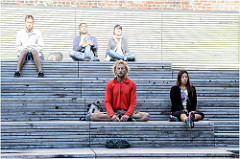
By PHILLIP LOPATE
When, in June 2009, the High Line Park opened to the public, it was declared an almost unqualified success. Some architecture critics nit-picked the design, but basically they endorsed it, and ordinary folk (I include myself in that category), less fastidious, greeted it with enthusiasm. Crowds lined up for hours to have the elevated promenade experience, it became a (free) hot-ticket item in New York City, which typically over-embraces a novelty for six months, then ignores it. Especially in hot weather, the challenge soon became to grab one of the reclining benches on the sundeck and tan yourself for hours, while envious masses stumbled by. The crowded, restless carnival-grounds movement of the park-goers above-ground rhymed the pedestrian conveyer-belt effect of the gridded streets below: Manhattan is a place where loitering in one place is done at your peril. Paris has boulevard cafes for cooling one’s heels, Rome comes to a rest at fountains and piazzas, but in Manhattan you keep moving forward. Well and good: I approve.

Don’t miss an issue! Subscribe to The Common.