By WYATT TOWNLEY
Review by AIDAN COOPER
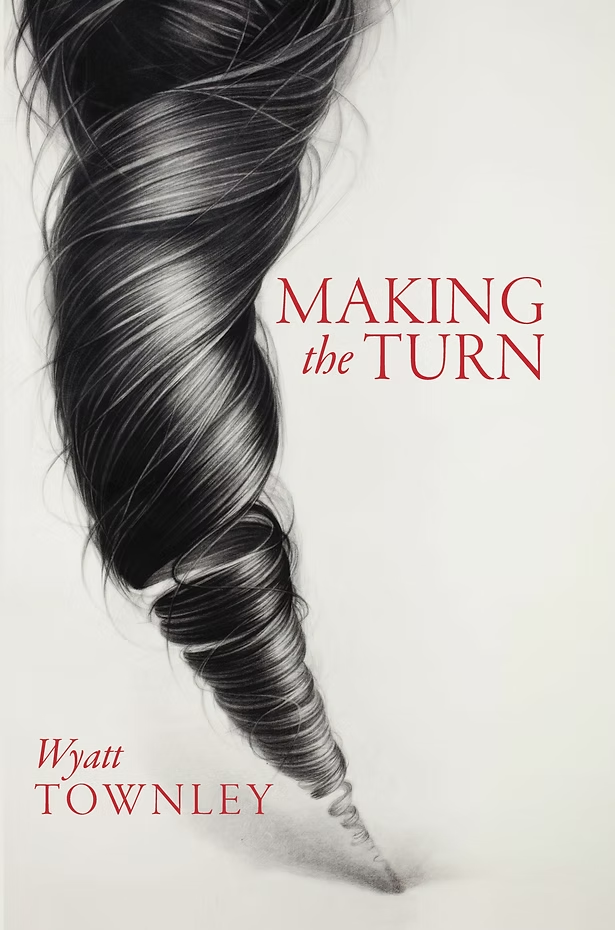
Since it first found me in The Common’s Issue 28, I’ve been hypnotized by Wyatt Townley’s “Wedding Vows.” “Falling is an art,” she says, “we have fallen all the way here.” The poem delights in the homology of movement among everything twirling in the world. And now, in Townley’s latest book of poems, Making the Turn, “Wedding Vows” takes on a whole new twirling world to enjoy. In her fifth poetry collection, falling is an art that constantly recurs, redirects, and finds in the force of moving some give in gravity itself. You can fall forever and in any direction; every instance of being is always in flux. Townley writes, “as word by word you are led / to where you are now standing.”
But Townley never just stands there; Making the Turn tap-dances on the ceiling. Writing into the curve of eight arcing sections, Townley bids the reader “ask the dancer to jump” because “the way up is down.” Each punnily-named subsection steers a kind of orbit within the book, as her registers circle from the light, to the dark, to the light again — from “tree to cradle / cradle to rocker / rocker to coffin” and finally, “coffin to tree.” Across these sections, she choreographs in her mostly free-verse lines a topsy-turvy poetics in which action is the only absolute. Words often shake down their font size or turn up sideways. Grammatical and formal conventions crumple for the sake of speed. For example, a man in a grocery store stops
to repeat and repeat one breath
many times one breath the same
breath many times repeat
the same breath sewn to the sob…
In Making the Turn, repetition, isocolons, and alliteration give sound logic to what is, at first glance, senseless. This is something sprung from Gertrude Stein; to Townley, a wall “is a river is a river is a river.” In a later poem entitled “Porch Art,” her line, “still the birds still the birds,” draws my focus to the word “still” as a thematic tether for the collection: still meaning motionless, still meaning ongoingness. Even at rest, something in the cells keeps swirling. Rest is a costume for restlessness. And in this unrest, the ability to grasp where you are in space can always go haywire, and your orientation toward others always requires realigning.
This is how Making the Turn pieces together its emotional core. In “Yoga Studio,” Townley writes, “our graves are flying carpets,” as the nonstop jostling of time forbids any kind of quietness or respite, which the speaker finds herself asking for. In another poem, “What Was Left,” the ending stanza lingers on the “wastebasket” where “dreams / collect their taxes / for the next bag of groceries.” What follows the fun freneticism of an active world is the anxiety that sense and solidity will stay elusive, glimpsed only here and there in brief, deficient flashes. Rules have become unrecognizable; too much movement has happened. In this way, the speaker sees herself drifting from her once-held assumptions and expectations. I found myself particularly caught by “The Library,” a villanelle whose rhyme scheme displaces the word “home” into “book[s]” “mid-air,” identifying how physical and mental shelters become more vital and less dependable when “countries have forgotten how to care / and cruelty’s contagious.” As I read, a distinct feeling arises in me that meaning’s gotten lost in the maze of time, that ground has given way, that nothing in the workings of history makes much sense at all.
However, in the final sections of the book, “nothing” discloses its own kind of sense. At the end of “Staring at Nothing,” Townley considers the astronomer Dr. Robert Williams, saying, “it’s nothing…look at nothing to see.” In this nothingness, “the middle of now is a circle,” a promise to begin and begin again, a belief in the possibility of becoming new. Amid the disorder of her life, this disillusioned speaker discovers a more instinctive, spontaneous way of being that bubbles up with spiritual sustenance. “It takes a vortex / to grow a galaxy,” she says. I’m reminded of Yeats’ “Second Coming” — “turning and turning in the widening gyre… the center cannot hold” — but in this collection, Townley seems to discover in the gusts of life that the turning itself is central. Life’s “mere anarchy” is simply its capacity to infinitely renew, and within every renewal there is a miniature apocalypse, a loss and a gain. When you keep time with the pivots of the present, “you are led / to where you are now standing,” motionful and motionless. You are still here. You — still — swing with the spin of it all.
Perhaps “Wedding Vows” epitomizes Making the Turn: a falling that becomes, or rather makes itself known as, falling together. It considers surrendering control and finding oneself an instance of a larger, universe-spanning tango. The whole book does this, flowing with direct, dizzying specificity; Townley writes, “dancing is losing your / balance / and finding it.” Throughout this entire book, Townley’s instability never feels obstreperous, and her falling never reads like flailing. Instead, each poetic spiral demonstrates not only her command of the language but also her willingness to let language lead her, allowing the poems to raise a racket through her voice with robust and sprightly results. On this “turnstile of a thousand faces / on the trail of a thousand years,” I was utterly captivated by the swirls this book unleashed as it landed in my hands, as it flew off, flying, or maybe falling, or I was flying, or both, all at once, together.
Aidan Cooper is a recent English graduate from Amherst College and the sixth annual Literary Editorial Fellow at The Common. They are a recipient of the Five College Prose and Poetry Prize.