Cajon del Maipo, Santiago, Chile
It is Easter weekend in a Catholic majority country. It’s Friday, and it feels like the whole world is counting down and holding its breath, waiting for a miracle they know will always come. Out here, though, Catholicism feels like a relic, a prop in an old mountain town with one main square. Something out of the Wild West, if such existed in Latin America. Old men sit around the square selling handmade tiles, reselling fake name-brand sports gear. A fine layer of dust covers everything.
We’re staying in a house off the two-way dirt road that weaves through the mountains until it can’t anymore. The fruit trees on the property are reluctantly giving up their last apples, their last walnuts, sucking from the ground all the water they can take.
When we come to the front gate, padlocked with a heavy chain, two mutts circle each other and then run up to the fence, kicking up clouds of dirt that spin like cyclones before settling.
I turn to Ella. Should we knock? There is no door to knock on, just bits of board in the process of composting, leaving behind a great empty frame.
It feels odd to be here, a place we decided to visit mere hours ago. We came because we had nowhere else to go. My planned trip to Brazil had fallen through, our beach trip with another friend was canceled when she fell ill. We came here because it was a metro and colectivo ride from the city. We came here because on Easter weekend Santiago shutters.
Our host comes rushing down from the house. Don’t mind the dogs, she says in Spanish. They’re friendly. Come in, come in. She ushers us through with a wave. I’m Romina.
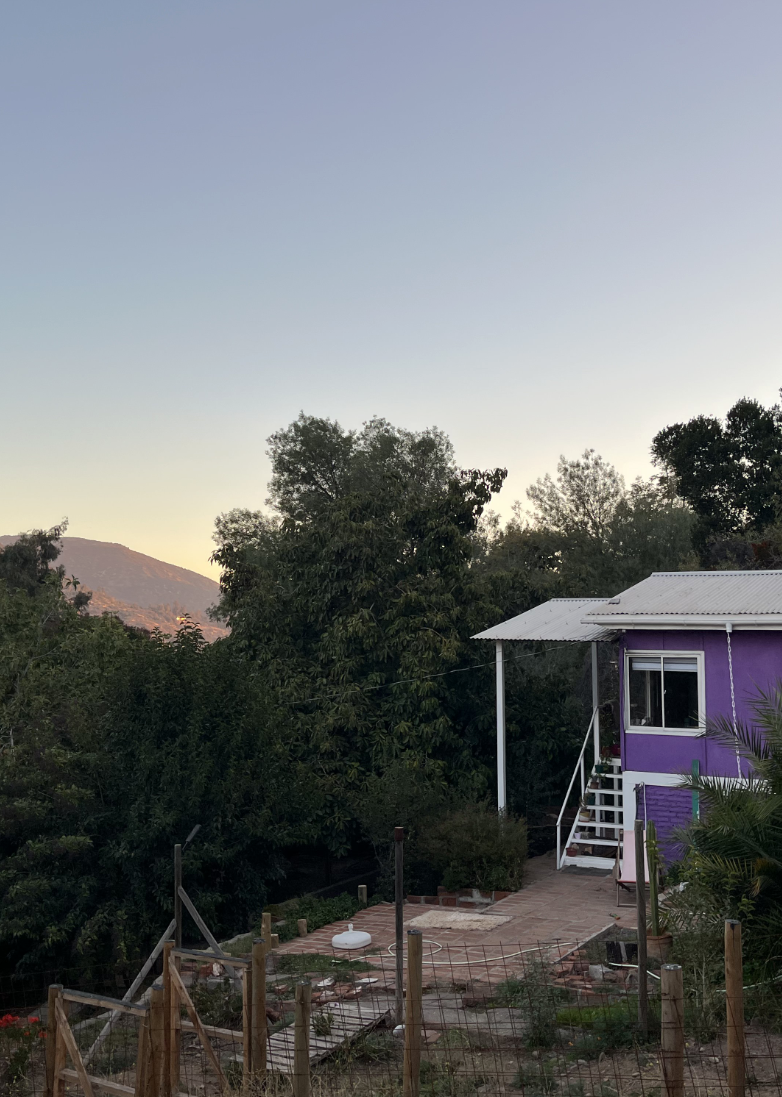
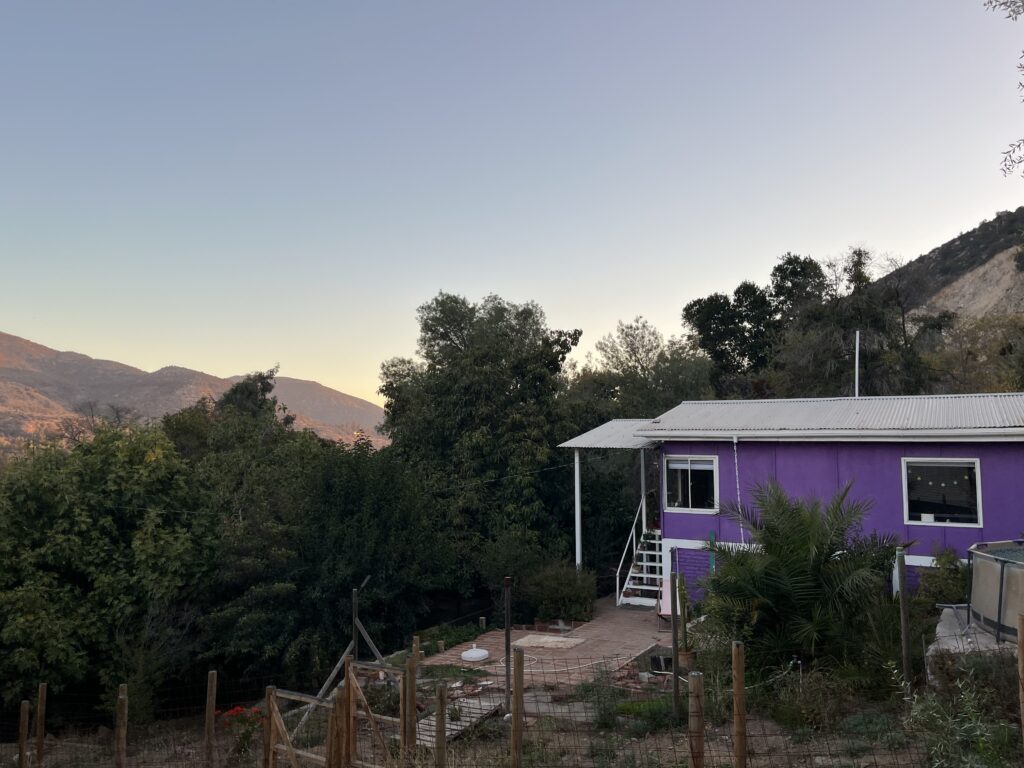
The house, wooden and sturdy, is up a packed-dirt slope. She shows us to our room, two twin beds with a window looking onto a purple house next door. My brother lives there, she says with a chuckle.
We set our bags down, and the floors resound with the thump. Romina watches us from the doorway. She tilts her head towards the kitchen and we follow.
Please, she says. Have some cake. I made it today, and the apples and nuts are from our orchard.
We bite into the cake. I taste the house in it, the workings of a stranger’s hands. I taste the dirt covering everything, the metallic water, the towering blue sky. The cake has sunk into itself in the middle, so each piece is slightly soggy, the apple tasting too earthy, the sugar sitting too heavy.
Thank you, Ella says, serving herself another piece.
The next morning we wake up to the crow of a rooster. Without a car there is nothing to do but wait for the colectivo to come by and take us up to town. There is no schedule posted. The van eventually arrives a half hour later, covered with stickers and without seatbelts. Fares are a dollar.
We’re dropped at the town center, slightly carsick and hungry. We ask around about getting to the regional park to hike. People look at us with blank stares, although that is all people come here to do: hike and then leave the Andes behind for the city.
You can’t get there without a rental car, an old woman tells us after we use her bathroom and drop a stack of coins into her beckoning palm. And there aren’t rental cars here. You’ll have to try a taxi. The next colectivo will take you a little further up, but at the last stop there will still be 10 kilometers left.
We ask five taxis for their prices and they deliver exorbitant amounts, as they would have to give up the entire day waiting for us to come down the mountain. We give up and take the colectivo to the last stop and try to hitchhike our way to the top. No one stops for two American study abroad students on the side of the road. The cars roar past. We cross to the other side of the street, hoping to get back into town, and the first car that passes my thumb slows and drives us back.
The entire ride back I cannot stop thinking about Romina, about the lonely little house waiting for us up on the hill. Perhaps it is the quietness of this weekend, perhaps it is the surprising emptiness I feel halfway through my semester abroad, but every car that speeds up the mountain in the other direction reminds me of all the places I cannot go, and the one place I am going: Romina’s.
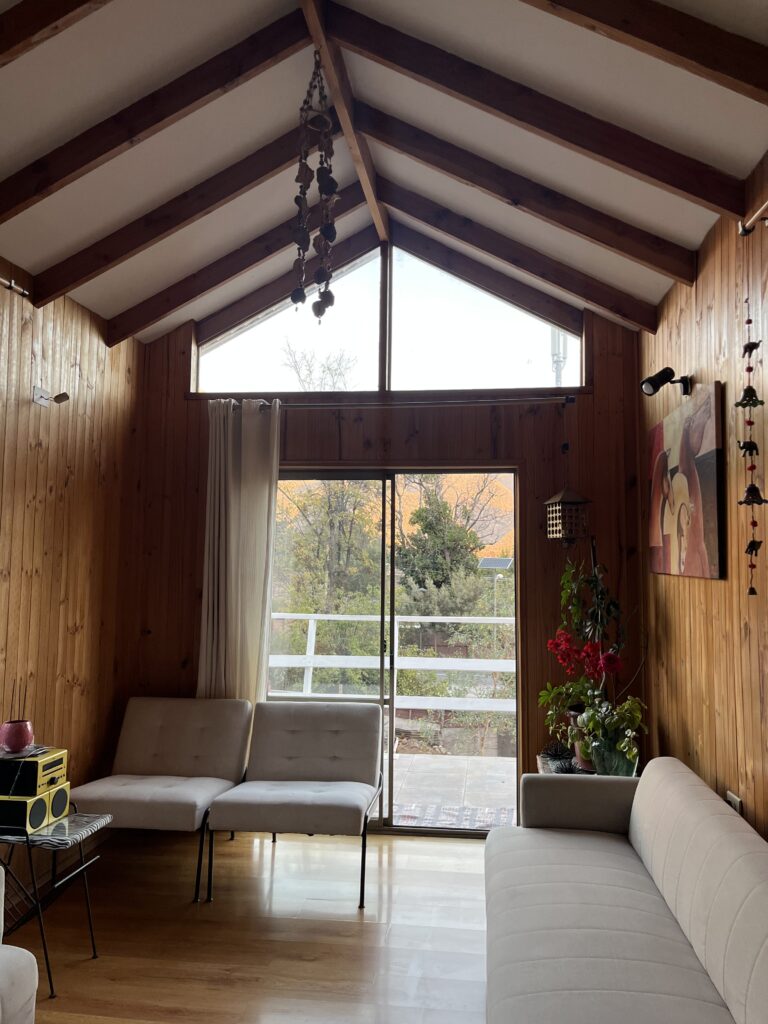
That night we are exhausted, our plans unfulfilled. Halfheartedly we cook spaghetti in Romina’s kitchen. When we are done we sit down on the living room floor. There is no dining room table. Romina comes out again. Feel free to eat whatever you want. Have more cake. We have too many apples. She lingers in the doorway, perpetually stuck in between rooms, a stranger in her own house. She is tall for a Chilean, and sturdy, like the house. She is in her early forties, and her body looks like it has grown accustomed to physical labor, to caring for her son and her orchard. She roams the house with a hunch, as if trying to make herself as small as possible, afraid to disturb the silence.
Come, sit with us, we say. She sits down on the floor next to us.
Would you like to play a game? It’s called dutch blitz, Ella says. It’s simple, she says. It’s fun, I say.
Romina smiles, and nods. My English isn’t good.
It’s okay, we say. Podemos hablar en español.
Ella explains the game and wins the first three rounds. Romina stands up. My son would love this game. Can I invite him to play?
We play again, the four of us in a circle on the floor. Romina tells us that her son is only a few years younger than we are. We converse in a language that has been adapted for the situation we are in, Romina explaining the game to her son, her son murmuring back to her, their soft voices like two birds at the edge of a pond.
Ella wins, again and again, even though I know she is holding back for us.
Romina smiles at the end of the last game. Shoot, she says, a cracked tooth showing through her smile. You got me again. I’m bad at this game. My son, though, he has a mind for these things. He likes to play video games like this.
Her son begins to play a game on her phone. His body curves into hers on the floor. We are silent for a moment, the ceiling light twitching above us.
My family has lived here for a long time, Romina says. All my family lives here, caring for the orchard. They fight all the time, you know how it is, I have my aunts and uncles on one side and my grandparents on the other side. My brother.
She pauses, twirling her son’s hair around a finger.
There is lots of machismo in Chilean culture. In the beginning, they didn’t want me to live alone. Raise my son alone. They looked down on me for not having a husband.
Before that, she says, I had gone to Santiago to study. And I studied at La Católica too, and I would party every weekend and then show up for class on Monday. But I was smart, a good student. I’d like to go back to school at some point. It was fun, in the city.
Why’d you come back? I ask her.
She smiles, her crows feet curving downwards, inwards, and points to her son. I got pregnant with him, she says. I came back here to have him before I could finish school.
She doesn’t say anything else, but pets his hair while he stares at the video game. He makes soft rumbling noises, occasionally looking up to confirm that it is she who continues touching his hair, as if he had dreamed the affection.
Her son has Asperger’s, she tells us, along with other physical health conditions that make it so that he can never live alone. They sleep in the same room. She tells us she doesn’t mind it and we sit there, silent again.
I became curious, later that night, and I peeked my head around to see that there was only one bed, not two. They slept together every night, while sharing a bathroom, a kitchen, a life with people who came and went, while they stayed here with the rotting apples.
Would you ever want to move to the city? We ask her. With your son?
My family is here, she replies. I could never leave them.
She tells us that she spends her days homeschooling her son. We don’t get that many tourists out here. But they are always kind. When I can, I have them in my home.
She explains that apart from tourism, the trees are what sustain many people out here. The trees, the travelers, and the crumbling quarries, all of these things slipping and digging into the falling dirt.
Romina gets up to go to sleep. Through the wooden walls, we hear her brushing her teeth with her son in the bathroom. Later, it will be hard for me to imagine a life for Romina and her son without the guests. It wasn’t just that their livelihood depended on Airbnbers willing to stay in a spare room; rather, I couldn’t imagine them existing once we walked down the dusty road back to the city. I imagined shutting a door behind me and Romina and her son crumbling away into dirt.
I remembered talking to my mom one night, weeks ago, about how being here in Chile somehow felt like I was everywhere and nowhere at all. About how I was just another person to make a home in a new country, only to leave it all behind; I felt I had crafted my own magical world, a secret that would disappear if I did not share it.
You will still remember it in thirty years, like I do, she had told me over the phone. And it will still be home.
That night, I watch as a light flickers in Romina’s brother’s house next door. I think about how, for so long, I had been captivated by the image of a country stretched thin from top to bottom, with only a handful of people able to inhabit each region. I think about those who live in Santiago’s shadow, on winding roads not far removed from the city, and how they are left out of Chile’s imagination, the country simply not wide enough to accommodate them. Here, San Jose de Maipo lingers at the furthest corner of the city map, tucked away far enough that it can be forgotten, its inhabitants busy in gaping mines, or occupied with the tourists who come and go, come and go.
We leave on Sunday, Easter, early enough to catch a ride with someone heading back to the city. I ask Romina about the last time it rained and she only smiles, looking at the trees.
Every year we get less rain. But still they continue fruiting.
The door is closed to their room as we walk out. Inside I hear her son softly singing.
You’re welcome back anytime, she tells us as we stand on the porch, pushing small woven bags into our hands. Happy Easter.
She follows us out the door and watches while we walk down, bags in hand, toward the gate, the dogs weaving between my legs all the while.
I look back once when I get to the gate, and smile and wave. She looks back at me with an unreadable expression and does not return the wave, only smiles. The smallest dog, its hair matted into a large nest behind its ear, chases me to the end of the drive and barks at our heels until we have long disappeared down the road.
On the bus I finally open the bag. Inside are a few foil wrapped chocolates, and, nestled among them, the last few walnuts and almonds of the season, the shells rustling up against each other, sharing some eternal and untranslatable secret.
Cigan Valentine is a senior at Amherst College and an editorial intern for The Common. Her work has been published and/or translated in The Common, The Cairn, and mOthertongue, and is forthcoming from Sieva Magazine. In her free time, she writes essays, short fiction, and poetry, and occasionally posts on her blog this is going nowhere.