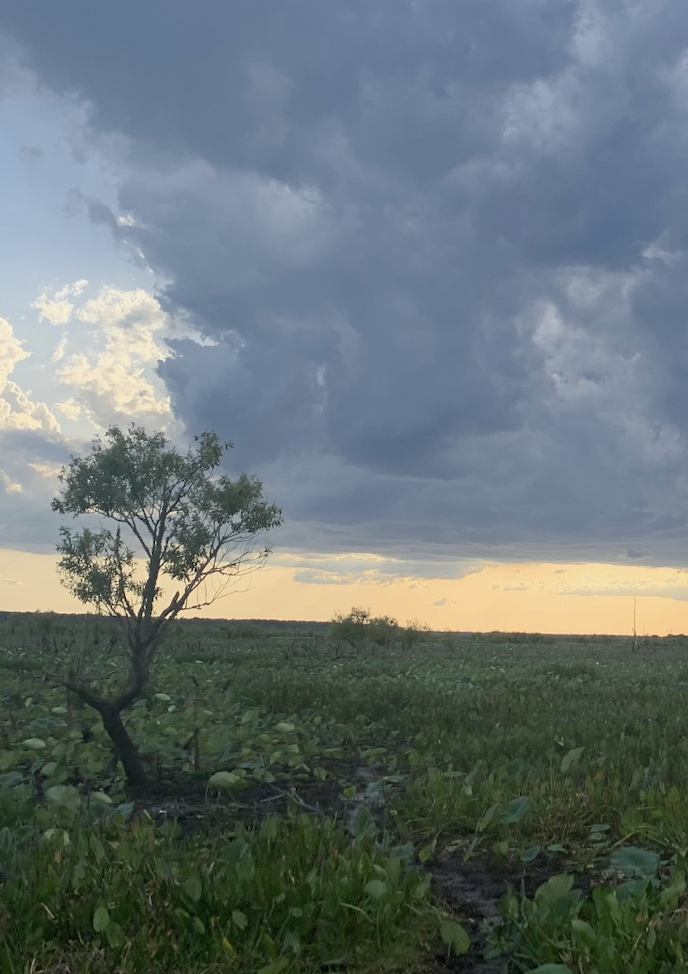
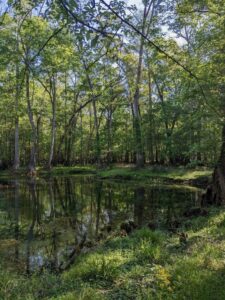
Photos courtesy of author.
Florida
After the Storm
(after Donald Justice)
I will die in Portland on an overcast day,
The Willamette River mirroring clouds’
Bleak forecast and strangers not forgetting—
Not this time—designer raincoats in their closets.
They will leave for work barely in time
To catch their railcars. It will happen
On a day like today. Florida’s winter
Brings the satisfaction of sunlit goosebumps
As I read on the veranda wondering whether
To retrieve a sweater. I’m learning
Of life’s many versions of triviality,
Which merely manage to repeat themselves.
One day, the sun will hide behind clouds,
And I will be dead. The shielded armadillo
Rustling in my backyard, too, will vanish,
Although strangers will still protect
Their own precious heads
From approaching storms
With old magazines,
Backpacks, cheap
Plastic bags.
After the Wreck
The recluse at the town’s outskirts
Begins his day by ripping a leaf
From his Ficus, burying it under
His hat, and prostrating himself
To nature. Behind squat, red-brick
Antique shops, the ironweed
And frostweed blossom.
Like much of Florida, Micanopy hides
A vast aquifer under its canopies.
At nearby lakes and ponds, the snail kites,
Once on the brink of extinction,
Are gradually making their comeback,
Their greedy talons clenched
Around shells. Briefly named Fort Defiance
During the Second Seminole War,
The buildings were ultimately torched
By Jackson’s wounded, retreating
Villains. Among weeds sprouting
In that wild rubble, settlers rebuilt:
An erasure of an erasure.
Swimming with the Manatees
For the first time, I felt like a tourist.
A woman on the boat was unable to swim.
Folks riding golf carts around the marina escaped
Luxurious multistory homes for dockside bars.
I was disgusting,
Unshowered and sleep-deprived.
The guide told homophobic jokes.
Colleagues I desperately wished
Could be my friends griped
About troublemaking students.
Which of our parents were ill, served
An eviction notice? Would we return,
Post-graduation, to meagre minimum wage,
The distressing paycheck-to-paycheck
And just-one-more-loan of my former
Night shift self? Emails read, Online courses,
of course, don’t teach themselves.
A naturally solitary animal, avoidant
Of conflict and without defenses,
I kept to the shallows of conversation
(Now we’re truly Floridian!),
Eyes focused on palm trees distorted
In water’s glinting ripples,
Daydreaming about local politics,
The private annoyances and sufferings
Otherwise inaccessible
To distracted newcomers like me.
The guide mentioned these sea cows
Are frequently hit by speedboats,
Claimed to know individuals
By their scars, to have watched them nurse
Their wounds, eat aquatic grasses,
Raise their young. Snorkled and goggled
In that water made murky with sediment
Disturbed by our wrinkled feet, I couldn’t
Believe him. I didn’t see a damn thing.
Edward Sambrano III is a Latinx poet, critic, and educator from San Antonio, Texas. They received their MFA from the University of Florida, and have received scholarships from the Bread Loaf Writers’ Conference and the New York State Summer Writers Institute. Their writing has appeared or is forthcoming in The Georgia Review, The Cincinnati Review, Pleiades, and elsewhere.