
“The Hare” and “Inês” Win O. Henry Prize 2026

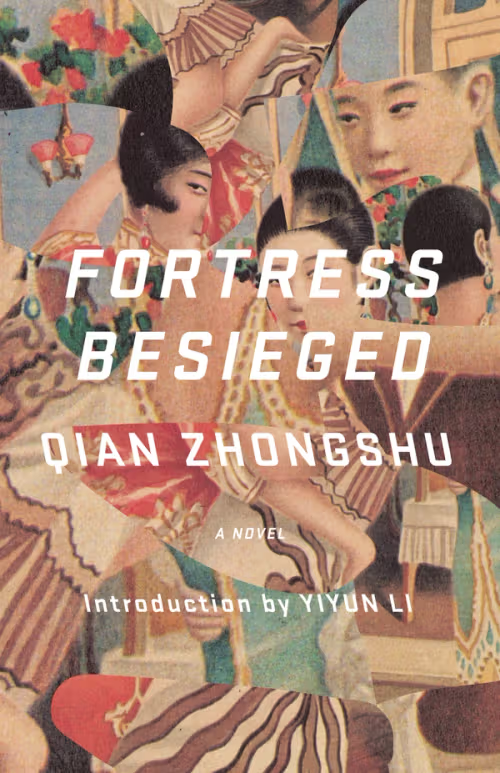
Book Cover of "The Best Short Stories 2026" edited by Tommy Orange

We are thrilled to announce that “The Hare,” written by Ismael Ramos and translated from the Galician by Jacob Rogers, and “Inês” by Joāo Pedro Vala have been selected for the O. Henry Prize for Short Fiction for 2026. Both stories were originally published in The Common Online in 2025. An anthology of the winning stories, edited by Tommy Orange, will be released this September from Vintage. 

In the prize announcement, series editor Jenny Minton Quigley writes, “Many of this year’s O. Henry Prize winners manifest a youthful, new way of seeing in their stories. If our world is to be saved it will be by the genius of the next generations.

View the full list of winners and read more about the prize at LitHub.

Congratulations to Ismael Ramos, Jacob Rogers, Joāo Pedro Vala, and all the winners! 
 

From the beginning, The Common has brought you transportive writing and exciting new voices. We are committed to supporting writers and maintaining free, unrestricted access to our website, but we can’t do it without you. Become an integral part of our global community of readers and writers by donating today. No amount is too small. Thank you!

“The Hare” and “Inês” Win O. Henry Prize 2026

Related Posts

Two Poems: Dispatches from Konstanz and Maastricht

ANA PRUNDARU
in a museum's throat now, here it is / here is a lesson in grieving the past / disappeared by just a flip phone / say it was converted to a tiny pub // here is a lesson in grieving the past / a tiny fit of existentialism / say it was converted to a tiny pub / it was the nineties, remember?

Other Pastorals: Sarah Audsley interviews Eve Alexandra

EVE ALEXANDRA
There’s a line from “Collision” — “we are all invasive and beautiful.” The veil between my grief and the natural world was very thin. And yes, I think there’s a reclamation of the queer pastoral through this feeling of belonging. I know this place so well. My body lives here and is part of this land. I can name those trees, rivers, and flowers.

Black and white Portrait of Bishnupriya

Excerpts from Khanandihi

SHATADAL MITRA
This is how it has always been and will continue to be as long as our prodigal lizard agrees—“thik-thik-thik.” So here in Khanyadi, people still cried in obeisance—“Oh hail, Mother Khana!” Khanyadi believed in her heart that it was a righteous namesake