By JULIANA LEITE
Translated by ZOË PERRY
Reviewed by JAY BOSS RUBIN
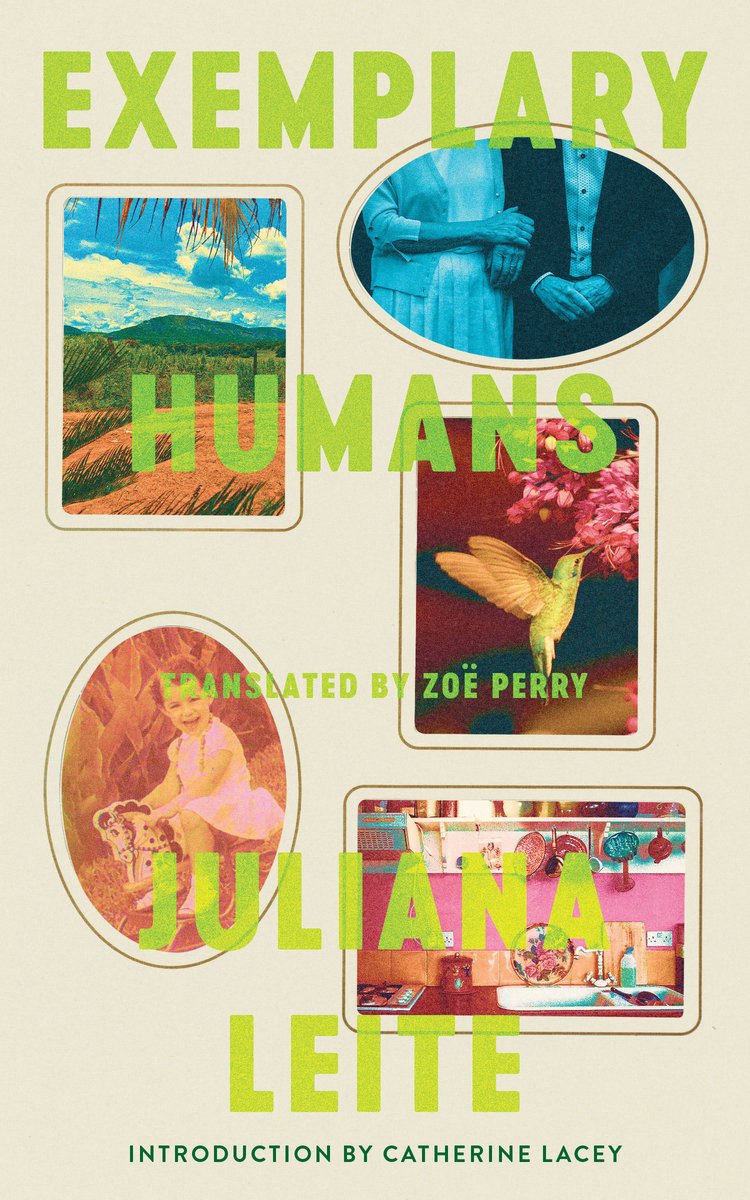
In the opening chapter of this subtle epic, the centenarian narrator Natalia confides: “At this point in life, I’d say that going on forever or for too long is a bad decision, a very bad one; what’s nice is to exist and then stop existing, to exist for a while and then be able to change the subject.” In other words, if the transition between life and death is an abrupt one, then so be it. “[L]et’s be done with it,” she says, “though it would be nice to have the time to spritz on some perfume beforehand.”
When I first encountered this sentiment in Juliana Leite’s Exemplary Humans, translated from the Portuguese by Zoë Perry, I took it be a bit of a bluff. It reminded me of a bumper sticker I saw a couple of years ago in Portland, Oregon, that read: “I ♥ AGING & DYING” (which I interpreted as an existentialist rejoinder to proclamations of commercial allegiance—“I ♥ Mr Plywood” and so on—so common in my hometown). But by the end of Leite’s novel, which takes place primarily in Rio de Janeiro and Petrópolis, Brazil, and spans that country’s lengthy dictatorship, I was convinced that Natalia’s breezy acceptance of her own mortality was absolutely serious. It is not only possible, but strongly advised to love aging and dying. It isn’t easy, though. To transcend dread, and transform it into something more palatable, a unique kind of emotional intelligence is required, and so is a talent for adjusting one’s perspectives. Natalia is the novel’s exemplar of both these qualities.
Isolated in her Rio apartment as a COVID-like but unnamed threat lurks outside her door, Natalia’s daily life revolves around her memories—of her late husband Vicente, their mutual friends, and other subjects—and also a daily phone call from her daughter, who lives abroad on an “upper ocean.” Natalia imagines that one day, when her daughter is as old as she is, she too will discover that, “the past is the only future, the only place where some get-togethers still happen.” Natalia’s relationship with the past, which is imaginative and exploratory rather than sentimental and nostalgic, is key to what makes her humanity so exemplary.
But Natalia isn’t sustained by metaphysics alone. Her existence is also physical and, at times, deeply sensory. When we first witness her breakfast routine, in the novel’s opening pages, it’s quite charming: she spreads globules of milkfat, along with softened butter, onto her not-so-fresh bread, then dunks the bread in her hot, milky coffee. “The fat is rich and the old woman’s entire body tingles.” (Sometimes Natalia is “I,” sometimes she is “Natalia,” and most often she is “the old woman.”) Much later in the novel, Natalia’s daughter hires a live-in emergency caretaker, who swaps out Natalia’s humble but ecstasy-inducing breakfast for “thick oatmeal, a porridge to be eaten in pieces. Apparently, it was a special delicacy for old people, and made their legs very strong.” In one of the novel’s most unforgettable scenes, Natalia insists on her right to not only enjoy good food, but to experience the full spectrum of bodily pleasure still available to her. She banishes the emergency caretaker by reclaiming her personhood autoerotically, beneath the relative privacy of her “little woolen blanket.”
“The daughter and the caretaker expected everything from that old woman,” Leite reveals, “even taking a spill in the hallway or spitting out her pills, but never for her to orgasm—ah, they’d never see that coming.” If an aging person’s only focus, and the only focus of their caregivers, is to prevent or at least forestall the inevitable, then their existence isn’t much of an existence at all. The morning after Natalia expels the emergency caretaker and liberates herself from mandatory gruel, she returns to her buttered bread, and it feels as though the story has just swirled, like a globule of milkfat, back to the novel’s opening scene. But the description of Natalia’s breakfast, in this later chapter, is more than just artfully rendered—it’s a victory statement, proof that Natalia is intent on living.
The political backdrop of Brazil’s military dictatorship will be familiar to viewers of the recent films The Secret Agent and I’m Still Here. As civil servants who are opposed to the regime, Natalia, Vicente, and their coworkers and friends have to cope with the possibility of being kidnapped or killed, and must be prepared to go into hiding at a moment’s notice. To survive, and to protect his family, Vicente reasons, he has to disappear. “And to really disappear, he had to disappear from everybody he knew, including himself.” This theme of disappearance—from civic and political life, from family life, and eventually, from life itself—permeates Exemplary Humans. And yet it is a remarkably life-affirming book.
Much of this depends on the novel’s exquisite calibration of voice—conversational yet philosophically sophisticated, tottering in its advanced age but also wise and clever because of it. Veteran translator Zoë Perry succeeds in bringing all the subtleties of Leite’s voice and that of her protagonist over from the Portuguese, and she creates a new, irresistible English-language voice in the process. Perry also handles the cultural, political, and gastronomical contextualization for the reader in English with aplomb and expertise. One doesn’t need to have tasted a brigadeiro before; one understands their deliciousness via the detail that Natalia’s best friend Sarah’s brigadeiros were rumored to be baptized.
Exemplary Humans is Leite and Perry’s first book-length collaboration, as well as Leite’s book-length debut in English. It comes somewhat on the heels of, and in a similar vein as Leite’s O. Henry Award-winning short story “My Good Friend,” which was also translated by Perry. The entire endeavor of introducing a novelist to new readers in English depends on both a fruitful author-translator dynamic and the aligned, sustained efforts of publishing houses, and often agents, in multiple countries. The limited-edition bumper sticker doled out on occasion by Two Lines Press’s parent organization, The Center for the Art of Translation—“I ♥ TRANSLATORS,” it reads—only tells part of the story. And yet, it’s a statement I agree with wholeheartedly.