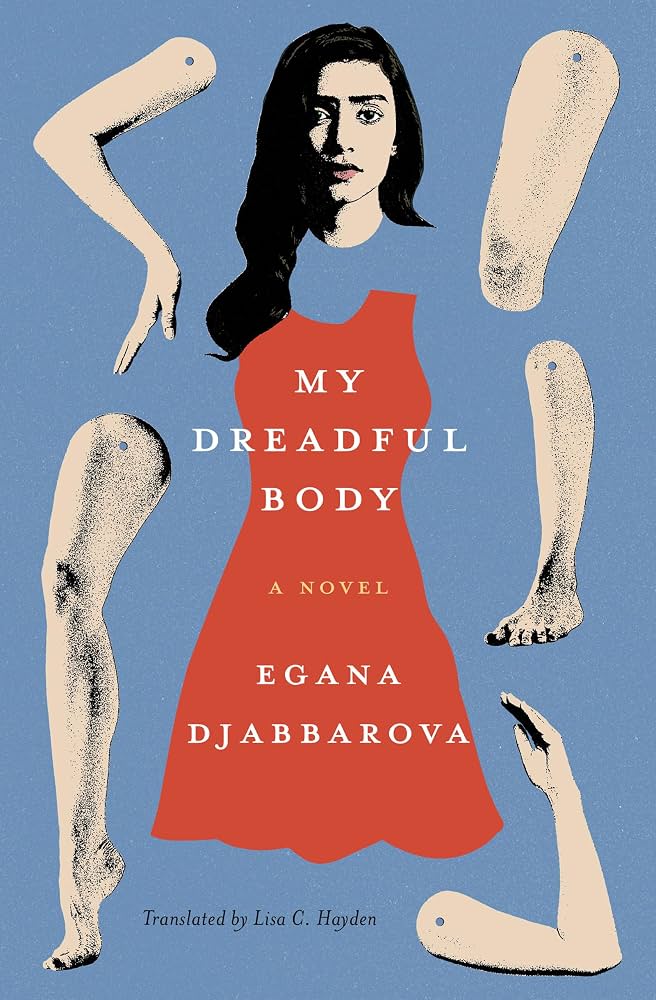
By EGANA DJABBAROVA
Review by BRITTA STROMEYER
Every now and then, a book is spawned that renders you speechless, demanding recognition for its searing vulnerability and astute cultural criticism. Egana Djabbarova’s My Dreadful Body, translated by Lisa C. Hayden, stands as one of those. The novel traces the lacerations of its largely unnamed narrator’s pain and grief bleeding into the suffering of an entire people by mapping a lineage of women—mothers, grandmothers, and aunts—whose identities are confined to roles as wives and caretakers, illustrating how societal expectations shape their lives and the lives of generations that follow.
Set in post-Soviet Yekaterinburg, Russia, the story follows the narrator’s upbringing within an Azerbaijani family, charting the cultural and societal challenges of life in the diaspora: “I don’t remember who it was and I don’t remember how long we ran; the only thing I remember is how much my shoulders ached from the heavy backpack, how the backpack hit my lower back, how I lost my breath, and how terrified I was. That was the first time I felt true primal danger and the proximity of death with my own skin. That was when I realized that being a stranger means being hated, being a vessel for rage.” The narrator’s toil with dystonia, a neurological movement disorder, serves as a visceral metaphor for this history; the illness not only robs her of speech and physical autonomy but mirrors the cultural constraints that have long stifled the women in her family. At its core, My Dreadful Body offers a piercing feminist critique of the systemic silencing and erasure of women’s agency, particularly within the context of the Azerbaijani diaspora.
Divided into eleven chapters named after body parts, the novel’s structure claims the female body as a battleground for cultural and personal struggles, using physicality to splinter rigid societal metrics of beauty and worth. Djabbarova’s evocative descriptions of her body start with the narrator’s reflections on her eyebrows in the opening chapter, which introduces an evolving relationship with her physical and emotional self. Watching women sculpt and thread their brows—a ritual denied to her, serving as a primary Azerbaijani marker of maidenhood and innocence—she wonders, “where their hands had mastered all those secret motions and how they’d learned to manipulate the thread so quickly and energetically that it flawlessly removed the unwanted while leaving the essential.” Later, she likens the reshaped eyebrows to a decorative vase, symbolizing how women’s bodies are treated as objects to be adorned and displayed. As the narrator comes to terms with the irregularities of her features, her self-acceptance is soon overshadowed by the haunting atmosphere of a hospital waiting room, where she seeks medical intervention for the unsettling distortions in her facial muscles. Surrounded by individuals whose appearances are ravaged by illness, she flees toward the tranquil blankness of a winter sky, seeking solace from overwhelming trauma. The metaphor of eyebrows as life experiences underscores her growing understanding of individuality, suggesting that identity is shaped by personal history and cannot be defined by societal standards.
Reflecting on imposed beauty standards and their roots in colonialism and cultural history, the narrator also rues her brown eyes, perceiving them as ordinary and unattractive compared to the blue and green eyes of her classmates and the idealized beauty of Turkish actresses. This internalized desire for blue eyes highlights the damaging effects of imperialistic beauty ideals, where lighter skin is synonymous with beauty and superiority. The narrator suggests that the Earth has been “poisoned to its very core” by the lingering standards of former colonizers—a systemic rot that equates beauty with “blueness” and brands “brown” as hideous. This internalized colorism drives even young girls to covet the features of the “trophies” of the Ottoman Empire, illustrating how historical violence and conquest continue to dictate modern self-worth. The text critiques the historical exploitation of women, questioning the ties between beauty and violence, prompting readers to question the cultural forces that shape perceptions of worth and attractiveness: “The ordeal of the violence that had occurred would thus turn us into something unusual, setting us apart from the crowd and placing us in the company of other beautiful girls. But why had beauty ended up being inseparable from violence? And why did one woman need to enslave another in order to become ‘the norm’?”
In the chapter titled “Back,” the narrator ruminates on her family’s history and the emotional wounds (at the hands of their fathers and husbands) passed down through the women in her lineage. She recalls her grandfather (one of the few positive male influences in her life) kissing a beauty mark between her shoulder blades, calling it “the prophet’s seal” and associating it with love and sacredness. The narrator probes the collective pain carried by the women in her family, whose backs bear the weight of their suffering and silence. Their ancestral burdens sculpt the very posture of their bodies, etching themselves into their marrow and muscles, and sealing their lips in a forced quietude that transfuses through generations, “On my mother’s back, on my maternal grandmother’s back, and on my paternal grandmother’s back—on any woman’s back—one can see the bond connecting a mother to a daughter, and a daughter to a sister. If one chose her words, another answered for them, which may be why at some point they all stopped speaking, stopped opening their mouths, and stopped writing and uttering words.”
Due to the narrator’s debilitating neurological condition, she temporarily loses her ability to speak but refuses to be silenced. When the disease robs her of her speech, she violates “the first commandment of the women” in her family by trading her voice for the written word, documenting what was meant to be buried:
“At some point, even my mute back stopped keeping quiet and shouted to me about our family history, turning it into crumpled papyrus. My muscles cramped so much it was as if someone was wringing out laundry: first the trapezius muscles, later the rhomboid major and rhomboid minor muscles, and then the muscle that went up to my shoulder blade. That pain was incomparable. Maybe it was the pain of all the women in my family: my father’s paternal grandmother, whose husband thrashed her out of jealousy; my paternal grandmother, whose husband thrashed her out of jealousy; my mother, whose husband thrashed her out of jealousy. How much pain was hidden in the bruises underneath their scarves? Sometimes the pain wouldn’t let me stand up, so I’d lie in bed, entreating some unknown force to stop it.”
The narrator grapples with her language and identity, exposing the painful betrayal of belonging for those who exist on the fringes of two cultural worlds. She questions, “How had it happened that the only language I could express myself in found no affectionate ways to address me, instead flinging insults at me like lifeless kernels of corn, reminding me that I’m black, blackie, black-ass, alien, monster, foreigner, foreign-born, and extraneous?” Although she has mastered Russian to the point of it becoming her inner voice, the language itself rejects her, often serving as a vessel for racial vitriol rather than affection. This creates a “poisonous” internal environment where her Eastern heritage and physical self become sites of abysmal isolation. The struggle to articulate her existence in a world that spurns her body as foreign underscores the larger theme of existential alienation faced by those on the margins.: “We were outsiders. Where, then, was our home if we didn’t belong here, either? Were we not seen as part of the world? It turned out that we didn’t fit into either of the worlds, like defective puzzle pieces. What happens to puzzle pieces that don’t fit, no matter which way you turn them? Is there a place for pieces like that? And where, in that case, is the “motherland”?
Djabbarova’s narrative voice does more than speak; it shatters a multi-generational quiet, defying the ancestral decree that “the mouth was not intended for speaking”—tracing a journey that resonates with a world that seeks to erase her. By exposing how societal expectations stifle the spirit, the novel forces a confrontation with historically imposed standards of beauty and worth, demanding a reclamation of the self from the barbed wires of race and identity.
Djabbarova’s reflective first-person narrator creates a sense of narrative urgency; as her illness progresses, her character is driven by a need to reconcile her past and present. Spanning decades, the deliberate time shifts between the “narrating self” and the “experienced self” allow the narrator to treat her younger identity as an object lesson to grasp the meaning of events that remained opaque when they first occurred. Ultimately, this storytelling process becomes a journey of self-correction, where the distance of time provides the clarity needed to reconcile her history.
Noteworthy is the multilayered sense of place in the novel, which transcends mere backdrop. The settings of Russia, Azerbaijan, and Georgia become integral components of the narrator’s memory and identity. The author captures the stark atmospheric shifts between these territories, contrasting the cold, gray hospital corridors of Russia, which symbolize sterile assimilation and diasporic isolation, with the vibrant, sun-drenched courtyards of Baku and the lush fields of Georgia that vibrate with the warmth of heritage and tradition.
My Dreadful Body is a short novel, steeped in rich cultural commentary and infused with emotional depth. Djabbarova braids personal ache into a collective anthem, forcing readers to confront the weight of unhealed personal and shared wounds. Her prose demands a new definition of beauty, worth, and what it means to belong. By exhuming voices long buried in silence, she drags the messy, vital contradictions of the human experience into the light. Through her lens, generational trauma is no mere memory; it is a living shadow that stalks the present, complicating the narrator’s defiant struggle to claim her own power and encouraging a broader dialogue on the complexities inherent in the weight of living. It emphasizes the resilience required to reclaim one’s voice in a world that frequently silences marginalized narratives. The narrator’s journey toward self-acceptance is fraught with challenges, yet it ultimately becomes a testament to the strength and courage of women who have historically been relegated to the background. The novel’s portrayal of the female experience is both haunting and empowering, but, above all, it is a plea for humanity to see the person beneath the displaced skin.
Britta Stromeyer is a member of the National Book Critics Circle. Her writing appears in The Common, World Literature Today, Tupelo Quarterly, Beyond Words Magazine, Necessary Fiction, On the Seawall, Flash Fiction Magazine, Bending Genres Journal, Marin Independent Journal, and other publications. Britta has authored award-winning children’s books and holds an MFA from Dominican University, CA, an M.A. from American University, and a Certificate in Novel Writing from Stanford University.