We had a quarrel, melee, detonation of hurt—
fisticuffs of invisible disfiguration in the countryside of Spain.
I slept that evening on a reclining lawn chair under the stadium of the sky.
You stayed in the bed, roof overhead. The next morning you left
in an economy red rental car for the village where you joined
a Catholic procession, walked amongst men carrying a wooden saint
above their heads down narrow cobblestoned streets and alleyways.
Each of us seeking pain relief, I fled on foot from our casita—
part of a working hacienda and loped aside a paved mountain road,
occasional cars whizzing rapidly and too-near to my jogging body.
My pavement pounding feet kept time with my injured heart.
I thought of leaving you—separating our passports and itinerary.
Detachment as a prelude towards intimacy with God.
What is a saint but a selling point? An emblem of purity and of deprivation;
holy starvation suppressing sexual desires.
Before the sparing, the spat, the spit,
we thought it symbiotic & symbolic that each time we made love
the stallion corralled adjacent to our casita went mad. Body
and senses agitated, caterwauling sounds from his cavernous lungs—
a high-pitched outcry—
while incessantly circling its iron enclosure at posthaste gallop—
as though sexual desire was unbearable—
What saint the men carried and what holy day it was—
I have no memory of. How my life might be different today if
I separated myself from you in that small Spanish village,
I cannot say. Perhaps I’d have changed my name to Josefina,
given birth to a third child or a dappled foal,
become a holy anorexic seeking passage—
Pain is language-destroying—it’s why-how I can’t talk sometimes.
No words but the colors in the sky—
narcotic from the Greek narkōtikos—
making stiff, numb, unconscious—a stupor.
Also, the electric ray. I’m going with the electric ray.
If I’d left you that day, I might now be a new color in the prism of light.
It’s never been my destiny to be a warder.
When I was nineteen, I freed a neighbor’s jailed goat
from its ramshackle confinement on a subzero winter night.
One of my most noble escapades. So cruel to encapsulate—
especially to keep a singular species without a mate—
without another of its kind—
I might have become a long-distance runner, a breeder of sled dogs.
I might have become acquainted with the hypodermic needle.
The voltaic jolt of the electric fish was used by the ancient Greeks
as anesthetic to numb the pain of childbirth and other surgeries—any
cutting into flesh. The word for an electric ray was narke—
so close to narcotic—or the betrayal of a narc.
I might have entwined my body with another—
Or with a field of Orange Hawkweed—
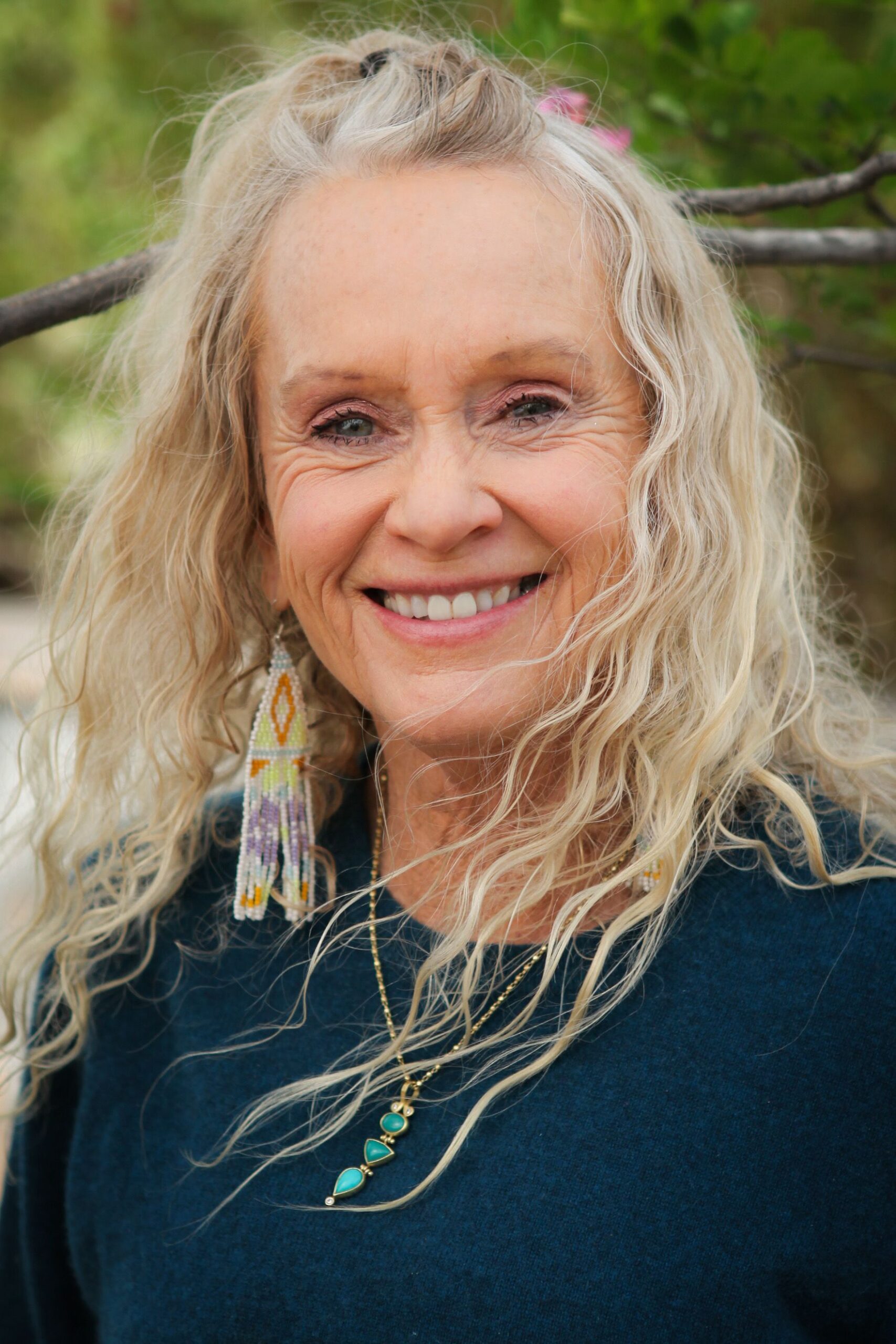
Joanne Dominique Dwyer is a writer, ceramicist, mountain hiker, and rider of horses in Northern New Mexico. She is the author of Rasa and Belle Laide, and her poems have appeared widely, including in Best American Poetry in 2019 and 2024. She is a past recipient of a Rona Jaffe Award for Emerging Women Writers.