
A. J. BERMUDEZ speaks to EMILY EVERETT about her story “The Sixteenth Brother,” which appears in The Common’s fall issue. With a fable-like feel, the story explores the dynamics of family and gender roles in Morocco, as fifteen brothers scheme to convince their youngest sibling to allow the sale of the family’s ancient and opulent riyad. A. J. discusses the story’s framing device—a storyteller relaying it, almost like gossip—and how it creates both intimacy and distance. She also talks about her work in film, and the interplay between writing for the page and for the screen.
Issue 30
Podcast: Casey Walker on “Islands”
CASEY WALKER speaks to EMILY EVERETT about his story “Islands,” which appears in The Common’s fall issue. Set at an old lake house rife with unresolved family tensions, the story explores the dynamics between three orphaned brothers, and between the narrator and his pregnant wife. Casey discusses how the piece evolved over more than a decade, and how he always hopes a story will take on a life of its own during the writing process. Also discussed is his forthcoming novel Mexicali, set in the US-Mexico borderlands during the first half of the 20th century.

Lawrence Joseph: New Poems
Ontologies
The love the love that massively seizes me,
the typewriter’s
ribbon needs replacing,
the great imperial
power game the price of oil,
a call, a response, I know you know
how precious to care is, the voice on the record on
the turntable is singing.
Late Orison
Let ours be the most boring of love stories, the happy-ending kind,
the obnoxiously-spooning-in-public kind,
the kind with a long denouement, tedious for everyone not actually
living it. This time around, let the only fireworks
Islands
By CASEY WALKER
Twelve years ago, in waters off the Azores, my father was thrown overboard on a whale-watching skiff and my mother thought she could save him. The trip had been my mother’s dream. She hadn’t seen the islands since she was a child, visiting her grandparents. My father’s overconfidence about boating in bad weather, an unanticipated storm surge, a possibly intoxicated boat pilot—that was the tragedy of my mother’s ancestral homecoming. No bodies were ever recovered. In lieu of caskets, the funeral director set up an oversized portrait taken on my parents’ wedding day. That young couple, with expressions formally posed, was all but unrecognizable to me.
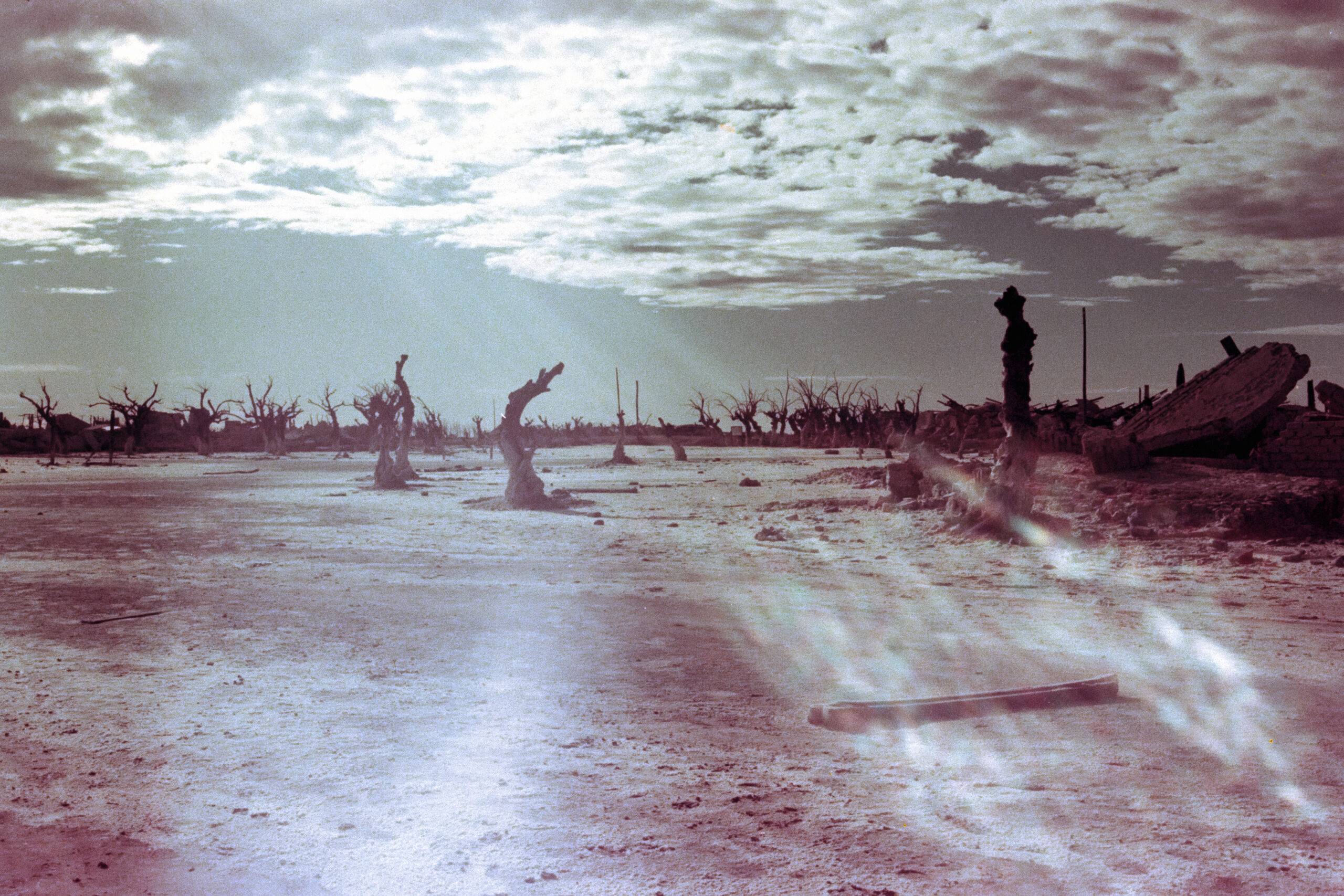
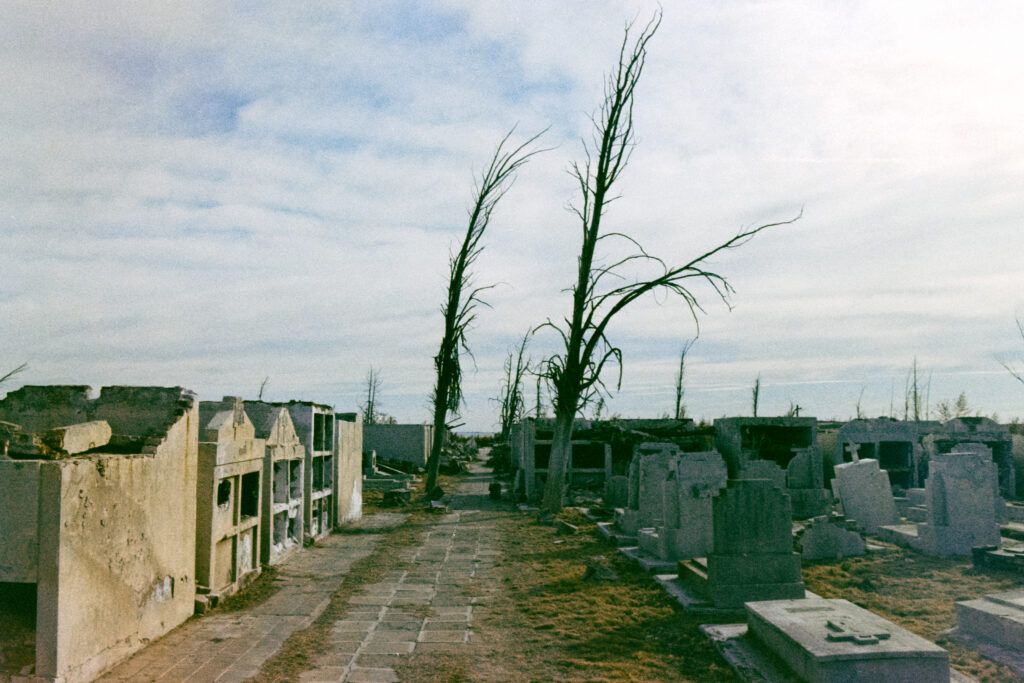
Future Remains: The Mysterious Allure of a Town in Ruins
“… [C]atastrophe is not something awaiting as in the future, something that can be avoided with well-thought-out strategy. Catastrophe in (not only) its most basic ontological sense is something that always-already happened, and we, the surviving humans, are what remains …. Our normality is by definition post-apocalyptic.”
Slavoj Žižek
Apocalyptica, “From Catastrophe to Apocalypse… and Back”

Turntables coated in rust and salt.
Illuminated beneath halogen lamps and stacked on one another like the layers of a wedding cake, the vintage record players boast a thick icing of sodium chloride and iron oxide, the granularity of which almost perfectly emulates the breading of a recently fried chicken finger.
Instead of occupying a warehouse shelf, a basement box, or a landfill, these outdated music makers ended up in a museum display case as witnesses to a singular event that some would define as catastrophic, others tragic, others fascinating. The museum, installed in a train station that hasn’t housed a locomotive for decades, commemorates the flooding and destruction of the town where it is located: Villa Epecuén.
Waiting for the Call I Am
Not the girl
after the party
waiting for boy wonder
Not the couple
after the test
awaiting word
Not the actor
after the callback
for the job that changes everything
Not the mother
on the floor
whose son has gone missing
I am the beloved
and you are the beloved
We’re all beside ourselves
as the phone is beside ourselves
One hand grips the menu
the other covers the eyes
Now the phone rings
it is singing on the table
To the dog across the room
to the waitress who is waiting
To the cat on the carpet
to the couple in the next booth
But the heart is in the cupboard
breaking the dishes
Wyatt Townley is poet laureate emerita of Kansas and has published six books. Her work has been read on NPR and has appeared in journals from Newsweek to The Paris Review, and Yoga Journal to Scientific American. Commissioned poems hang in libraries including the Space Telescope Science Institute, home of the Hubble.
On Fifteen Years of The Common
My horse was called Emmy, short for Emerald Star. Dad’s more mature, larger mount was named Sassafras, which he shortened to Sassy. If we hadn’t taken these girls home, they’d have been shipped to the glue factory.
Ellen
By ELSA LYONS
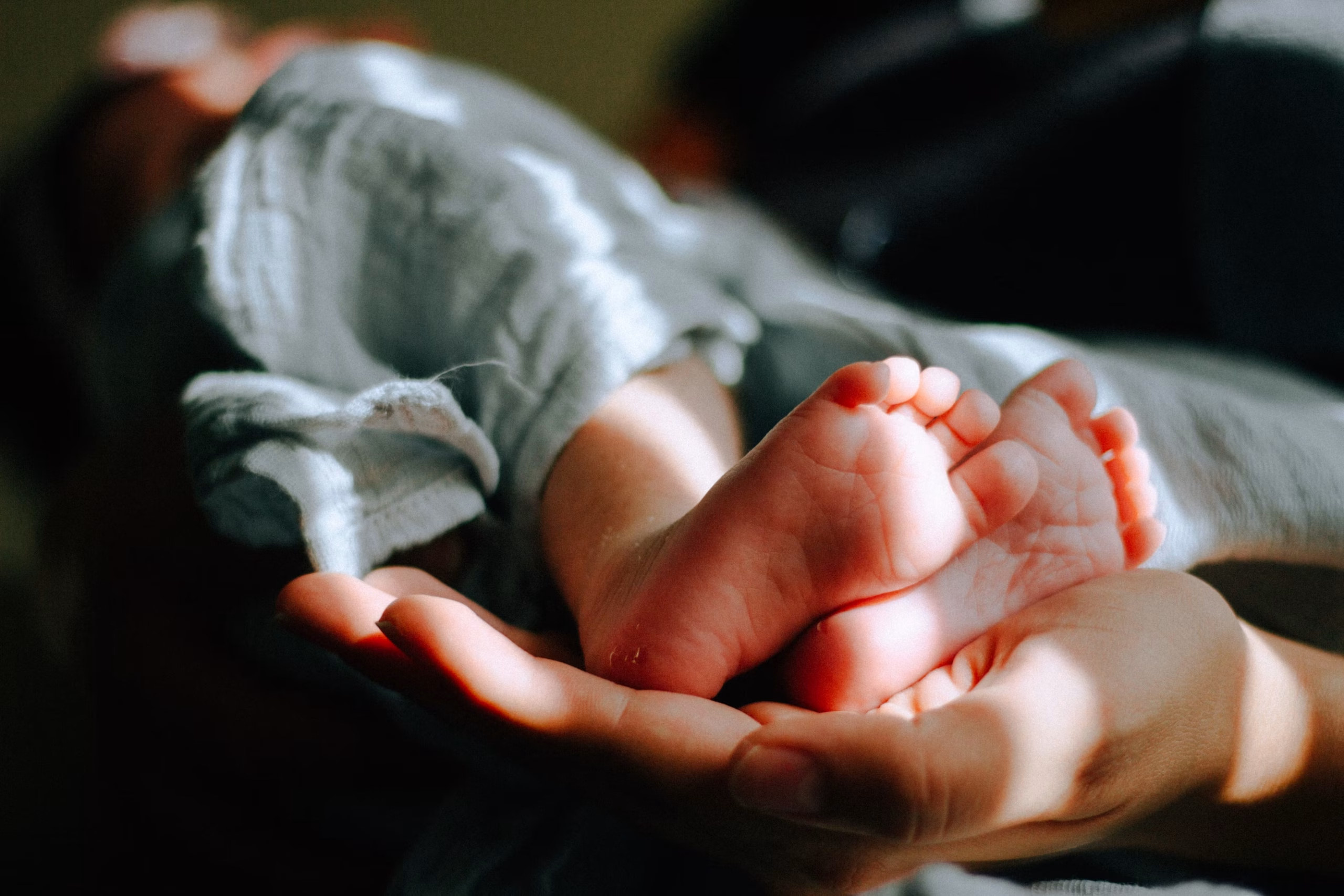
Giving birth hurt much less than I had expected. There was a feeling like someone’s hands were tying my organs into intricate knots and then loosening them. Finally, a great loosening, and a wail, a tiny squirming marvel lowered into my arms. During pregnancy, I had been afraid of the pain. It seemed wrong to be afraid, so I didn’t discuss it, not even with Andrew. I had never experienced overwhelming physical pain; nothing more than a fractured ankle in ninth grade, a couple of bad toothaches. I knew this would be worse—I just wished there was a way to know precisely how much worse.
Sasha Burshteyn: Poems
Donbas Days
this is not the fault of the people but it is
the people’s problem
a lack of nerve
a chance to make a little meat
and unemployment like a flood