They could have danced straight out
of a Brueghel painting into our basement,
partially finished in fake wood paneling
and a dropped ceiling that still left
some plumbing exposed—
All posts tagged: Poetry
October 2025 Poetry Feature: From DEAR DIANE: LETTERS FOR A REVOLUTIONARY
By TINA CANE

Photo of Tina Cane by Cormac Crump
On DEAR DIANE: LETTERS FOR A REVOLUTIONARY
Between May 1968 and December 1971, poet Diane Di Prima wrote a poetry collection comprised of sixty-three “Revolutionary Letters.” Several years ago, I purchased a rare set of the first thirty-four of Di Prima’s letter poems—typed on long sheets of construction paper, stapled, and hand-corrected in ballpoint pen. Bought as a celebratory gift for myself, after having been awarded a fellowship, it’s a humble yet fierce extravagance. While the booklet appears sturdy, its yellowed pages are somewhat delicate. I rarely handle it—too worried about spilling coffee, or having someone in my house mistake the unassuming bundle for recycling. Most of the time, my sheath of Di Prima poems sits in my bookcase, atop a row of books by Marguerite Duras.
“During the Drought,” “Sestina, Mount Mitchill,” “Dragonflies”
By LIZA KATZ DUNCAN
The Jersey Shore, NJ, USA
During the Drought
During the drought, we traded water
for wine. Let our plants wither, stopped
doing laundry. Learned to shudder
at the smell of fire. Hoped
it was just some asshole with a chiminea. Every
impostor cloud was suspect: steam rising
September 2025 Poetry Feature: Earth Water Fire Poems, a Conversation
Poems and sculptures by LISA ASAGI
This is a conversation with whales, clay, and poetry.
A wonderment with whales began in a childhood alivened by the early days of the Save the Whales movement and stories from my father of mysterious encounters on overnight boating trips. This fascination resurfaced seven years ago when I found myself working with my hands—clay sculpture and stand-up paddling led to long overdue reconnections with both earth and sea. Research deepened my curiosity: before the centuries of whaling, very different kinds of relationships existed between whales and humans. Here in the 21st century, what’s possible? These pieces are part of an ongoing series of rememberings, imaginings, longings, and offerings.
— Lisa Asagi
Hitting a Wall and Making a Door: A Conversation between Phillis Levin and Diane Mehta

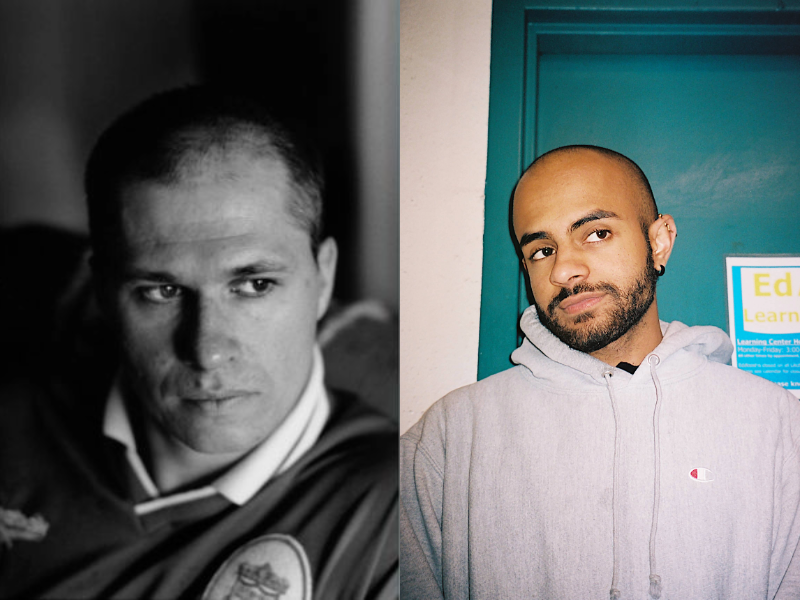
Phillis Levin (left) and Diane Mehta (right)
DIANE MEHTA and PHILLIS LEVIN’s conversation took place over the course of weeks—over daily phone calls and long emails, meals when they were in the same place, and a weekend in the Connecticut countryside. Though what appears below can only be fragments of their full exchange, the two poets—both previous contributors to The Common—share what they draw from each other’s work, and the work of others, exploring the pleasures of language, geometric movement, formal constraint, and expressing multiple perspectives in poems.
This interview includes recordings of many of the poems mentioned, read by the author.
August 2025 Poetry Feature: Anna Malihon, translated by Olena Jennings
By ANNA MALIHON
Translated from the Ukrainian by OLENA JENNINGS
From Girl with a Bullet, forthcoming October 2025
Presented in Olena Jennings’ seamless translation, Anna Malihon’s new collection, Girl with a Bullet, is one of the most important books of the year for those with an interest in the fate of Ukraine, a gift to Anglophone readers.
—John Hennessy, poetry editor

Table of Contents:
[The girl with a bullet in her stomach]
[Don’t go into that home]
[Now the only thing that you can do for her, Christ,]
[Unfold and dive into me, to my very bone,]
Talks with the Besieged: Documentary Poetry from Occupied Ukraine
Translated by OKSANA MAKSYMCHUK, MAX ROSOCHINSKY, and the author
Piece appears below in English and the original Russian and Ukrainian.
Translators’ Note
Alex Averbuch authored Talks with the Besieged on the basis of his engagement with group chats on Telegram and other public IM platforms by Ukrainian civilians in Russian-occupied Ukrainian territory. The present selection is excerpted from this larger work that explores the relentless and evolving nature of the occupation, capturing the initial bewilderment and disorientation experienced by those who stayed behind. These brief, fragmented exchanges reflect civilians navigating the chaos of war in real time. Oscillating between found poetry, a digital archive, and virtual testimony, the text presents the fears, anxieties, aspirations, and dreams of the community enduring liminality and existential uncertainty. In translating these dispatches, we’ve attempted to approximate the casual, matter-of-fact tone of participants, their poignant attempts to lighten the mood, encourage each other, and offer reassurance and consolation.While Telegram and many other IM platforms offer automatic capitalization for each new comment, we decided to use lowercase letters instead, capitalizing only toponyms and proper names. We have also removed the names of the original contributors, blurring the distinctions between them and obscuring where one utterance ends and another begins. We hope that these decisions help render the text as a continuous uninterrupted expression of hope and terror and create an impression of a living chorus, a droning and wailing unbroken human voice.
A Tour of America

Photo courtesy of Jules Weitz.
America
This afternoon I am well, thank you.
Walking down Main Street in Danville, KY.
The heavy wind so sensuous.
Last night I fell-
ated four different men back in
Philadelphia season lush and slippery
with time and leaves.
Keep your eyes to yourself, yid.
As a kid, I pledged only to engage
in onanism on special holidays.
Luckily, America.
Giving the Poem a Body: Megan Pinto interviews Lena Moses-Schmitt

Lena Moses-Schmitt (left) and Megan Pinto (right)
When we listen to language, what do we hear? When we look at an image, what do we see? LENA MOSES-SCHMITT’s poetry beautifully captures the nature of perception. Her lyric-narrative meditations are interested in the mind’s movement across the field (visual, sonic) and the page. Moses-Schmitt writes in “The Hill”: “This morning I heard the man/ who lives downstairs say I love you to the woman–/not the words, but the rhythm, the shape, and I filled in the rest/ as if with red crayon.” Her debut collection, True Mistakes, moves between perception and imagination, the grieving for and the making of a life. MEGAN PINTO sat down with Lena Moses-Schmitt on a sunny June afternoon in Brooklyn. They marveled at the light through the leaves and drank cold seltzers with bitters. Their conversation shifted from superhero alter egos to how poetry sustains them through life’s many blips and heartbreaks.
Four Ways of Setting the Table
By CLARA CHIU

Photo courtesy of author.
Amherst, Massachusetts
I. Tablecloth Winter
We are holding the edges of the fabric,
throwing the center into the air.
& even in dusk this cloth
billowing over our heads
makes a souvenir of home:
mother & child in snowglobe.
Yet we are warm here, beneath
this dome, & what light slips through
drapes the dining room white.