Luchik Belau-Lorberg

Biography of a Dress

By JAMAICA KINCAID

This story is reprinted in honor of Amherst College’s eleventh annual literary festival, which features Jamaica Kincaid as a guest author. Register and see the full list of LitFest 2026 events here.
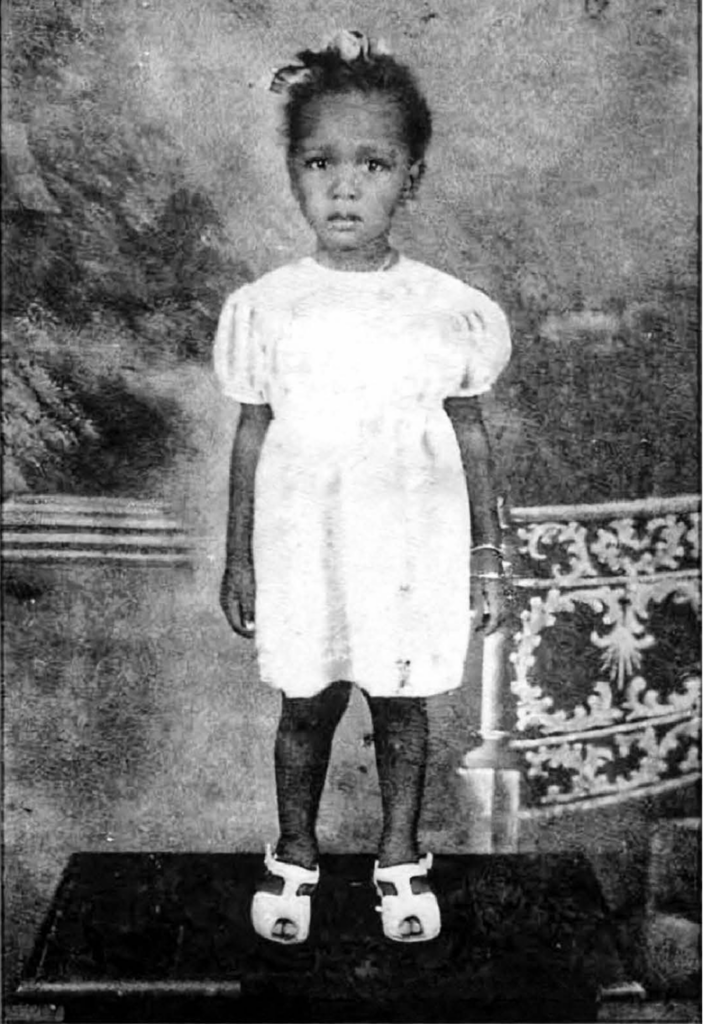
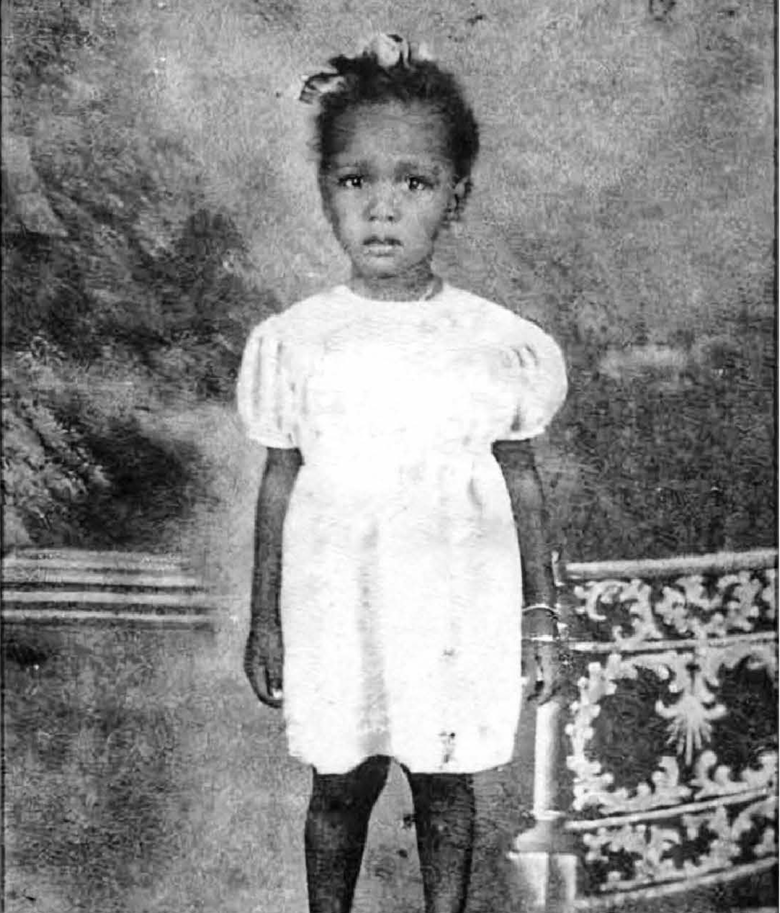
Early photograph of the author in a light-colored dress.

Image courtesy of the author.

The dress I am wearing in this black-and-white photograph, taken when I was two years old, is a yellow dress made of cotton poplin (a fabric with a slightly un-smooth texture first manufactured in the French town of Avignon and brought to England by the Huguenots, but I could not have known that at the time), and it was made for me by my mother. This shade of yellow, the color of my dress that I was wearing when I was two years old, was the same shade of yellow as boiled cornmeal, a food that my mother was always eager for me to eat in one form (as a porridge) or another (as fongie, the starchy part of my midday meal) because it was cheap and therefore easily available (but I did not know that at the time), and because she thought that foods bearing the colors yellow, green, or orange were particularly rich in vitamins and so boiled cornmeal would be particularly good for me. But I was then (not so now) extremely particular about what I would eat, not knowing then (but I do now) of shortages and abundance, having no consciousness of the idea of rich and poor (but I know now that we were poor then), and would eat only boiled beef (which I required my mother to chew for me first and, after she had made it soft, remove it from her mouth and place it in mine), certain kinds of boiled fish (doctor or angel), hard-boiled eggs (from hens, not ducks), poached calf’s liver and the milk from cows, and so would not even look at the boiled cornmeal (porridge or fongie). There was not one single thing that I could isolate and say I did not like about the boiled cornmeal (porridge or fongie) because I could not isolate parts of things then (though I can and do now), but whenever I saw this bowl of trembling yellow substance before me I would grow still and silent, I did not cry, that did not make me cry.
Biography of a Dress
Read more...

Map

By MARIN SORESCU

Translated by DANIEL CARDEN NEMO


Translator’s note

Marin Sorescu, despite being one of the most translated Romanian writers, is one of the literary world’s best kept secrets. The reason for it, to my mind, lies squarely in the quality of existing English translations, as many of them have failed to capture his poetic essence. Twice nominated for the Nobel Prize in Literature, he never received the award based on his translated work.

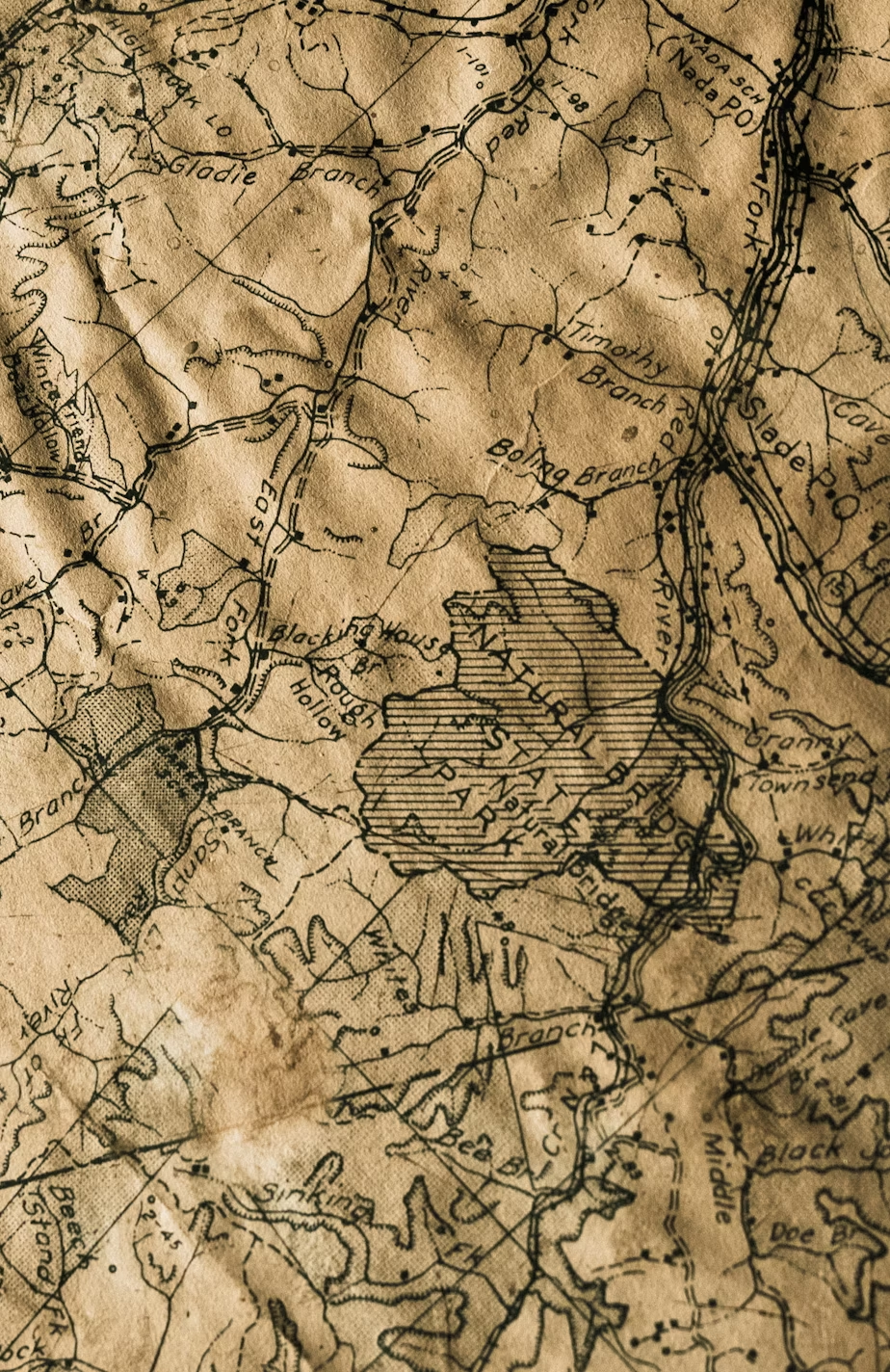
Like many of his poems, “Map” reveals Sorescu’s depth of thought and highly associative mind, and above all his ability to convey the most complex emotions and contemplations into a multi-layered poetry that remains accessible to all. The challenge in the translation here comes from the ability to convey an intimate, almost didactic exploration of the body, revealing the speaker’s vulnerability as he opens himself up for in(tro)spection. The body becomes a cartographic landscape, with known and uncharted areas, while the self is a terrain molded by time, animated by the soul, and inevitably oriented toward death. The poem blends stark physicality with cosmic metaphysics, suggesting that human identity, just like the Earth’s geography, contains vastness, complexity, and the unknowable. It is consciousness which imbues the world with dynamism. Without internal life, and perhaps without poetry, existence becomes static, ornamental.

Map
Read more...

Corazon

By ISABEL CRISTINA LEGARDA


Excerpted from The Conviction of Things Not Seen, a finalist for the Restless Books Prize for New Immigrant Writing 2025.


The cemetery had inhabitants, and not just those whose descendants had laid them to rest. Two old men were living on the Ordoñez plot. Next to the abandoned Llora mausoleum, a family of four had pitched their makeshift tent. As more squatters crept in, to whom the administrators of the Cementerio de Manila turned a blind eye, a village of sorts arose, keeping watch over the stones of the dead, sweeping fallen leaves from their graves and removing flowers that had wilted and browned in the tropical sun. Thus they styled themselves caretakers of the graves, inspiring even greater tolerance for their presence among those in charge, such that far from brusquely restricting their movements, the guards at the gate greeted them by name and allowed them free access and egress without much resistance. The crypt of the Romulo family even hosted a sari-sari store for the cemetery’s living inhabitants, and some cunning member of the community had taken the key to the public restroom for safekeeping at the store, under the watchful eye of a gray-haired woman affectionately known as Tandang Cora—a joke entirely lost on foreign visitors who, in any case, were few.

Corazon
Read more...

Tethered Hearts

By LARA ATALLAH


From Buenos Aires, Argentina

For Eduardo Rios Pulgar,

San Telmo rings through me, like an unlived memory from a distant past. All colors, linden trees, worn down buildings, from the last century and the one before it, next to towering cement. The Argentinian Peso crumbles like the Lebanese Lira. We collect its ruins at the casa de cambio, our American dollars grotesque in the face of this country’s protracted collapse. The city is angry with love. Its sidewalks echo Beirut, and a life there, long-forgotten, languishing in the rearview mirror. Everywhere I look, an almost-déjà-vu skims the walls of my mind. Buenos Aires is Beirut, is Paris, is an aubade to the lost and never found. Down by Recoleta, Haussmann buildings dot the avenues. Dregs of a time where French architects flooded the city and left their prints along its urban landscape.

Tethered Hearts
Read more...

Waiting for the Call I Am

By WYATT TOWNLEY

Not the girl
            after the party
waiting for boy wonder

            Not the couple
after the test
           awaiting word

Not the actor
            after the callback
for the job that changes everything

            Not the mother
on the floor
            whose son has gone missing       

I am the beloved
and you are the beloved

            We’re all beside ourselves
            as the phone is beside ourselves

One hand grips the menu
the other covers the eyes

            Now the phone rings
            it is singing on the table

To the dog across the room
to the waitress who is waiting

            To the cat on the carpet
            to the couple in the next booth

But the heart is in the cupboard
breaking the dishes


[Purchase Issue 30 here.]


Wyatt Townley is poet laureate emerita of Kansas and has published six books. Her work has been read on NPR and has appeared in journals from Newsweek to The Paris Review, and Yoga Journal to Scientific American. Commissioned poems hang in libraries including the Space Telescope Science Institute, home of the Hubble.

Waiting for the Call I Am
Read more...

Ellen

By ELSA LYONS

Giving birth hurt much less than I had expected. There was a feeling like someone’s hands were tying my organs into intricate knots and then loosening them. Finally, a great loosening, and a wail, a tiny squirming marvel lowered into my arms. During pregnancy, I had been afraid of the pain. It seemed wrong to be afraid, so I didn’t discuss it, not even with Andrew. I had never experienced overwhelming physical pain; nothing more than a fractured ankle in ninth grade, a couple of bad toothaches. I knew this would be worse—I just wished there was a way to know precisely how much worse.

Ellen
Read more...

Anti-Aubade

By GRAY DAVIDSON CARROLL

November 6th, 2024

I wake in the night, check the news. Watch you
turn in your sleep, rest your cheek on my chest.
How everything and also this: the heat of your skin,
hand wrapping my waist, the off-beat of our breaths
finding rhythm in the dark.

In the kitchen, I cry to the sound of my mother’s sobs.
Count the injections I have left before the vials run out.
There is no point in asking how, in asking why. Empire
does not answer questions. Genocide does not answer
questions—the answers were right there.

At the train station, the man next to me cries, 
turns his face to meet my own. Somehow, the sun
is shining. A dog barks. Someone laughs. Everything
fragments. A mother & daughter step up to the tracks,
squeeze each other’s hands.


[Purchase Issue 30 here.]


Gray Davidson Carroll is a white, nonbinary writer, dancer, singer, cold water plunger, and (self-proclaimed) hot chocolate alchemist hailing from Brooklyn by way of Western Massachusetts and other strange and forgotten places.

Anti-Aubade
Read more...

Oblation

By MATT W. MILLER

My dad could be tough and distant
and push a little too hard into what hurt

but if God pulled that Isaac shit on him,
saying “I want you to sacrifice your son

for me” it never would have got as far
as me strapped to some Moriah altar.

If I was nearby, he’d tell me to go inside.
Then, he’d resign, curtly quit, from God,

flick a Lucky at the old man’s feet, and
walk away. Later, I know he’d joke,

“That fucking guy? He couldn’t spell God
if you spotted him the G and the D,”

making me laugh even if behind his eyes
he was making peace with perdition.


[Purchase Issue 30 here.]


Matt W. Miller is a poet, essayist, teacher, and author of Tender the River, The Wounded for the Water, Club Icarus (winner of the Vassar Miller Prize in Poetry), and Cameo Diner. A former Walter E. Dakin Fellow and Wallace Stegner Fellow, he lives in coastal New Hampshire with his family.

Oblation
Read more...

Castanets 84 | Being fond on praise

By ANNA MARIA HONG

for & after William Shakespeare

To your beached blessings, add this curse:
not making worse what glass makes
so clear but neither smoking the path
to your impaneled store, absconded
documents across your bathroom floor,
public security, national writ walled in
where you eat shit, as if to flank your fake
glory and never break your bloated story,
without flourish, without wit,
everywhere the news grows: May you dwell
among cases evermore.


[Purchase Issue 30 here.] 


Anna Maria Hong’s books include Age of Glass and Fablesque and the novella H & G. She has received fellowships from the Radcliffe Institute for Advanced Study, the Amy Clampitt Poet Residency, Hawthornden Foundation, and the Marion and Jasper Whiting Foundation.

Castanets 84 | Being fond on praise
Read more...

Death of a Hero (The Mosquito)

By VIKTOR NEBORAK
Translated by JOHN HENNESSY and OSTAP KIN

The rusty hollows inside the old mosquito
reduce his soprano to dust. Down the pipe
of his fragile beak, the pumps are already weak.
And his blood flows through fossilized riverbeds.

His gas tanks empty, song silenced, not a drop
of compassion in him… Running on coal fumes,
the rusted engines deliver him to drill
one last buzz through the ears of the crowd.

A kamikaze who would have dropped heavenly tons
on these civilians as on military echelons
and then been posthumously awarded

the highest orders! his name on honor lists!   
banners! trumpets! salutes! obelisks!
… if my slap hadn’t smashed him dead.


 [Purchase Issue 30 here.]


Viktor Neborak is a poet, writer, literary scholar, and critic. He is also a founding member (along with Yuri Andrukhovych and Oleksandr Irvanets) of the Bu-Ba-Bu literary performance group. His collection The Flying Head and Other Poems appeared in English translation in 2005.

John Hennessy’s most recent books are Exit Garden State, a collection of poems, and Set Change, selected poems by Yuri Andrukhovych co-translated with Ostap Kin.

Ostap Kin is the editor of Babyn Yar: Ukrainian Poets Respond and New York Elegies: Ukrainian Poems on the City. With John Hennessy, he translated Set Change by Yuri Andrukhovych, and A New Orthography by Serhiy Zhadan.

Death of a Hero (The Mosquito)
Read more...